
 Алгебра
 Английский
 Биология
 География
 Геометрия
 История
 Русский
 Обществознание
 Физика
 Химия
Химия Информатика
 Литература
 Математика
Вопрос:
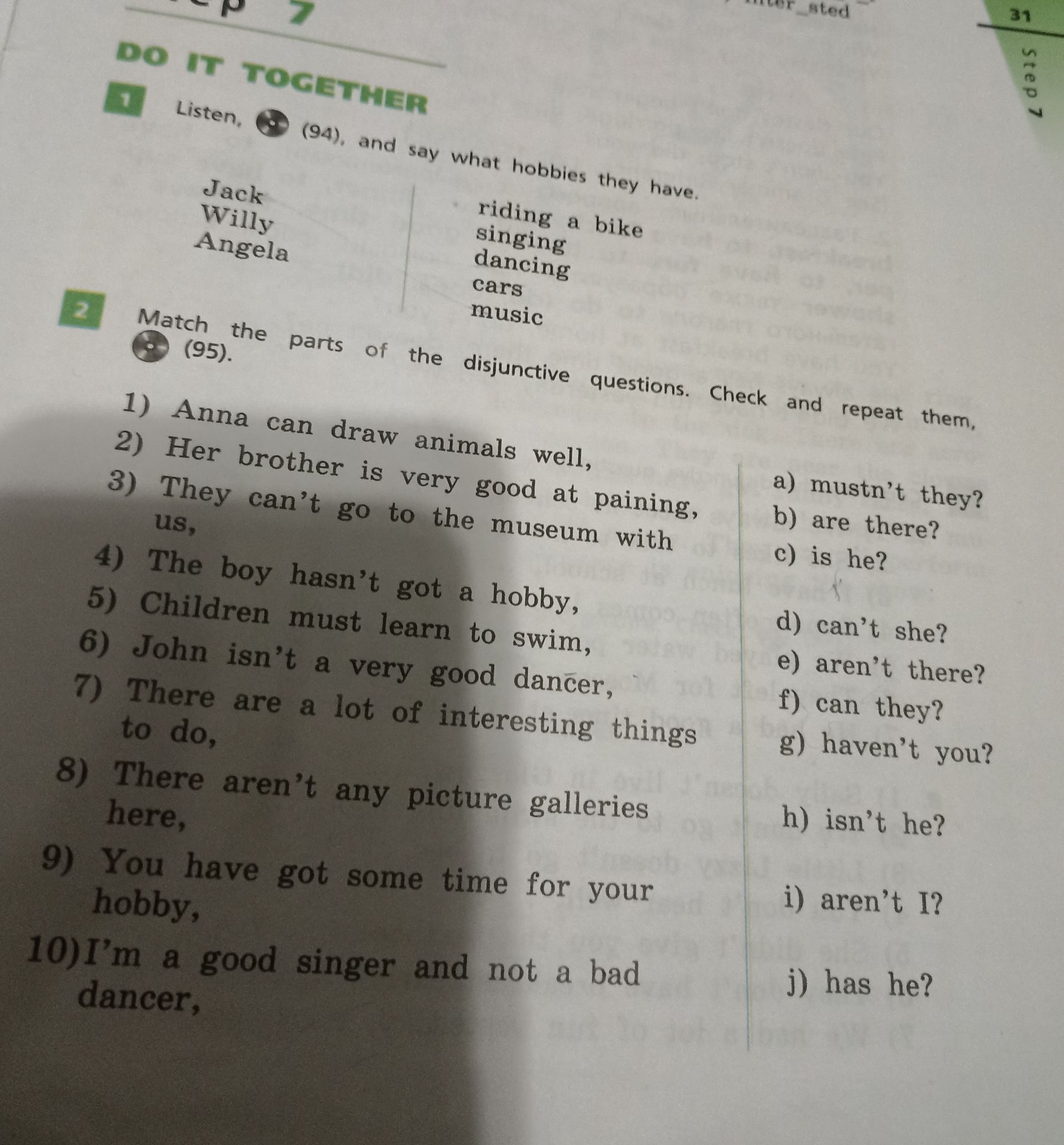
1) Anna can draw animals well, 2) Her brother is very good at paining, 3) They can't go to the museum with us, 4) The boy hasn't got a hobby, 5) Children must learn to swim, 6) John isn't a very good dancer, 7) There are a lot of interesting things to do, 8) There aren't any picture galleries here, 9) You have got some time for your hobby, 10) I'm a good singer and not a bad dancer,
Ответ:
Matching the parts of disjunctive questions:
- 1. Anna can draw animals well, can't she?
- 2. Her brother is very good at painting, isn't he?
- 3. They can't go to the museum with us, can they?
- 4. The boy hasn't got a hobby, has he?
- 5. Children must learn to swim, mustn't they?
- 6. John isn't a very good dancer, is he?
- 7. There are a lot of interesting things to do, aren't there?
- 8. There aren't any picture galleries here, are there?
- 9. You have got some time for your hobby, haven't you?
- 10. I'm a good singer and not a bad dancer, am I? (Note: 'aren't I?' is also common, but 'am I?' is grammatically more precise in some contexts.)
Explanation: Disjunctive questions (tag questions) are formed by adding a short question at the end of a statement. The auxiliary verb in the tag question usually matches the auxiliary verb in the statement (or 'to be' or 'to do' if no auxiliary verb is present). The pronoun in the tag question refers to the subject of the statement. The polarity of the tag question is opposite to the polarity of the statement (positive statement + negative tag; negative statement + positive tag).
