
 Алгебра
 Английский
 Биология
 География
 Геометрия
 История
 Русский
 Обществознание
 Физика
 Химия
 Информатика
 Литература
 Математика
Ответ:
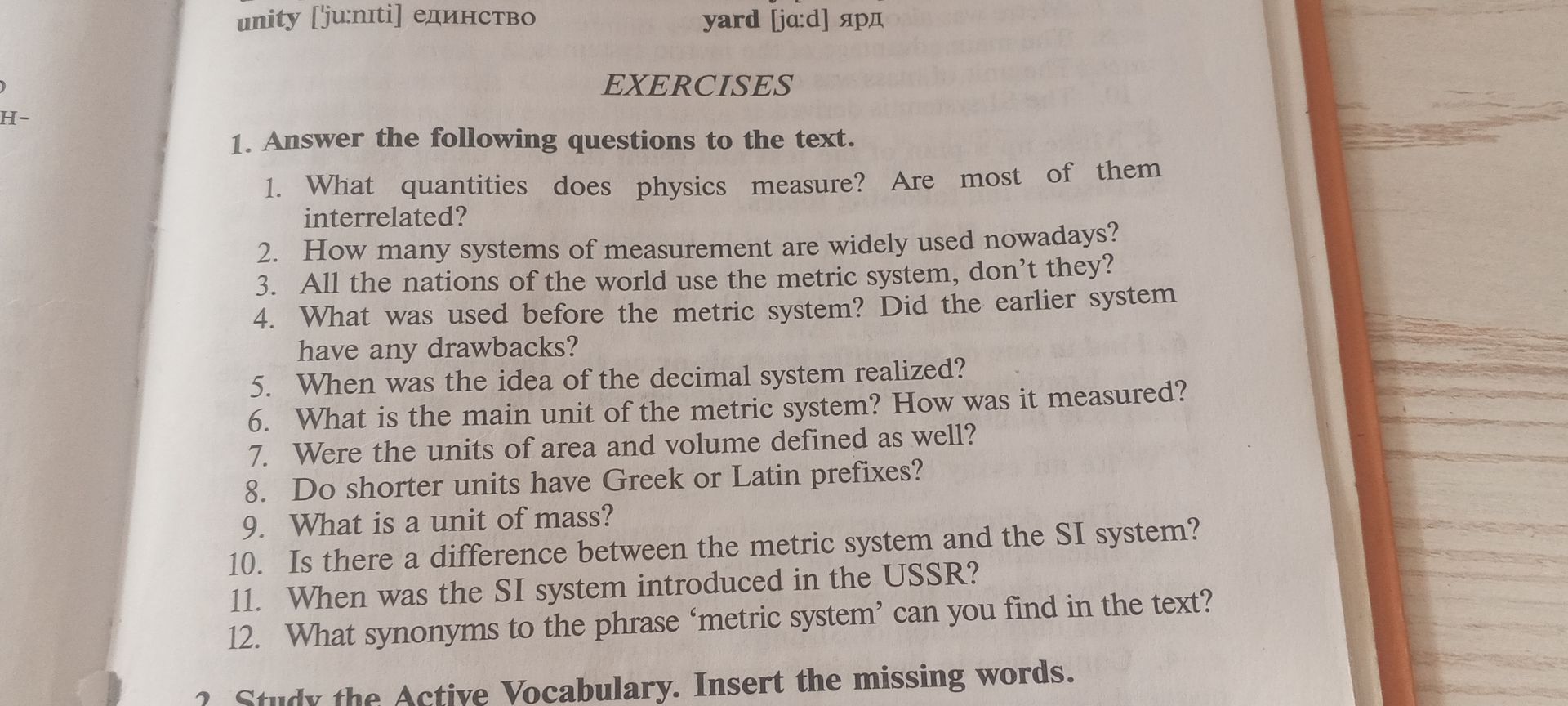
Translation of the task: Ответьте на следующие вопросы по тексту.
Note: The passage these questions refer to is not visible in the image. The answers below give standard background information; questions about the text’s exact wording or details may differ.
- Physics measures physical quantities such as length, time, mass, temperature and force. Many are interrelated: for example, speed depends on distance and time.
- Two systems are commonly contrasted in introductory texts: the metric system and the British (Imperial) system.
- No. Most countries use the metric system, but the United States commonly uses customary units, and some Imperial units remain in use elsewhere.
- Before metric units, people used local and customary measures, sometimes based on body parts. These varied from place to place and were not consistently related, which made comparison and calculation difficult.
- The decimal system of measurement was adopted in France in the late eighteenth century, during the French Revolution.
- The metre is the basic unit of length in the metric system. It was originally defined as one ten-millionth of the distance from the equator to the North Pole along a meridian.
- Yes. Units of area and volume were derived from units of length: for example, the square metre and cubic metre.
- In the usual system of metric prefixes, smaller units use Latin-derived prefixes, such as deci-, centi- and milli-. Larger units traditionally use Greek-derived prefixes, such as deca- and kilo-.
- The gram is a metric unit of mass; the kilogram is the SI base unit of mass.
- SI is the International System of Units, built on and extending the metric system. The terms are related, but they are not strictly identical.
- The USSR adopted the SI system in 1960.
- The passage is needed to identify the exact synonyms used there. Common related expressions include “decimal system” and “system of metric units,” but these cannot be confirmed as wording from the missing text.
Перевод ответа:
- Физика измеряет физические величины, например длину, время, массу, температуру и силу. Многие величины взаимосвязаны: например, скорость зависит от расстояния и времени.
- Во вводных учебных текстах обычно противопоставляют две системы: метрическую и британскую (имперскую).
- Нет. Большинство стран использует метрическую систему, однако в США широко применяются традиционные единицы, а некоторые имперские единицы используются и в других странах.
- До появления метрических единиц использовали местные и традиционные меры, иногда основанные на частях тела. Они различались в разных местах и не имели единых соотношений, из-за чего было трудно сравнивать величины и выполнять вычисления.
- Десятичную систему мер приняли во Франции в конце XVIII века, во время Французской революции.
- Метр — основная единица длины метрической системы. Изначально он определялся как одна десятимиллионная расстояния от экватора до Северного полюса вдоль меридиана.
- Да. Единицы площади и объёма выводились из единиц длины, например квадратный метр и кубический метр.
- В обычной системе метрических приставок для меньших единиц используются приставки латинского происхождения, например деци-, санти- и милли-. Для больших единиц традиционно используются приставки греческого происхождения, например дека- и кило-.
- Грамм — метрическая единица массы; килограмм — основная единица массы в СИ.
- СИ — Международная система единиц, основанная на метрической системе и расширяющая её. Эти понятия связаны, но не полностью совпадают.
- СССР принял систему СИ в 1960 году.
- Чтобы назвать точные синонимы из текста, нужен сам текст. Среди связанных распространённых выражений — «десятичная система» и «система метрических единиц», однако нельзя подтвердить, что именно эти выражения есть в отсутствующем отрывке.
