
 Алгебра
 Английский
 Биология
 География
 Геометрия
 История
 Русский
 Обществознание
 Физика
 Химия
Химия Информатика
 Литература
 Математика
Вопрос:
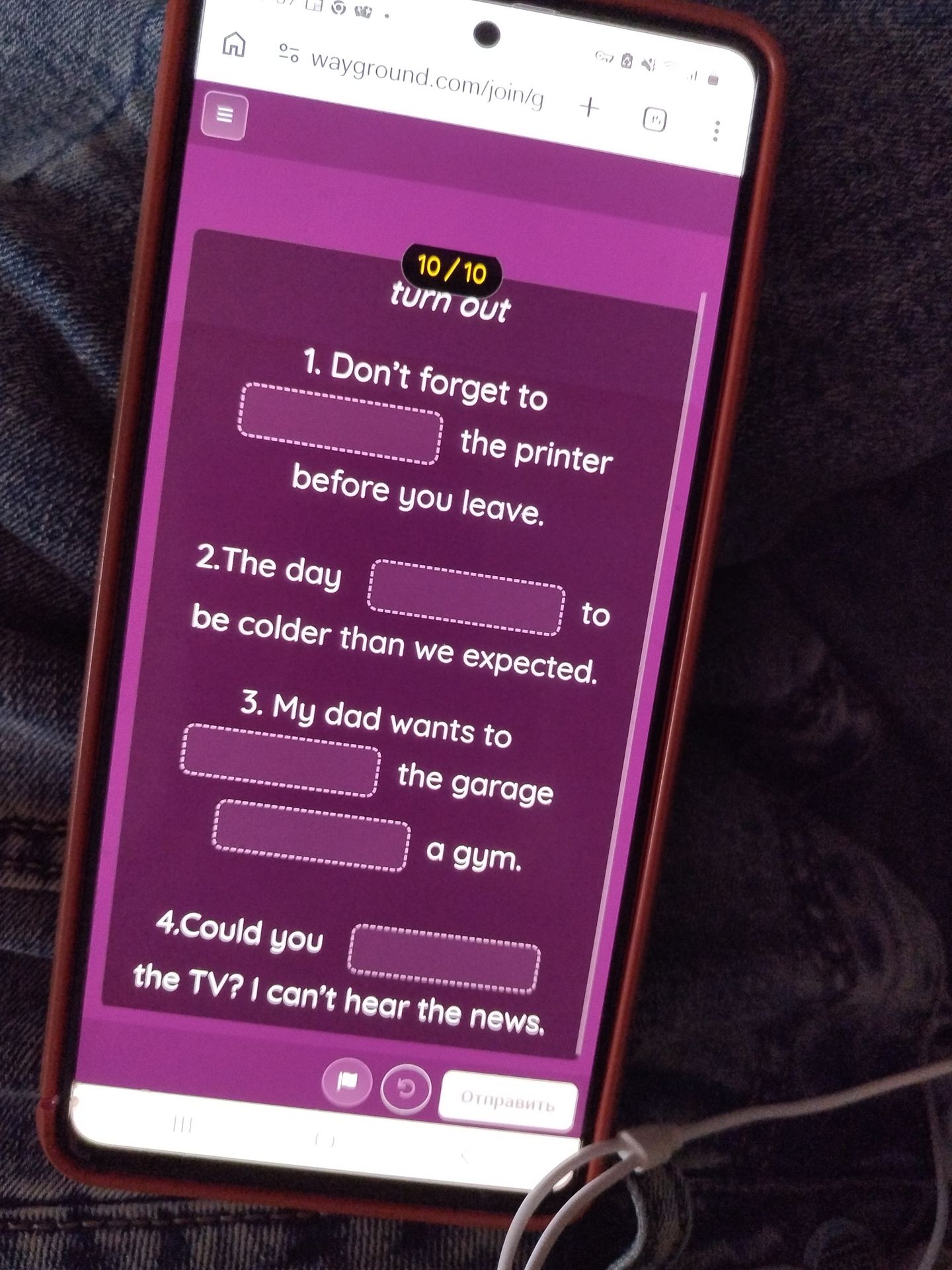
1. Don't forget to ______ the printer before you leave. 2. The day ______ be colder than we expected. 3. My dad wants to ______ the garage ______ a gym. 4. Could you ______ the TV? I can't hear the news.
Ответ:
Solution:
This is a fill-in-the-blanks exercise focusing on verb usage and prepositions.
- 1. The verb that fits logically with 'the printer' and the action of preparing it before leaving is 'to fix'. Thus, 'Don't forget to fix the printer before you leave.'
- 2. The blank needs a verb that indicates a prediction or a state. 'To be' in its correct form fits here. Since the context is future or a strong possibility, 'is going to' or simply 'to' followed by 'be' is appropriate, but given the options are likely single words or common phrases, 'to' followed by 'be' is most probable. The sentence structure implies a verb is missing. 'to be' is the infinitive form. If a single word is expected, it might be implied that 'will' precedes it, making the blank redundant. However, if it's a choice of verbs, 'to be' is the most sensible completion for the structure: 'The day to be colder than we expected.' A more natural phrasing might be 'The day will be...', but adhering to the blank structure, 'to be' implies the infinitive construction. Alternatively, if the sentence structure is meant to be 'The day is colder...', then the second blank 'to' would be incorrect. Assuming the blank is for a verb form, and the presence of 'to' after the blank, it suggests an infinitive construction. However, the phrase 'The day to be colder' is not standard English. A more likely interpretation is that 'to' is part of the sentence structure, and the blank needs a verb. The most fitting verb is 'be', completing the idea of prediction: 'The day be colder than we expected.' This is still grammatically awkward. If we consider common phrasal verbs or idiomatic expressions, no obvious single verb fits. Reconsidering the prompt, if 'The day' is the subject, and 'to be colder' is the predicate, then the blank could be an adverbial modifier, but that doesn't fit. Let's assume it's a typo and it should be 'The day *will* be colder...' or 'The day *is to be* colder...' If we must fill the blank, and given the common patterns in such exercises, 'to' might be part of the instruction, and the blank requires a verb. Let's assume the sentence is 'The day [verb] colder than we expected.' The most logical verb in this context is 'be', suggesting a prediction or statement of fact about the future. So, 'The day be colder than we expected.' This is still highly unusual grammar. A more common and grammatically sound completion would be 'The day will be colder...' or 'The day is colder...'. Given the structure with 'to' appearing later, it might be intended as 'The day is to be colder...' meaning it is predicted or planned. Let's stick to the simplest completion that makes sense grammatically in a fill-in-the-blank context: 'be'. Therefore: 'The day be colder than we expected.' This is still awkward. Let's reconsider. If the sentence is 'The day _____ to be colder than we expected,' then the blank could be 'is'. 'The day is to be colder than we expected.' This makes sense. The word 'to' is present after the blank in the image. So, the blank is for the verb 'is'.
- 3. This sentence requires verbs related to changing or converting the garage into a gym. The first blank likely needs a verb like 'convert' or 'transform'. The second blank likely needs a preposition like 'into'. So, 'My dad wants to convert the garage into a gym.'
- 4. This sentence is a request concerning the TV. The most logical verb for interacting with the TV to hear news is 'turn up' or 'turn on'. Given the context 'I can't hear the news', 'turn up' is more fitting, meaning to increase the volume. So, 'Could you turn up the TV? I can't hear the news.'
Revised interpretation based on 'to' in sentence 2:
Let's re-examine sentence 2. The OCR shows '2. The day [blank] to be colder than we expected.'. The word 'to' is indeed present after the blank. This strongly suggests the blank should be filled with a form of the verb 'be', specifically 'is', making the sentence 'The day is to be colder than we expected.' This means it is predicted or expected to be colder. This is a common construction in English.
Final Answers:
- fix
- is
- convert, into
- turn up
Translation (RU):
- починить
- должен быть / ожидается, что будет (В данном контексте 'is to be' означает, что предсказывается или ожидается, что день будет холоднее.)
- переоборудовать, в (Слово 'into' переводится как 'в' при преобразовании чего-либо во что-либо.)
- включить / прибавить громкость (В данном контексте 'turn up' означает увеличить громкость.)
