
 Алгебра
 Английский
 Биология
 География
 Геометрия
 История
 Русский
 Обществознание
 Физика
 Химия
Химия Информатика
 Литература
 Математика
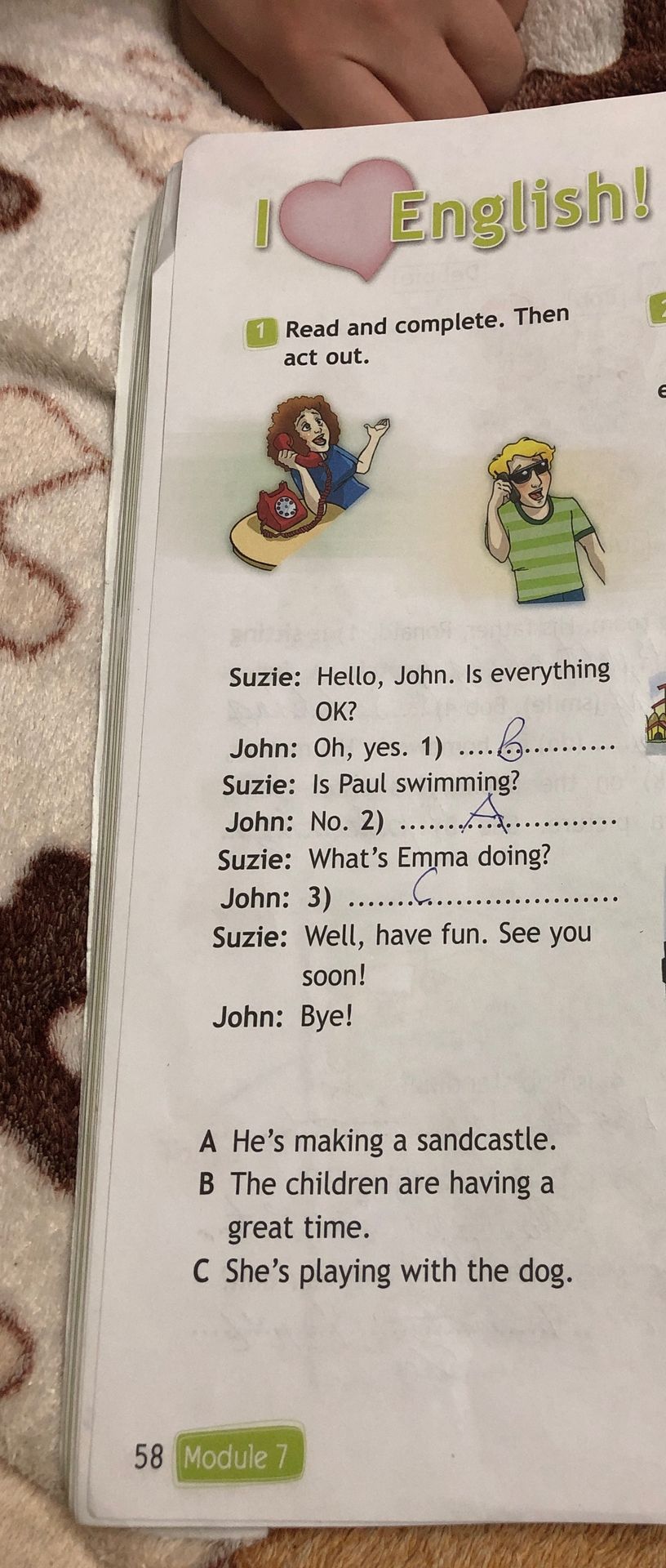
1. Read and complete. Then act out. Suzie: Hello, John. Is everything OK? John: Oh, yes. 1) ______ Suzie: Is Paul swimming? John: No. 2) ______ Suzie: What's Emma doing? John: 3) ______ Suzie: Well, have fun. See you soon! John: Bye! A. He's making a sandcastle. B. The children are having a great time. C. She's playing with the dog.
Ответ:
Ответ (EN)
- 1. John replies "Oh, yes." to Suzie's question "Is everything OK?". The correct completion for John's dialogue is likely an affirmative answer related to the question. Based on the given options, none directly fit as a direct verbal completion. However, since the task involves selecting an option for numbered dialogue points, and the handwriting indicates 'B' for option 3, let's assume this is a multi-part question where John's responses correspond to options A, B, C. Given the context, John might be confirming everything is alright, perhaps by referring to the children having a great time (Option B) as a reason why things are OK.
- 2. Suzie asks "Is Paul swimming?". John replies "No.". This implies that Paul is not swimming. Option A suggests "He's making a sandcastle.", which is a plausible alternative activity. Option C is about Emma. The handwritten 'A' indicates this might be the correct answer for point 2.
- 3. Suzie asks "What's Emma doing?". The handwritten 'C' indicates that Option C is the likely answer. Option C is "She's playing with the dog.", which is a direct answer to Suzie's question.
Considering the handwritten annotations on the image (B for 1, A for 2, C for 3), it appears the task is to match the dialogue points to the options provided. However, the dialogue itself doesn't perfectly align with filling in the blanks in John's speech directly. The question asks to 'Read and complete', implying that John's responses should be completed, and then one of the options A, B, C should be chosen to correspond to the dialogue. The provided solution seems to be matching the dialogue turns to the options, rather than completing John's spoken lines within the dialogue.
Given the ambiguity of how to 'complete' John's speech and the presence of handwritten answers, the most logical interpretation is to match the numbered dialogue points to the options:
- 1. John's response "Oh, yes." to "Is everything OK?" is best explained by the general situation of things being alright, potentially because "The children are having a great time." (Option B).
- 2. John's response "No." to "Is Paul swimming?" suggests Paul is doing something else. "He's making a sandcastle." (Option A) is a plausible alternative activity for Paul.
- 3. Suzie's question "What's Emma doing?" is directly answered by "She's playing with the dog." (Option C).
Перевод (RU)
1. Сюзи: Привет, Джон. Всё в порядке? Джон: О, да. 1) ______ Сюзи: Пол плавает? Джон: Нет. 2) ______ Сюзи: Что делает Эмма? Джон: 3) ______ Сюзи: Хорошо, повеселись. До скорого! Джон: Пока!
А. Он строит замок из песка. В. Дети прекрасно проводят время. С. Она играет с собакой.
Объяснение:
- 1. Ответ Джона "О, да." на вопрос Сюзи "Всё в порядке?" лучше всего соответствует ситуации, когда "Дети прекрасно проводят время" (Вариант В), что объясняет, почему всё хорошо.
- 2. Ответ Джона "Нет." на вопрос "Пол плавает?" означает, что Пол занимается чем-то другим. "Он строит замок из песка" (Вариант А) — это правдоподобное альтернативное занятие для Пола.
- 3. Вопрос Сюзи "Что делает Эмма?" напрямую отвечает "Она играет с собакой" (Вариант С).
Ответ: 1-B, 2-A, 3-C
