
 Алгебра
 Английский
 Биология
 География
 Геометрия
 История
 Русский
 Обществознание
 Физика
 Химия
Химия Информатика
 Литература
 Математика
Вопрос:
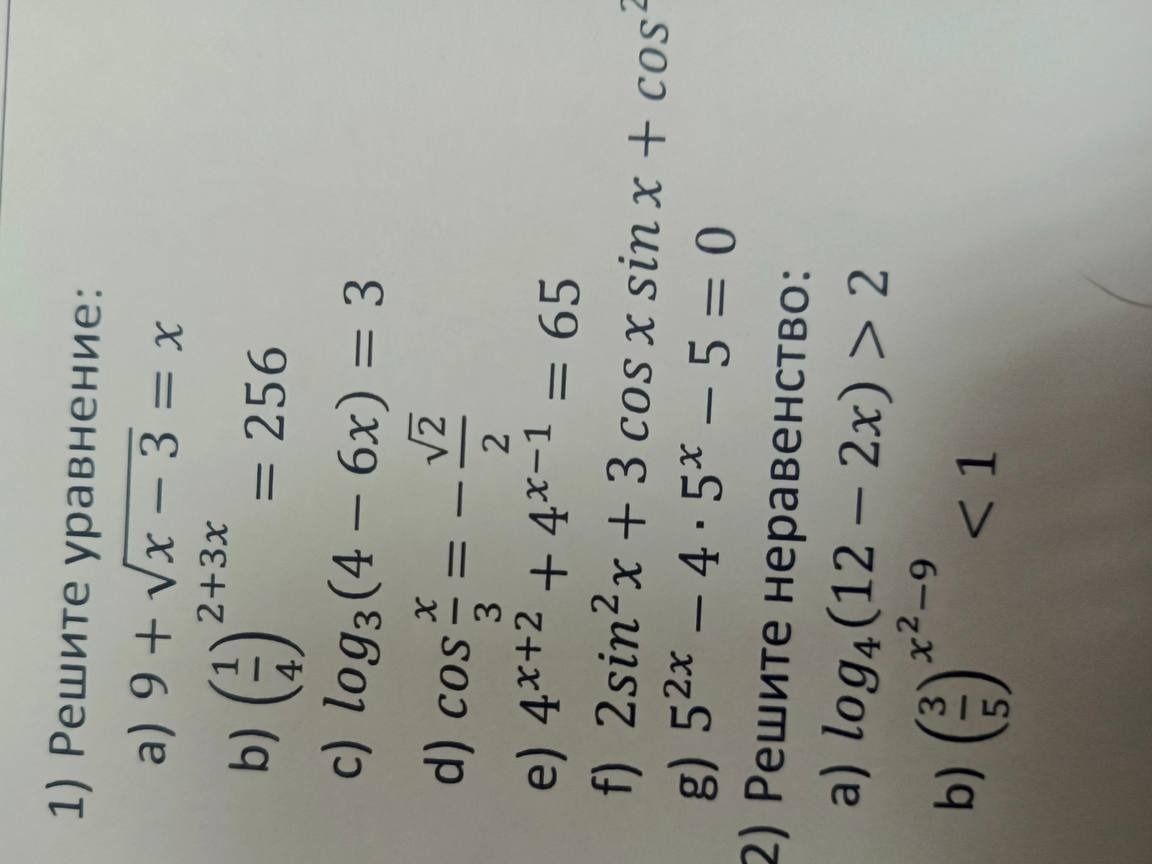
1) Решите уравнение: a) 9 + \(\sqrt{x}\) - 3 = x b) \(\frac{1}{4}\)^{2+3x} = 256 c) \(\log\)_{3}(4 – 6x) = 3 d) \(\cos\) \(\frac{x}{3}\) = -\(\frac{\sqrt{2}}{2}\) e) 4^{x+2} + 4^{x-1} = 65 f) 2\(\sin\)^2 x + 3 \(\cos\) x \(\sin\) x + \(\cos\)^2 x = 0 g) 5^{2x} – 4 \(\cdot\) 5^x – 5 = 0
Ответ:
Решение:
- a) \( 9 + \sqrt{x} - 3 = x \)
\( \sqrt{x} = x - 6 \)
Возведём обе части в квадрат:
\( x = (x-6)^2 \)
\( x = x^2 - 12x + 36 \)
\( x^2 - 13x + 36 = 0 \)
\( D = (-13)^2 - 4 \cdot 1 \cdot 36 = 169 - 144 = 25 \)
\( x_1 = \frac{13 + 5}{2} = 9 \)
\( x_2 = \frac{13 - 5}{2} = 4 \)
Проверка:
При \( x=9 \): \( \sqrt{9} = 9 - 6 \) → \( 3 = 3 \) (верно).
При \( x=4 \): \( \sqrt{4} = 4 - 6 \) → \( 2 = -2 \) (неверно).
Ответ: x = 9. - b) \( (\frac{1}{4})^{2+3x} = 256 \)
\( (4^{-1})^{2+3x} = 4^4 \)
\( 4^{-2-3x} = 4^4 \)
\( -2 - 3x = 4 \)
\( -3x = 6 \)
\( x = -2 \)
Ответ: x = -2. - c) \( \log_3 (4 - 6x) = 3 \)
\( 4 - 6x = 3^3 \)
\( 4 - 6x = 27 \)
\( -6x = 23 \)
\( x = -\frac{23}{6} \)
Проверка:
\( 4 - 6(-\frac{23}{6}) = 4 + 23 = 27 > 0 \) (верно).
Ответ: x = -\(\frac{23}{6}\). - d) \( \cos \frac{x}{3} = -\frac{\sqrt{2}}{2} \)
\( \frac{x}{3} = \pm \frac{3\pi}{4} + 2\pi k \), где \( k \in \mathbb{Z} \)
\( x = \pm \frac{9\pi}{4} + 6\pi k \), где \( k \in \mathbb{Z} \)
Ответ: x = \(\pm \frac{9\pi}{4} + 6\pi k \), где \( k \in \mathbb{Z} \). - e) \( 4^{x+2} + 4^{x-1} = 65 \)
\( 4^x \cdot 4^2 + 4^x \cdot 4^{-1} = 65 \)
\( 16 \cdot 4^x + \frac{1}{4} \cdot 4^x = 65 \)
Пусть \( y = 4^x \).
\( 16y + \frac{1}{4}y = 65 \)
\( \frac{64y + y}{4} = 65 \)
\( 65y = 65 \cdot 4 \)
\( y = 4 \)
\( 4^x = 4 \)
\( x = 1 \)
Ответ: x = 1. - f) \( 2\sin^2 x + 3 \cos x \sin x + \cos^2 x = 0 \)
Разделим обе части на \( \cos^2 x \) (при условии \( \cos x \neq 0 \)):
\( 2\frac{\sin^2 x}{\cos^2 x} + 3\frac{\sin x}{\cos x} + 1 = 0 \)
\( 2\operatorname{tg}^2 x + 3\operatorname{tg} x + 1 = 0 \)
Пусть \( t = \operatorname{tg} x \).
\( 2t^2 + 3t + 1 = 0 \)
\( D = 3^2 - 4 \cdot 2 \cdot 1 = 9 - 8 = 1 \)
\( t_1 = \frac{-3 + 1}{4} = -\frac{1}{2} \)
\( t_2 = \frac{-3 - 1}{4} = -1 \)
\( \operatorname{tg} x = -\frac{1}{2} \) или \( \operatorname{tg} x = -1 \)
\( x = \operatorname{arctg}(-\frac{1}{2}) + \pi k \) или \( x = -\frac{\pi}{4} + \pi n \), где \( k, n \in \mathbb{Z} \)
Проверка \( \cos x = 0 \): Если \( \cos x = 0 \), то \( x = \frac{\pi}{2} + \pi m \). Тогда \( \sin^2 x = 1 \), \( \sin x = \pm 1 \).
\( 2(1) + 3(0)(\pm 1) + 0 = 2 \neq 0 \). Значит, \( \cos x \neq 0 \).
Ответ: x = \(\operatorname{arctg}(-\frac{1}{2}) + \pi k \) или x = \(-\frac{\pi}{4} + \pi n \), где \( k, n \in \mathbb{Z} \). - g) \( 5^{2x} – 4 \cdot 5^x – 5 = 0 \)
Пусть \( y = 5^x \).
\( y^2 - 4y - 5 = 0 \)
\( D = (-4)^2 - 4 \cdot 1 \cdot (-5) = 16 + 20 = 36 \)
\( y_1 = \frac{4 + 6}{2} = 5 \)
\( y_2 = \frac{4 - 6}{2} = -1 \)
\( 5^x = 5 \) → \( x = 1 \)
\( 5^x = -1 \) (решений нет).
Ответ: x = 1.
