
 Алгебра
 Английский
 Биология
 География
 Геометрия
 История
 Русский
 Обществознание
 Физика
 Химия
 Информатика
 Литература
 Математика
Ответ:
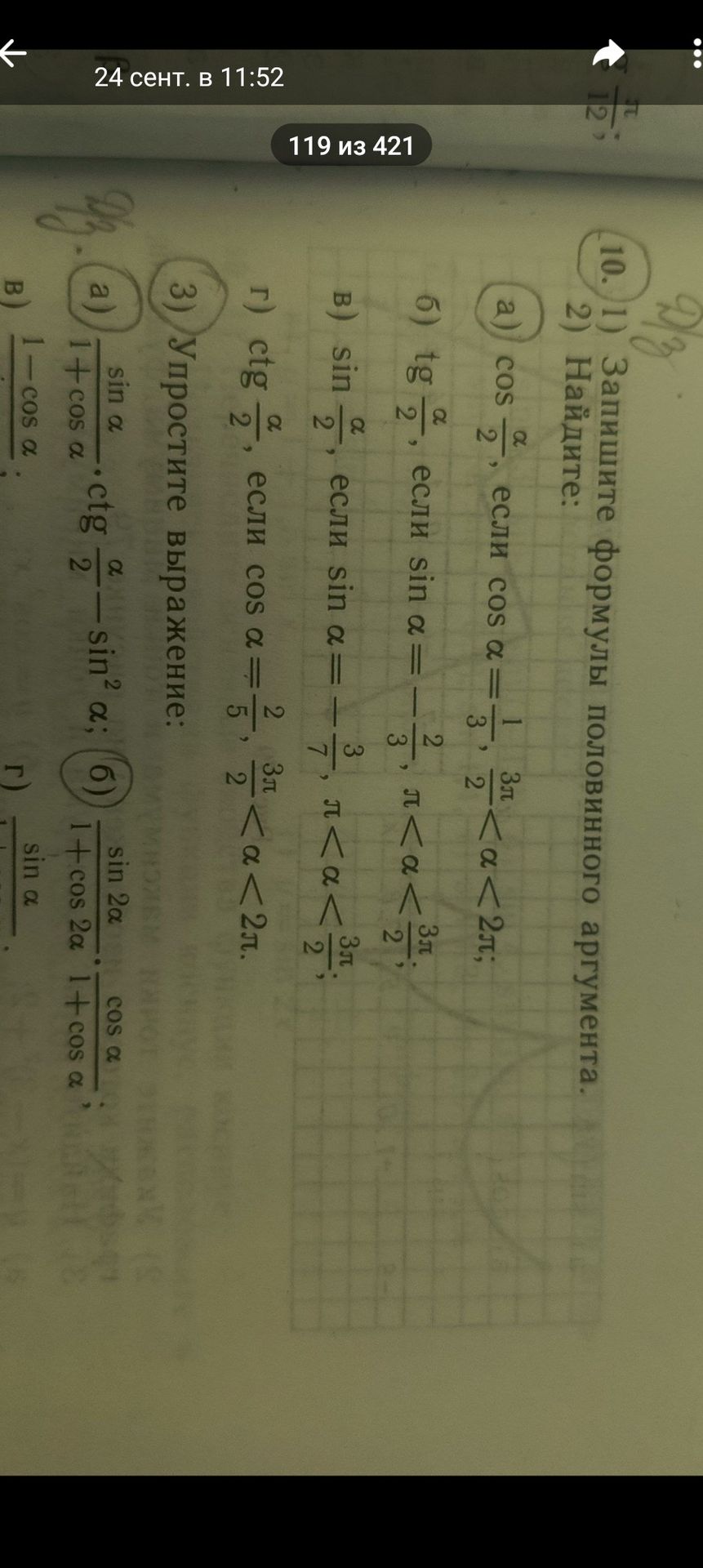
1) Формулы половинного аргумента:
\(\sin\frac{\alpha}{2}=\pm\sqrt{\frac{1-\cos\alpha}{2}}\), \(\cos\frac{\alpha}{2}=\pm\sqrt{\frac{1+\cos\alpha}{2}}\), \( g\frac{\alpha}{2}=\pm\sqrt{\frac{1-\cos\alpha}{1+\cos\alpha}}\), \(\ctg\frac{\alpha}{2}=\pm\sqrt{\frac{1+\cos\alpha}{1-\cos\alpha}}\). Знак выбирается по четверти, в которой находится \(\alpha/2\).
2а) Так как \(3\pi/2<\alpha<2\pi\), то \(3\pi/4<\alpha/2<\pi\), поэтому косинус отрицателен.
\(\cos\frac{\alpha}{2}=-\sqrt{\frac{1+\cos\alpha}{2}}=-\sqrt{\frac{1+1/3}{2}}=-\sqrt{\frac23}=-\frac{\sqrt6}{3}.\)
2б) Из \(\pi<\alpha<3\pi/2\) следует \(\pi/2<\alpha/2<3\pi/4\), значит тангенс отрицателен. По тождеству \(\cos^2\alpha=1-\sin^2\alpha\) и знаку косинуса в III четверти получаем \(\cos\alpha=-\sqrt{1-4/9}=-\frac{\sqrt5}{3}\).
\( g\frac{\alpha}{2}=-\sqrt{\frac{1-\cos\alpha}{1+\cos\alpha}}=-\sqrt{\frac{3+\sqrt5}{3-\sqrt5}}=-\frac{3+\sqrt5}{2}.\)
2в) При \(\pi<\alpha<3\pi/2\) имеем \(\pi/2<\alpha/2<3\pi/4\), поэтому синус положителен. \(\cos\alpha=-\frac{\sqrt5}{3}\).
\(\sin\frac{\alpha}{2}=\sqrt{\frac{1-\cos\alpha}{2}}=\sqrt{\frac{3+\sqrt5}{6}}.\)
2г) Из \(3\pi/2<\alpha<2\pi\) следует \(3\pi/4<\alpha/2<\pi\), поэтому котангенс положителен. Так как \(\cos\alpha=-\frac25\),
\(\ctg\frac{\alpha}{2}=\sqrt{\frac{1+\cos\alpha}{1-\cos\alpha}}=\sqrt{\frac{3/5}{7/5}}=\sqrt{\frac37}.\)
Ответ: а) \(-\frac{\sqrt6}{3}\); б) \(-\frac{3+\sqrt5}{2}\); в) \(\sqrt{\frac{3+\sqrt5}{6}}\); г) \(\sqrt{\frac37}\).
