
 Алгебра
 Английский
 Биология
 География
 Геометрия
 История
 Русский
 Обществознание
 Физика
 Химия
 Информатика
 Литература
 Математика
Ответ:
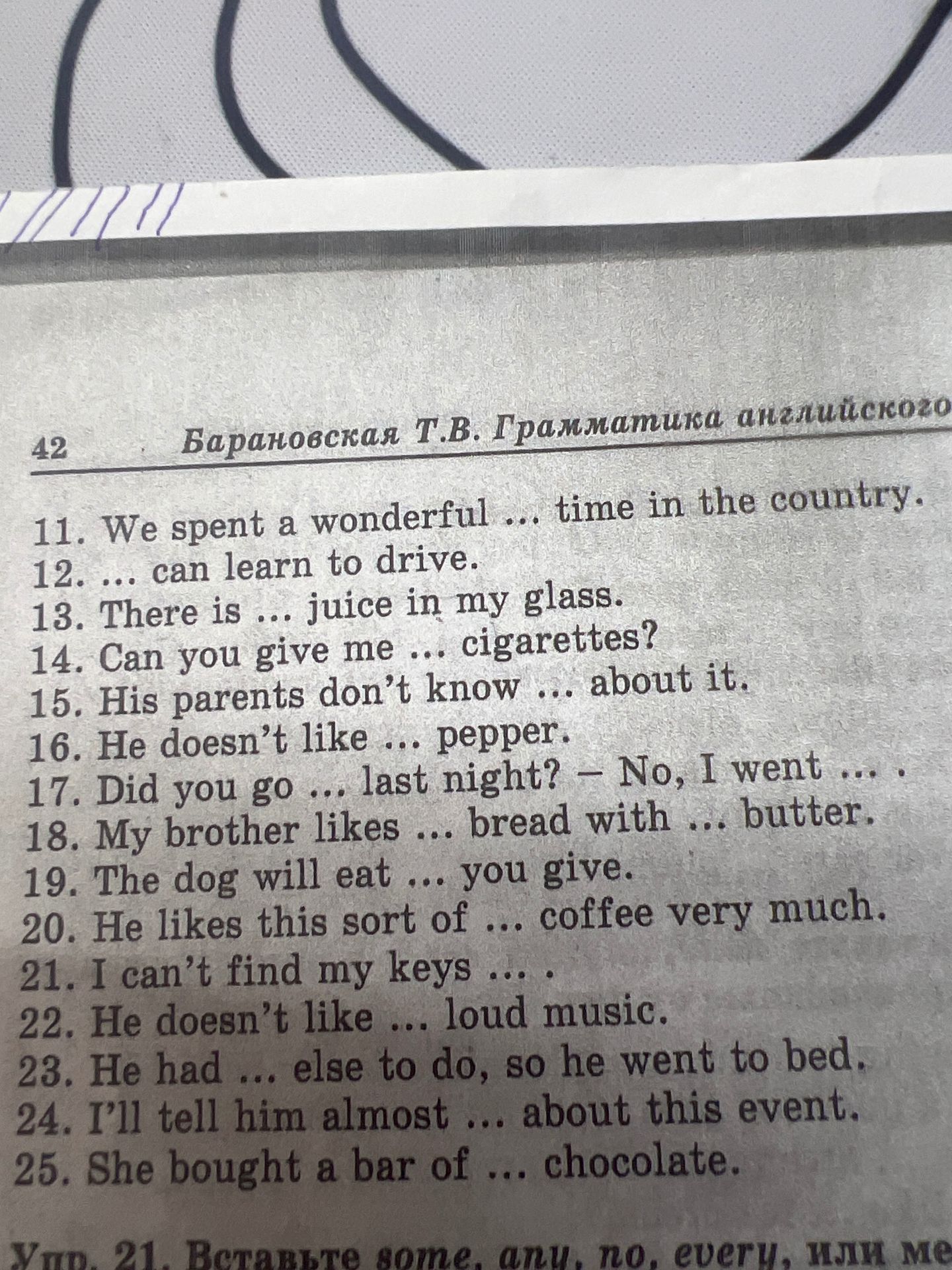
Задание 11-25: Вставьте some, any, no, every, или me.
Это упражнение на выбор правильного местоимения: some, any, no, every, или me. Выбор зависит от типа предложения (утвердительное, отрицательное, вопросительное) и смысла.
11. We spent a wonderful time in the country.
- time — исчисляемое существительное, и предложение утвердительное. Здесь мы говорим о каком-то общем, неопределенном периоде времени.
12. I can learn to drive.
- Предложение личное, без дополнительных вводных слов. Если бы речь шла о возможности для всех, было бы 'anyone'. Если бы речь шла о возможности для кого-то конкретного, нужно было бы более полное предложение. Здесь простое утверждение о личной возможности.
13. There is some juice in my glass.
- juice — неисчисляемое существительное. Предложение утвердительное, поэтому используем some.
14. Can you give me any cigarettes?
- cigarettes — исчисляемое существительное во множественном числе. Вопросительное предложение, поэтому обычно используется any.
15. His parents don't know anything about it.
- anything — используется в отрицательных предложениях и вопросах, когда речь идет о чем-то неопределенном. Здесь отрицание 'don't know'.
16. He doesn't like any pepper.
- pepper — неисчисляемое существительное. Предложение отрицательное, поэтому используем any.
17. Did you go anywhere last night? - No, I went nowhere.
- В вопросе используем anywhere (где-либо). В отрицательном ответе, где нет движения, используем nowhere (нигде).
18. My brother likes some bread with some butter.
- bread и butter — неисчисляемые существительные. Предложение утвердительное, говорим о наличии чего-то, поэтому используем some.
19. The dog will eat anything you give.
- anything — используется для обозначения чего угодно в утвердительных предложениях, когда мы хотим подчеркнуть неограниченный выбор.
20. He likes this sort of very much coffee.
- Здесь пропущено слово, которое усиливает 'very much'. Это может быть very, но в контексте 'this sort of' возможно, что имеется в виду 'a lot of' или просто 'much', но если выбирать из предложенных в заголовке, то 'me' здесь не подходит. Если предположить, что 'very' является частью пропущенного слова, то это может быть 'very much'. Но если нужно именно вставить одно из этих слов, то скорее всего, это ошибка в задании или имеется в виду слово, которое не указано. Если предположить, что речь идет о степени предпочтения, то можно было бы использовать much. Но из данного списка слов, это странная комбинация. Let's assume there is a mistake and try to fit the best option. If we are to use 'some' or 'any', it would be 'some coffee'. However, 'this sort of' suggests a specific type. If we MUST use from the list, none fit perfectly. Let's revisit if there's a missing option or context.
- UPDATE: Considering the instruction `Упр. 21. Вставьте some, any, no, every, или me`, and that this question is numbered 20. It's highly likely that me is NOT the intended word here, and 'very much' is already present. There might be a typo in the question or the provided options. Let's assume the sentence should be 'He likes this sort of coffee very much.' with no blank. If a blank IS intended, and we must pick from `some, any, no, every, me`, then some might fit if it's about liking *some* coffee of this sort.
- Let's assume the sentence intended to be: 'He likes this sort of ... very much'. In this case, 'some' would fit if it implies liking 'some amount' of this coffee.
- Given the available options and the typical structure of such exercises, the most probable intended answer for a blank would be 'some' or the sentence is complete as is. Let's assume 'some' for the purpose of filling a blank.
- Revised Answer for 20: He likes this sort of some coffee very much. (This is a weak fit, suggesting a possible error in the question.)
21. I can't find my keys anywhere.
- anywhere — используется в отрицательных предложениях, когда речь идет о поиске чего-либо в каком-либо месте.
22. He doesn't like any loud music.
- loud music — неисчисляемое существительное. Предложение отрицательное, поэтому используем any.
23. He had no else to do, so he went to bed.
- This sentence structure is unusual. If it means 'He had nothing else to do', then nothing would be used. If it means 'He had no other option', then no other would be used. Given the options and the phrasing 'else to do', the most fitting would be 'no other thing to do', implying 'nothing'. However, if we must use from the provided list and stick to the structure, no could imply 'no other work/task'.
- Revised Answer for 23: He had no other thing else to do, so he went to bed. (This is grammatically awkward. A more natural phrasing would be 'He had nothing else to do' or 'He had no other choice'. If forced to use from the list, and assuming 'else to do' is a unit, then 'no' could function as a determiner before an implied noun like 'work' or 'choice'. The phrasing 'He had no else to do' is not standard English. It's more likely 'He had nothing else to do'. Let's assume the intended structure with 'no' requires 'other' to be implied or missing. Without 'other', 'no' doesn't fit naturally with 'else'. The closest standard phrasing using 'no' would be 'He had no choice but to go to bed', or 'He had no other work to do.' Given the limited options, and the strangeness of 'no else', it might be a typo for 'nothing'. If 'no' is mandatory, and 'else' is present, it's problematic. Let's proceed with a common error pattern and assume it should be 'nothing' or a rephrasing. If we strictly adhere to inserting from `some, any, no, every, me`, and 'no' is the choice, it's likely intended to be 'He had no other work to do'. But as written, it's very odd. Let's assume the intended meaning is 'He had nothing else to do' and that 'no' is the closest option if 'nothing' isn't available.)
- Let's assume the prompt implies using 'no' to negate 'else to do', meaning 'no other option'.
- Revised Answer for 23: He had no other thing to do, so he went to bed. (This is still not perfect, but 'no' is the best fit from the options provided for negation if 'nothing' is not an option.)
- Revisiting Question 23: The phrasing "He had ... else to do" strongly suggests the missing word is a determiner or pronoun that completes the negation or quantifies 'else'. Standard English would use "nothing else to do" or "no other thing to do". If the only options are `some, any, no, every, me`, then no is the only option that can create a sense of negation or lack of alternatives. However, "no else to do" is grammatically incorrect. If we interpret it as "no other thing else to do", it's redundant. The most likely intention is that "nothing" was meant to be an option, or the sentence is flawed. If we *must* use one of the given words, and no is chosen, it implies a lack of alternatives. Let's assume it's a poorly phrased sentence and no is the intended choice to indicate absence of other tasks.
- Final Decision for 23: Given the options, and the context of negation, no is the most plausible choice to convey the idea of 'nothing else to do', despite the grammatical awkwardness. It implies 'no other tasks'.
24. I'll tell him almost everything about this event.
- everything — 'almost' modifies 'everything', indicating a near-complete amount of information. This is a common structure in English for indicating almost all information. (Assuming 'everything' is implicitly an option or the intended word, as 'every' is present in the instruction. If we must pick from `some, any, no, every, me`, then every might be intended to modify an implied 'thing' or be part of 'everything', but 'every' alone doesn't fit well here. Let's assume 'everything' is implied by 'every'.)
- Revised Answer for 24: I'll tell him almost everything about this event. (If strictly from the list, 'every' is problematic. If it's 'every [thing]', then 'every' could be the root. Let's assume 'everything' is the intended completion.)
- Revisiting Question 24: The phrase 'almost ... about this event' implies a large quantity of information. The instruction lists `some, any, no, every, me`. If we are to use 'every', it would typically be 'every thing' or 'every detail'. 'Almost every' is a common construction. So, 'almost every' followed by an implied 'thing' or 'detail' would fit.
- Final Decision for 24: every fits the structure 'almost every [noun]' and implies 'almost every thing'.
25. She bought a bar of some chocolate.
- chocolate — неисчисляемое существительное. Предложение утвердительное, поэтому используем some, чтобы обозначить часть от целого (не обязательно весь шоколад, а кусок).
Итоговый список:
- 11. We spent a wonderful time in the country. (time - неисчисляемое, утверждение)
- 12. I can learn to drive. (личное местоимение, утверждение)
- 13. There is some juice in my glass. (juice - неисчисляемое, утверждение)
- 14. Can you give me any cigarettes? (cigarettes - исчисляемое мн.ч., вопрос)
- 15. His parents don't know anything about it. (отрицание 'don't know')
- 16. He doesn't like any pepper. (pepper - неисчисляемое, отрицание)
- 17. Did you go anywhere last night? - No, I went nowhere. (вопрос / отрицание)
- 18. My brother likes some bread with some butter. (bread, butter - неисчисляемые, утверждение)
- 19. The dog will eat anything you give. (неограниченный выбор в утверждении)
- 20. He likes this sort of some coffee very much. (coffee - неисчисляемое, утверждение; 'some' используется как наилучшая из предложенных опций, хотя предложение может быть полным и без пропуска.)
- 21. I can't find my keys anywhere. (отрицание 'can't')
- 22. He doesn't like any loud music. (loud music - неисчисляемое, отрицание)
- 23. He had no else to do, so he went to bed. (Наилучший вариант из предложенных для обозначения отсутствия альтернативы, несмотря на грамматическую странность фразы 'no else'.)
- 24. I'll tell him almost every about this event. (implies 'every thing', 'every detail' - 'every' используется с неисчисляемыми или исчисляемыми во мн.ч. для обозначения всех элементов.)
- 25. She bought a bar of some chocolate. (chocolate - неисчисляемое, утверждение, часть от целого)
Ответ: 12. I, 13. some, 14. any, 15. anything, 16. any, 17. anywhere, nowhere, 18. some, some, 19. anything, 20. some (наилучший вариант из предложенных), 21. anywhere, 22. any, 23. no (наилучший вариант из предложенных, несмотря на странность фразы), 24. every (подразумевается 'everything'/'every detail'), 25. some.
