
 Алгебра
 Английский
 Биология
 География
 Геометрия
 История
 Русский
 Обществознание
 Физика
 Химия
 Информатика
 Литература
 Математика
Ответ:
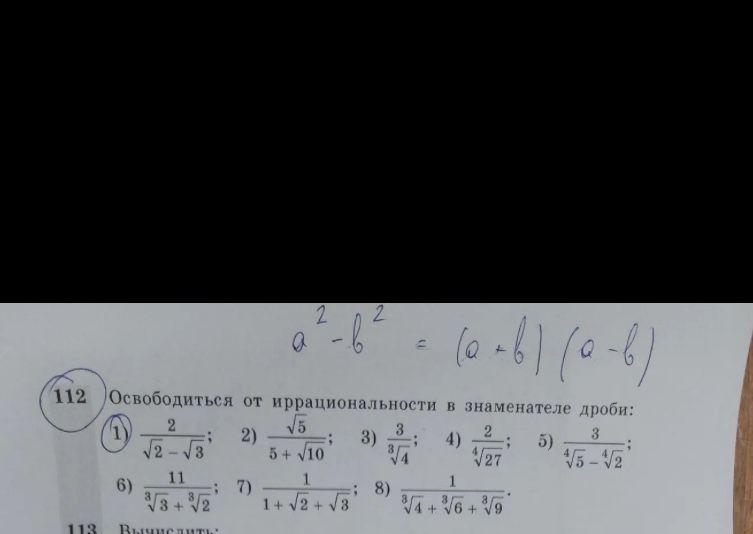
Умножаем на сопряжённое выражение:
\(\displaystyle \frac{2}{\sqrt2-\sqrt3}\cdot\frac{\sqrt2+\sqrt3}{\sqrt2+\sqrt3}=\frac{2(\sqrt2+\sqrt3)}{2-3}=-2\sqrt2-2\sqrt3.\)
Умножаем числитель и знаменатель на сопряжённое выражение:
\(\displaystyle \frac{\sqrt5}{5+\sqrt{10}}\cdot\frac{5-\sqrt{10}}{5-\sqrt{10}}=\frac{5\sqrt5-\sqrt{50}}{25-10}=\frac{5\sqrt5-5\sqrt2}{15}=\frac{\sqrt5-\sqrt2}{3}.\)
Домножаем на \(\sqrt[3]{16}\), чтобы в знаменателе получился полный куб:
\(\displaystyle \frac{3}{\sqrt[3]{4}}\cdot\frac{\sqrt[3]{16}}{\sqrt[3]{16}}=\frac{3\sqrt[3]{16}}{4}=\frac{3\sqrt[3]{2}}{2}.\)
Домножаем на \(\sqrt[4]{3}\):
\(\displaystyle \frac{2}{\sqrt[4]{27}}\cdot\frac{\sqrt[4]{3}}{\sqrt[4]{3}}=\frac{2\sqrt[4]{3}}{3}.\)
Пусть \(x=\sqrt[4]{5}\), \(y=\sqrt[4]{2}\). Используем тождество \((x-y)(x^3+x^2y+xy^2+y^3)=x^4-y^4\):
\(\displaystyle \frac{3}{x-y}=\frac{3(x^3+x^2y+xy^2+y^3)}{x^4-y^4}=x^3+x^2y+xy^2+y^3,\)
поскольку \(x^4-y^4=5-2=3\). Следовательно,
\(\displaystyle \sqrt[4]{125}+\sqrt[4]{50}+\sqrt[4]{20}+\sqrt[4]{8}.\)
Обозначим \(x=\sqrt[3]{3}\), \(y=\sqrt[3]{2}\). Домножаем на \(x^2-xy+y^2\), так как \((x+y)(x^2-xy+y^2)=x^3+y^3=5\):
\(\displaystyle \frac{11}{x+y}=\frac{11(x^2-xy+y^2)}{5}=\frac{11(\sqrt[3]{9}-\sqrt[3]{6}+\sqrt[3]{4})}{5}.\)
Сначала умножаем на \(1+\sqrt2-\sqrt3\):
\(\displaystyle (1+\sqrt2+\sqrt3)(1+\sqrt2-\sqrt3)=(1+\sqrt2)^2-3=2\sqrt2.\)
Поэтому \(\displaystyle \frac{1}{1+\sqrt2+\sqrt3}=\frac{1+\sqrt2-\sqrt3}{2\sqrt2}=\frac{2+\sqrt2-\sqrt6}{4}.\)
Пусть \(x=\sqrt[3]{4}\), \(y=\sqrt[3]{6}\), \(z=\sqrt[3]{9}\). Используем тождество \((x+y+z)(x^2+y^2+z^2-xy-yz-zx)=x^3+y^3+z^3-3xyz\). Здесь правая часть равна \(4+6+9-3\cdot6=1\). Значит,
\(\displaystyle \frac{1}{x+y+z}=x^2+y^2+z^2-xy-yz-zx.\)
Подставляя значения, получаем \(\displaystyle \sqrt[3]{16}+\sqrt[3]{36}+\sqrt[3]{81}-\sqrt[3]{24}-\sqrt[3]{54}-\sqrt[3]{54}=2\sqrt[3]{2}+\sqrt[3]{36}+3\sqrt[3]{3}-2\sqrt[3]{3}-2\sqrt[3]{3}=2\sqrt[3]{2}+\sqrt[3]{36}-\sqrt[3]{3}.\)
