
 Алгебра
 Английский
 Биология
 География
 Геометрия
 История
 Русский
 Обществознание
 Физика
 Химия
Химия Информатика
 Литература
 Математика
Вопрос:
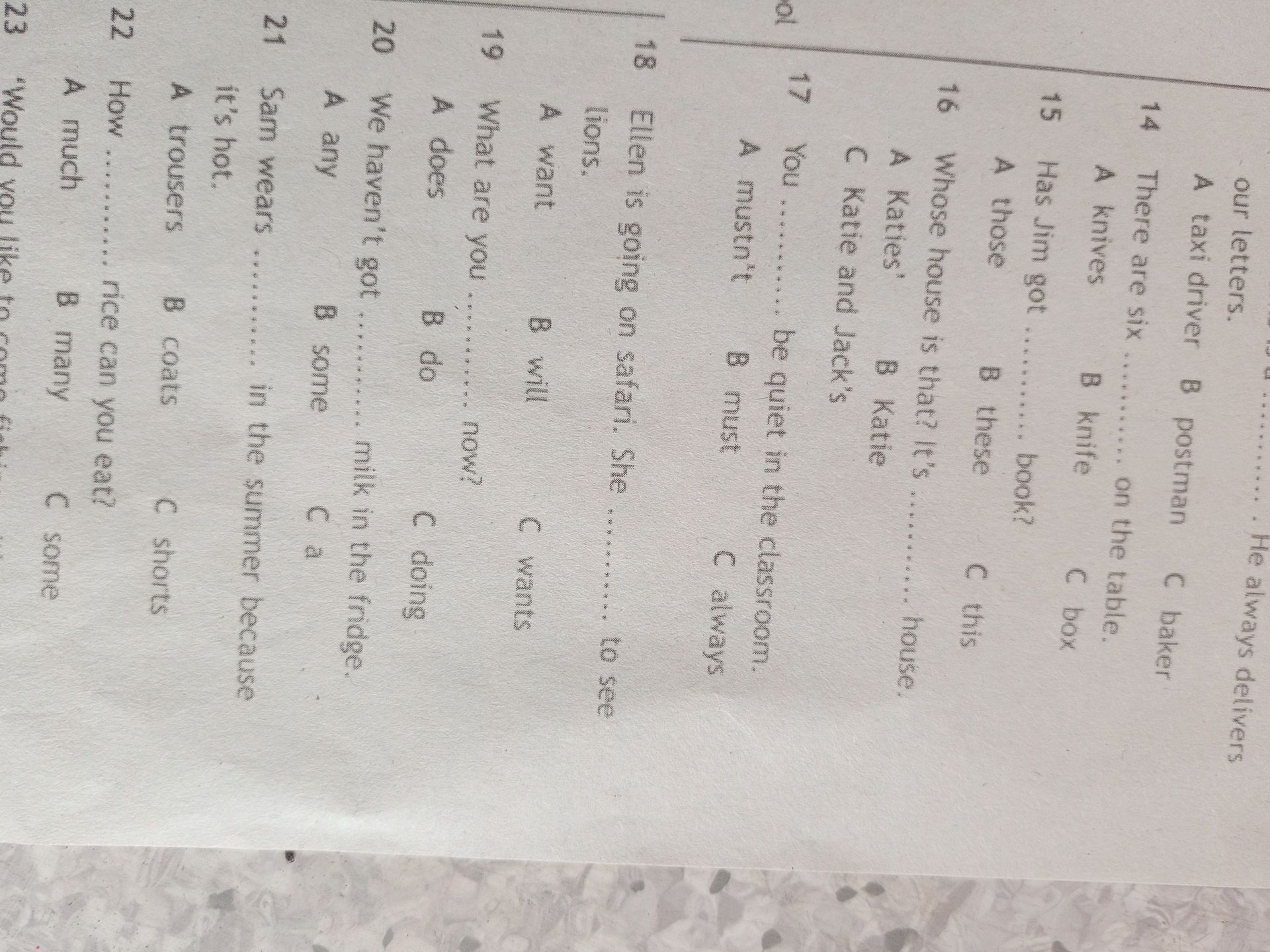
15. Has Jim got _____. A) those B) these C) this
Ответ:
Solution:
- The question is asking about possession ('has got').
- 'These' and 'this' are demonstrative pronouns. 'These' is plural and 'this' is singular.
- 'Those' can be used to refer to something at a distance, but in this context, it's likely referring to a specific item. However, 'these' is a more common and direct possessive form in this type of question when referring to something that is present or being discussed. 'This' is singular and would require a singular item. 'Those' implies distance. Given the options, 'these' is the most appropriate to ask about something one possesses.
- Revisiting common usage, 'has Jim got this book?' is more natural than 'has Jim got these book?' or 'has Jim got those book?'. However, without context, 'these' could refer to multiple items. If we consider the possibility of a singular item, 'this' would be appropriate. Let's re-evaluate the options. If it's a singular item, 'this' fits. If it's multiple items, 'these' fits. 'Those' implies distance. Let's assume a singular item.
- Upon further reflection, questions like 'Has he got this?' or 'Has he got these?' are common. 'Those' is less likely unless there's a context of distance. Between 'this' and 'these', if we assume a single item, 'this' is the correct choice. If multiple items, 'these'. Let's consider the provided options again. The question is 'Has Jim got _____?'. If it's asking about a single object, it would be 'this'. If it's asking about multiple objects, it would be 'these'. 'Those' implies distance. Given the lack of context, and typical question phrasing, 'this' is the most likely singular option. Let's re-examine the common phrase structure. 'Has Jim got this?' is a standard question. 'Has Jim got these?' is also standard if referring to multiple items. Without further context, it's ambiguous. However, if we consider the typical flow of such exercises, they often test singular/plural distinctions or demonstratives. Let's assume a singular object.
- Let's reconsider the options in terms of grammatical correctness and common usage for a direct question about possession. 'Has Jim got this?' is grammatically correct for a singular object. 'Has Jim got these?' is correct for plural objects. 'Has Jim got those?' is correct for plural objects at a distance. If we assume the question is about a single, near item, 'this' is the best fit.
- Let's look at the options again. The question implies a single item or a group of items. If it's singular, 'this'. If it's plural, 'these'. 'Those' implies distance and plurality. Without context, it's hard to be certain. However, often these questions test the difference between singular and plural. Let's assume the simplest case: a singular object.
- Upon reviewing common grammatical patterns for this type of question, both 'this' and 'these' can be correct depending on whether the noun is singular or plural. 'Those' is less likely without a clear indication of distance. If we are forced to choose one, and considering 'this' refers to a singular item and 'these' to a plural item, and there's no indication of plurality, 'this' might be the intended answer for a singular object.
- Let's re-examine the options provided. If the question is asking about a singular object, 'this' is the correct demonstrative pronoun. If it's asking about multiple objects, 'these' would be correct. 'Those' is used for plural objects at a distance. Given the simple structure, it's likely testing the singular demonstrative.
- Final consideration: The most common phrasing for a direct question about possession of a single item is 'Has Jim got this?'.
Answer: C) this
Похожие
- 14. There are six _____. A) knives B) knife C) box
- 16. Whose house is that? It's _____. A) Katies' B) Katie C) Katie and Jack's
- 17. You ____ be quiet in the classroom. A) mustn't B) must C) always
- 18. Ellen is going on safari. She ____ lions. A) want B) will C) wants
- 19. What are you ____? A) does B) do C) doing
- 20. We haven't got ____ milk in the fridge. A) any B) some C) a
- 21. Sam wears _____ in the summer because it's hot. A) trousers B) coats C) shorts
- 22. How _____ rice can you eat? A) much B) many C) some
- 23. 'Would you like to _____ fish?' A) eat B) to eat C) eating
