
 Алгебра
 Английский
 Биология
 География
 Геометрия
 История
 Русский
 Обществознание
 Физика
 Химия
Химия Информатика
 Литература
 Математика
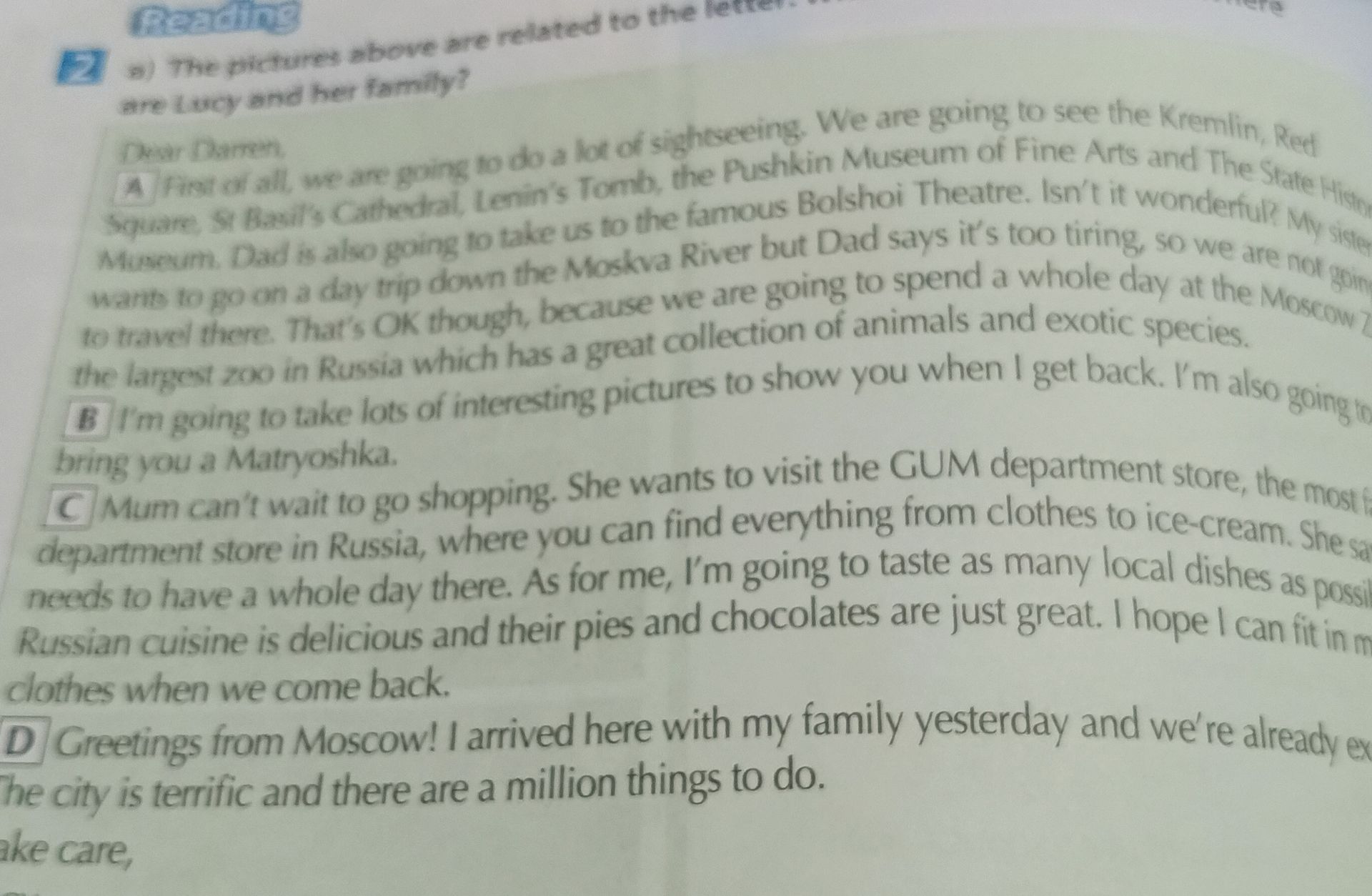
2 a) The pictures above are related to the letter. are Lucy and her family?
Ответ:
Analysis:
The question asks about the relationship between the pictures and the letter, specifically if they are related to Lucy and her family. The provided text is a letter written by someone to their friend 'Darren', describing a trip to Moscow. The letter mentions sightseeing, visiting museums, going to the Bolshoi Theatre, and enjoying Russian cuisine. It also mentions that the writer is with their 'family' (parents and sister) but does not explicitly mention 'Lucy' or confirm if the pictures are of Lucy and her family. Without the pictures, it's impossible to definitively answer the question based solely on the text.
However, the structure of the problem suggests that the text options (A, B, C, D) are meant to be potential continuations or summaries related to the letter and potentially the pictures.
Evaluating the Options:
- A) First of all, we are going to do a lot of sightseeing. We are going to see the Kremlin, Red Square, St Basil's Cathedral, Lenin's Tomb, the Pushkin Museum of Fine Arts and The State Historical Museum. Dad is also going to take us to the famous Bolshoi Theatre. Isn't it wonderful? My sister wants to go on a day trip down the Moskva River but Dad says it's too tiring, so we are not going to travel there. That's OK though, because we are going to spend a whole day at the Moscow Zoo, the largest zoo in Russia which has a great collection of animals and exotic species. - This option details a lot of activities that align with a trip to Moscow, as described in the letter. It mentions family members.
- B) I'm going to take lots of interesting pictures to show you when I get back. I'm also going to bring you a Matryoshka. - This option focuses on taking pictures and bringing a souvenir, which is plausible for a trip.
- C) Mum can't wait to go shopping. She wants to visit the GUM department store, the most famous department store in Russia, where you can find everything from clothes to ice-cream. She says she needs to have a whole day there. As for me, I'm going to taste as many local dishes as possible. Russian cuisine is delicious and their pies and chocolates are just great. I hope I can fit in more clothes when we come back. - This option details shopping and food, also consistent with a trip.
- D) Greetings from Moscow! I arrived here with my family yesterday and we're already excited. The city is terrific and there are a million things to do. Take care, - This option serves as a greeting and an introduction to the trip, confirming arrival with family.
Since the question specifically asks if the pictures are related to 'Lucy and her family', and the letter mentions the writer is with *their* family, and options A, B, C, and D all seem to be parts of the letter or descriptions related to the trip, we need to infer the connection. Typically, in such exercises, one of these options would be a caption or a summary that connects to the pictures.
Without the pictures, it's impossible to definitively say if they are of 'Lucy and her family'. However, if we assume the question is asking which statement *best* fits a scenario involving Lucy's family on a trip to Moscow, and considering the letter describes a family trip:
Option D provides a direct greeting from Moscow, stating arrival with family, which is a general statement that could precede details about specific activities (as in A, B, C). If Lucy is the one writing the letter, then 'her family' is the group described.
Given the ambiguity without the pictures, and focusing on the letter's content, all options (A, B, C, D) describe activities and aspects of a family trip to Moscow. Option D is a direct statement about arriving in Moscow with family.
If the question implies that the pictures *show* Lucy and her family *during* their trip, then the most fitting option would be one that describes the family's presence and general excitement, or specific activities they are doing. Option D is the most general statement of arrival and excitement with family.
However, the question asks if the *pictures* are related to Lucy and her family. If the pictures show Lucy and her family, then the letter content (A, B, C, D) should relate to what they are doing. The prompt is likely asking to select the statement that best describes what the pictures might show, given the context of the letter.
Let's re-examine the introductory sentence: "2 a) The pictures above are related to the letter. are Lucy and her family?" This phrasing is a bit awkward. It could mean: "The pictures above are related to the letter. [Do the pictures show] Lucy and her family?" or "The pictures above are related to the letter. [And they show] Lucy and her family?".
The letter itself is written by someone to Darren, and it describes their family's trip. If Lucy is the writer, then 'her family' is the group mentioned. The options A, B, C, D are potential parts of the letter or summaries.
If we consider the structure of such exercises, usually one of the options is the correct answer to the question posed. Option D is a direct statement of arrival with family in Moscow. If the pictures were of Lucy and her family in Moscow, this statement would be a very appropriate beginning or summary related to those pictures.
Without seeing the pictures, it's an educated guess. However, based on the common structure of these exercises, Option D is a strong candidate as it directly confirms arrival with family in the context of Moscow.
Let's assume the question implies that one of the options A, B, C, or D is a statement about Lucy and her family in relation to the pictures and the letter. Option D is the most direct statement about arriving in Moscow with family.
