
 Алгебра
 Английский
 Биология
 География
 Геометрия
 История
 Русский
 Обществознание
 Физика
 Химия
Химия Информатика
 Литература
 Математика
Вопрос:
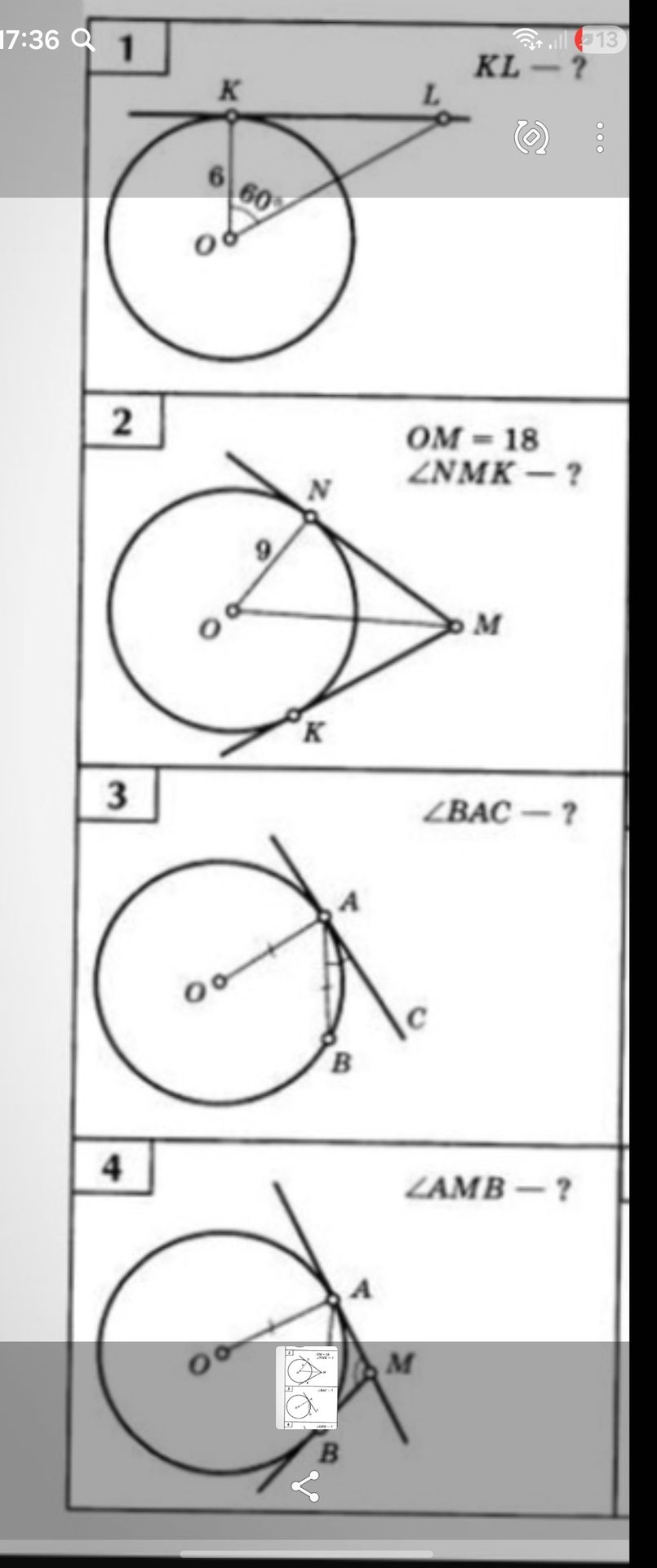
2. OM = 18. Find \(\angle\) NMK.
Ответ:
Solution:
- OM = 18 is given. The radius of the circle is ON = OK = 9.
- Since ON and OK are radii and NM and MK are tangents from point M to the circle, ON is perpendicular to NM, and OK is perpendicular to MK. So, \(\angle ONM = 90^{\circ}\) and \(\angle OKM = 90^{\circ}\).
- Triangle ONM and triangle OKM are right-angled triangles.
- In \(\triangle ONM\), we have ON = 9 and OM = 18. We can find NM using the Pythagorean theorem: \( NM^2 + ON^2 = OM^2 \) => \( NM^2 + 9^2 = 18^2 \) => \( NM^2 + 81 = 324 \) => \( NM^2 = 243 \) => \( NM = \sqrt{243} = \sqrt{81 \times 3} = 9\sqrt{3} \).
- Similarly, in \(\triangle OKM\), NK = 9 and OM = 18, so MK = $$9\sqrt{3}$$.
- Also, tangents from an external point to a circle are equal in length, so NM = MK.
- In \(\triangle ONM\), we can find \(\angle NOM\) using sine: \( \sin(\angle NOM) = \frac{NM}{OM} = \frac{9\sqrt{3}}{18} = \frac{\sqrt{3}}{2} \). Therefore, \(\angle NOM = 60^{\circ}\).
- Similarly, \(\angle KOM = 60^{\circ}\).
- Thus, \(\angle NOK = \angle NOM + \angle KOM = 60^{\circ} + 60^{\circ} = 120^{\circ}\).
- In quadrilateral ONMK, the sum of angles is 360 degrees. \(\angle ONM = 90^{\circ}\), \(\angle OKM = 90^{\circ}\), \(\angle NOK = 120^{\circ}\).
- So, \(\angle NMK = 360^{\circ} - 90^{\circ} - 90^{\circ} - 120^{\circ} = 60^{\circ}\).
- Alternatively, consider \(\triangle ONM\) and \(\triangle OKM\). They are congruent by RHS (Right angle, Hypotenuse, Side) since ON = OK (radii), OM is common, and \(\angle ONM = \angle OKM = 90^{\circ}\).
- Therefore, \(\angle NMO = \angle KMO\).
- In \(\triangle ONM\), \(\sin(\angle NMO) = \frac{ON}{OM} = \frac{9}{18} = \frac{1}{2}\). Thus, \(\angle NMO = 30^{\circ}\).
- Since \(\angle NMK = \angle NMO + \angle KMO\) and \(\angle NMO = \angle KMO\), then \(\angle NMK = 30^{\circ} + 30^{\circ} = 60^{\circ}\).
Answer: \(\angle NMK = 60^{\circ}\).
Похожие
