
 Алгебра
 Английский
 Биология
 География
 Геометрия
 История
 Русский
 Обществознание
 Физика
 Химия
Химия Информатика
 Литература
 Математика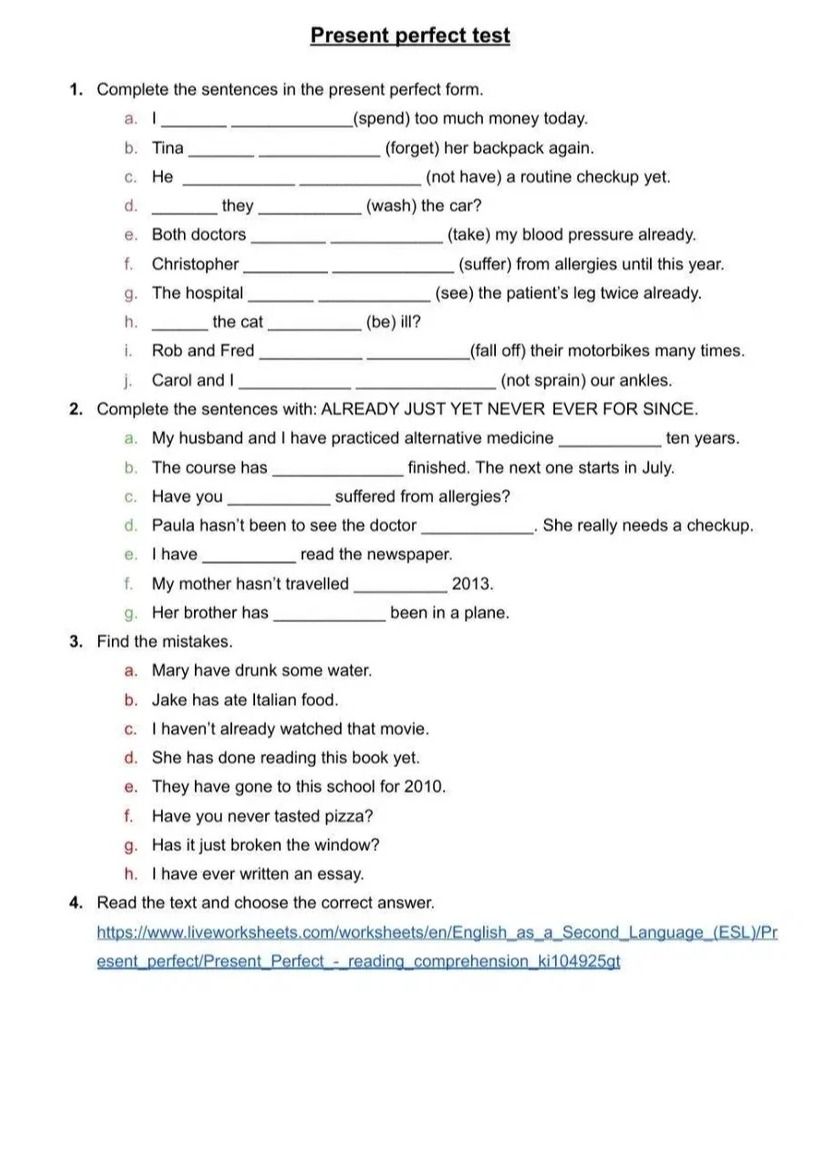
Ответ:
3. Find the mistakes.
- Mary has drunk some water. (Mistake: 'have' should be 'has')
- Jake has eaten Italian food. (Mistake: 'ate' is past simple, 'eaten' is past participle)
- I have watched that movie already. OR I haven't watched that movie yet. (Mistake: 'already' is usually used in affirmative sentences or with a surprised tone in questions; 'yet' is used in negative sentences and questions. The placement of 'already' is also unusual.)
- She has finished reading this book already. OR She hasn't finished reading this book yet. (Mistake: 'done reading' is not the standard phrasing; 'finished reading' or 'read' is more common. 'Yet' would be more appropriate here.)
- They have gone to this school since 2010. (Mistake: 'for' is used for duration, 'since' is used for a starting point in time. If they started in 2010 and are still there, 'since' is correct, but if it implies they are no longer there, 'for' would be used for the duration. Assuming they are still there, 'since' is correct, but it could also be 'for 10 years' if the duration is implied.) - *Correction based on common usage: Assuming the sentence implies a duration or a point in the past.* They have gone to this school for 10 years. OR They have gone to this school since 2010 (if the starting point is emphasized and they are still attending). The original sentence is ambiguous. Let's assume a duration: They have been at this school for 10 years. Or they have attended this school since 2010. A more direct correction to the original structure would be: They have been going to this school since 2010. The original sentence implies they *left* for the school in 2010, which is unlikely. Let's correct it to: They have been to this school since 2010. However, the most common mistake is using 'for' with a specific year. It should be 'since'. Therefore, the original sentence might be considered correct if the meaning is 'since the year 2010'. Let's re-examine. The most likely intended mistake is using 'for' instead of 'since' with a year. The sentence as written is grammatically sound if it means they started attending in 2010 and are still there. If the intention was to indicate a duration, it would be 'for 10 years'. Given the context of present perfect, 'since' is appropriate for a starting point. Let's assume the original sentence implies they started attending school in 2010. If the mistake is in the word 'for', then it should be 'since'. If the mistake is in 'have gone', it should be 'have been going' or 'have been'. Let's focus on the word 'for'. It should be 'since'. The sentence is: 'They have gone to this school for 2010.' This is incorrect. It should be 'since 2010'. So, the mistake is using 'for' instead of 'since'.
- Have you ever tasted pizza? (Mistake: 'never' is used in affirmative sentences to express absence of experience. 'Ever' is used in questions.)
- Has it broken the window just? OR It has just broken the window. (Mistake: 'just' usually comes before the main verb or after the auxiliary verb 'have/has' in affirmative sentences and questions.)
- I have never written an essay. OR I have written an essay before. (Mistake: 'ever' is used in questions and affirmative sentences to indicate experience. 'Never' is used to negate experience. If it's a statement of fact, 'never' is appropriate if the person has truly never written one. If the intention is to ask if they have *ever* written one, then the sentence should be a question.) Let's assume the statement is about having *no* experience: 'I have never written an essay.' If the intention was to say they have written one, 'ever' would be used in a question: 'Have you ever written an essay?' The current sentence 'I have ever written an essay' is likely a mistake, and it should be either 'I have never written an essay' or 'Have you ever written an essay?' Let's correct it to the most direct contrast: 'I have never written an essay.'
Ответ: 1. has drunk; 2. eaten; 3. watched ... already OR haven't watched ... yet; 4. finished reading OR read ... yet; 5. since; 6. ever; 7. just broken; 8. never written.
