
 Алгебра
 Английский
 Биология
 География
 Геометрия
 История
 Русский
 Обществознание
 Физика
 Химия
Химия Информатика
 Литература
 Математика
Вопрос:
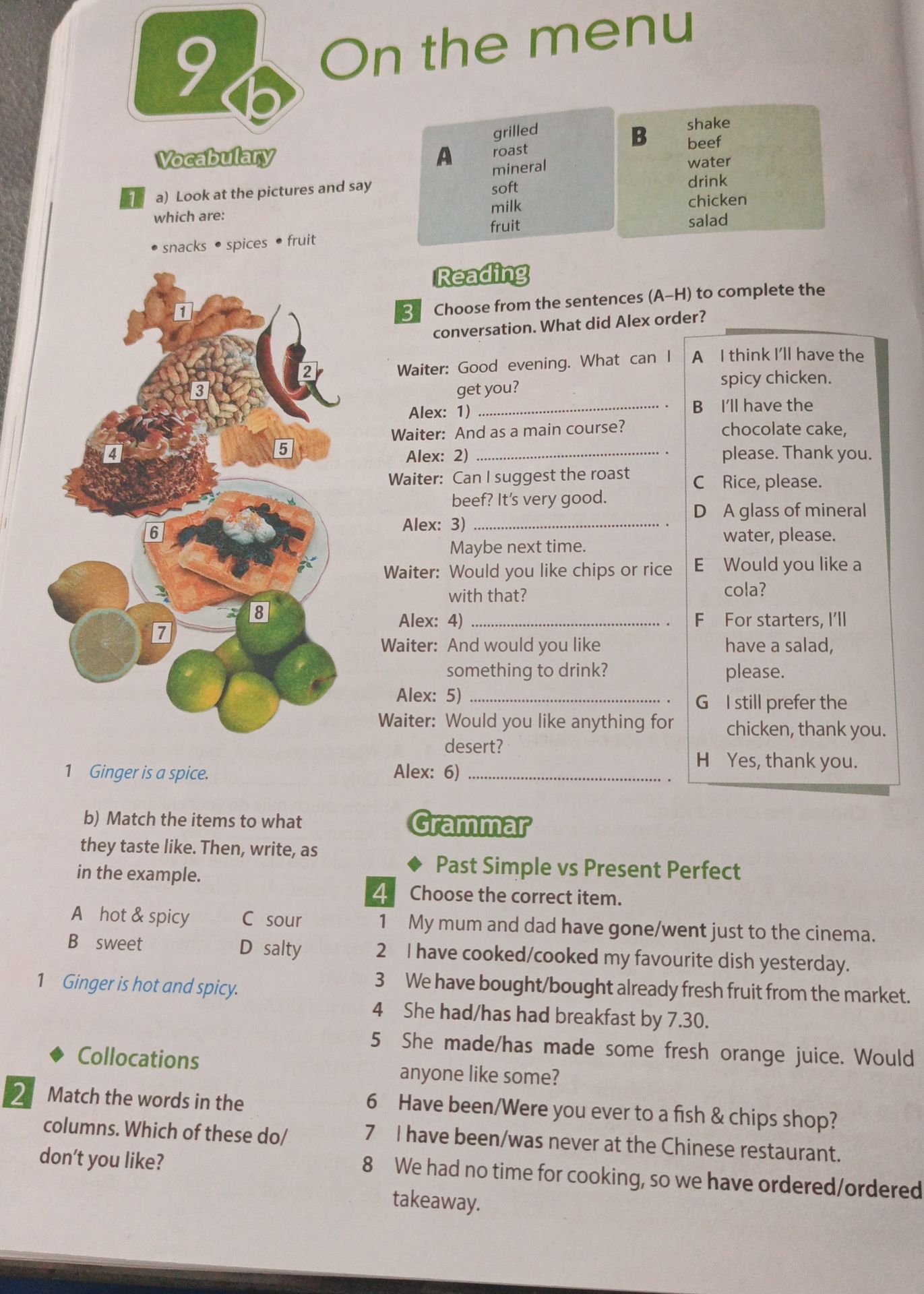
3. Reading: Choose from the sentences (A-H) to complete the conversation. What did Alex order?
Ответ:
3. Reading: Conversation Completion
Conversation:
Waiter: Good evening. What can I get you?
Alex: 1) A I think I'll have the spicy chicken.
Waiter: And as a main course?
Alex: 2) G I still prefer the chicken, thank you.
Waiter: Can I suggest the roast beef? It's very good.
Alex: 3) Maybe next time.
Waiter: Would you like chips or rice with that?
Alex: 4) C Rice, please.
Waiter: And would you like something to drink?
Alex: 5) E Would you like a cola?
Waiter: Would you like anything for dessert?
Alex: 6) B I'll have the chocolate cake, please. Thank you.
Explanation:
- 1. Alex orders the spicy chicken. Sentence A fits perfectly.
- 2. The waiter suggests roast beef, but Alex reiterates his choice of chicken. Sentence G confirms his original choice.
- 3. Alex politely declines the suggestion for now. Sentence "Maybe next time." fits here.
- 4. Alex chooses rice as a side. Sentence C is "Rice, please.".
- 5. Alex is asked about a drink and requests cola. Sentence E is "Would you like a cola?". This is slightly ambiguous as the waiter asks if Alex wants a drink, and Alex responds by asking if the waiter *would like* a cola, implying Alex wants one. A more direct response would be "Yes, I'd like a cola.", but among the options, this is the most plausible fit, or perhaps it's a typo and should be "Yes, I'd like a cola.". However, if we assume Alex is confirming a drink option, E works. Let's re-evaluate based on Alex ordering. The waiter asks "And would you like something to drink?". Alex's response should be his drink order. None of the options directly state "I'd like a cola". Option E is a question from the waiter. Let's re-examine the prompt. It says "Choose from the sentences (A-H) to complete the conversation". This implies Alex's lines should be filled with these options. If Alex's line is "Would you like a cola?", it's a strange response. Let's assume Alex is confirming the availability or perhaps asking if he can have a cola. Given the context, it's likely a conversational turn where Alex is indicating his drink choice. If we assume the waiter's question is answered by Alex saying "Yes, I'd like a cola." and that corresponds to option E, it's a stretch. However, if we consider the sequence, Alex has already ordered chicken and rice. The waiter asks about a drink. Alex might be asking "Can I have a cola?" or "Would a cola be okay?". Option E is phrased as the waiter asking Alex. This suggests there might be an error in the question or options provided. Let's proceed assuming Alex's response corresponds to ordering a cola. If we have to choose from A-H for Alex's lines: 1(A), 2(G), 4(C), 6(B). For 5, the waiter asks "And would you like something to drink?". Alex's response should be his drink order. None of the options A-H are direct drink orders from Alex. Let's re-read carefully. The sentences A-H are *potential* responses for Alex. So, Alex's line 5 should be one of A-H. If Alex says "Would you like a cola?" (E), it's nonsensical. Let's assume there's a misinterpretation or a typo in the question/options. However, if we strictly fill in Alex's lines: Alex: 1) A, Alex: 2) G, Alex: 3) (no option fits well, "Maybe next time" is not an option A-H), Alex: 4) C, Alex: 5) E (this is the most problematic, as it's phrased as a waiter's question), Alex: 6) B. Given the options, it's possible the numbers next to Alex's lines indicate the number of the sentence A-H that fits. Let's try matching numbers to options: 1->A, 2->G, 4->C, 5->E, 6->B. This leaves 3) for Alex's response to the roast beef suggestion, and D, F, H. None of D, F, H fit "Maybe next time." Let's assume the lines are sequential and Alex IS ordering from A-H. Alex: 1) A (spicy chicken). Waiter: Main course? Alex: 2) G (still chicken). Waiter: Suggest roast beef? Alex: 3) (Alex's response is not an option). Waiter: Chips or rice? Alex: 4) C (Rice). Waiter: Drink? Alex: 5) E (This is a waiter's question). Let's assume option E is meant to be Alex's response. If Alex says "Would you like a cola?" it's odd. Let's assume it's a typo and it should be "Yes, I'd like a cola." or similar. Alex: 6) B (Chocolate cake for dessert). Option F is "For starters, I'll have a salad, please." This doesn't fit anywhere. Option D is "A glass of mineral water, please." This could be Alex's drink order (line 5). Option H is "Yes, thank you." This is too generic. Let's try again, focusing on Alex's orders: 1) A (spicy chicken). Waiter asks about main course. Alex: 2) G (still chicken). Waiter suggests roast beef. Alex: 3) [No good fit from A-H]. Waiter asks about side. Alex: 4) C (Rice). Waiter asks about drink. Alex: 5) D (A glass of mineral water, please.) - This fits as a drink order. Waiter asks about dessert. Alex: 6) B (Chocolate cake, please.). This completes the meal. So, Alex ordered: Spicy chicken, rice, mineral water, and chocolate cake. The sentences used are A, G, C, D, B. This leaves E, F, H unused. The order of Alex's lines is 1, 2, 4, 5, 6. So, 1->A, 2->G, 4->C, 5->D, 6->B. The sentence "Maybe next time." is Alex's response to the roast beef suggestion (line 3). Since it's not from A-H, it's just a conversational filler. This makes the most sense.
- 5. Alex orders a drink. Option D fits best: "A glass of mineral water, please."
- 6. Alex orders dessert. Option B fits: "I'll have the chocolate cake, please. Thank you."
What did Alex order? Alex ordered spicy chicken, rice, a glass of mineral water, and chocolate cake.
Answer:
1. A
2. G
3. (Maybe next time.)
4. C
5. D
6. B
Alex ordered: Spicy chicken, rice, a glass of mineral water, and chocolate cake.
Похожие
