
 Алгебра
 Английский
 Биология
 География
 Геометрия
 История
 Русский
 Обществознание
 Физика
 Химия
 Информатика
 Литература
 Математика
Ответ:
📍Тапни предложение — включится подсветка для легкого переноса текста в тетрадь.
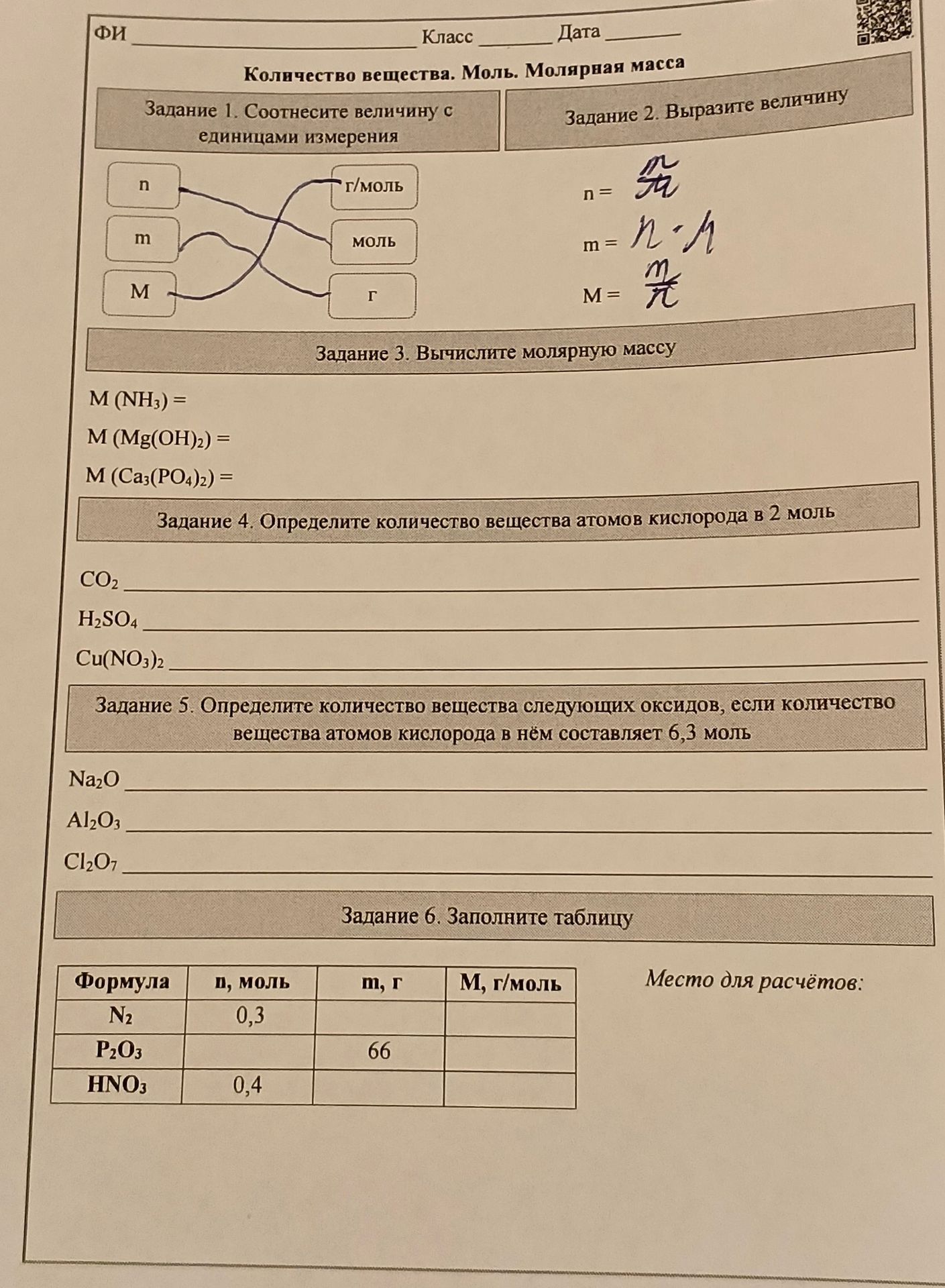
Используем относительные атомные массы: \(A_r(\mathrm{H})=1\), \(A_r(\mathrm{N})=14\), \(A_r(\mathrm{Mg})=24\), \(A_r(\mathrm{O})=16\), \(A_r(\mathrm{Ca})=40\), \(A_r(\mathrm{P})=31\).
- \(M(\mathrm{NH_3}) = 14 + 3 \cdot 1 = 17\) г/моль.
- \(M(\mathrm{Mg(OH)_2}) = 24 + 2 \cdot (16+1) = 58\) г/моль.
- \(M(\mathrm{Ca_3(PO_4)_2}) = 3 \cdot 40 + 2 \cdot (31+4 \cdot 16) = 120+190=310\) г/моль.
Ответ: \(M(\mathrm{NH_3})=17\) г/моль; \(M(\mathrm{Mg(OH)_2})=58\) г/моль; \(M(\mathrm{Ca_3(PO_4)_2})=310\) г/моль.
