
 Алгебра
 Английский
 Биология
 География
 Геометрия
 История
 Русский
 Обществознание
 Физика
 Химия
Химия Информатика
 Литература
 Математика
Вопрос:
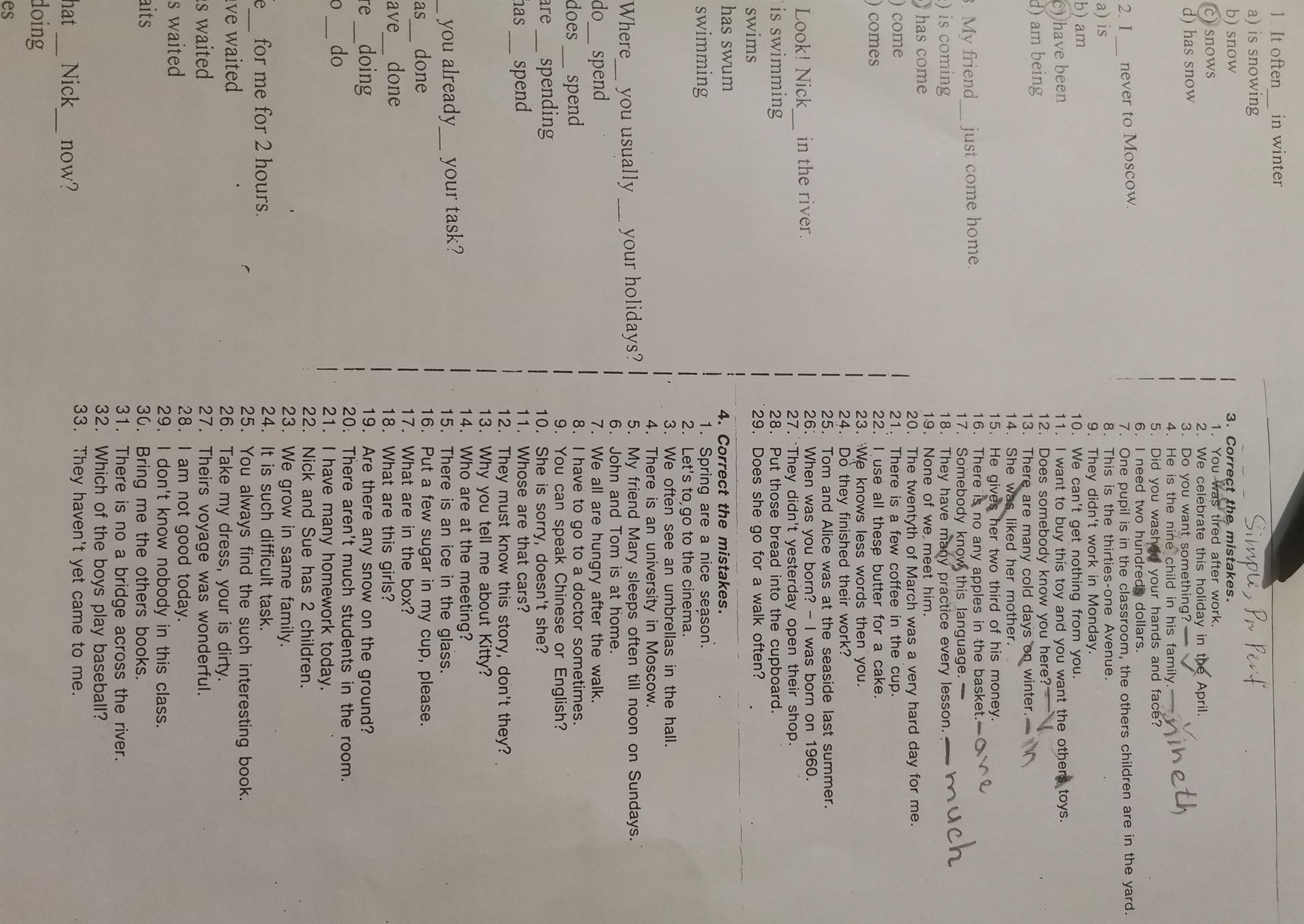
4. Correct the mistakes. 1. Spring are a nice season. 2. Let's to go to the cinema. 3. We often see an umbrellas in the hall. 4. There is an university in Moscow. 5. My friend Mary sleeps often till noon on Sundays. 6. John and Tom is at home. 7. We all are hungry after the walk. 8. I have to go to a doctor sometimes. 9. You can speak Chinese or English? 10. She is sorry, doesn't she? 11. Whose are that cars? 12. They must know this story, don't they? 13. Why you tell me about Kitty? 14. Who are at the meeting? 15. There is an ice in the glass. 16. Put a few sugar in my cup, please. 17. What are in the box? 18. What are this girls? 19. Are there any snow on the ground? 20. There aren't much students in the room. 21. I have many homework today. 22. Nick and Sue has 2 children. 23. We grow in same family. 24. It is such difficult task. 25. You always find the such interesting book. 26. Take my dress, your is dirty. 27. Theirs voyage was wonderful. 28. I am not good today. 29. I don't know nobody in this class. 30. Bring me the others books. 31. There is no a bridge across the river. 32. Which of the boys play baseball? 33. They haven't yet came to me.
Ответ:
Решение:
- Spring is a nice season. (Spring - ед.ч.)
- Let's go to the cinema. (После 'Let's' идет инфинитив без 'to')
- We often see umbrellas in the hall. ('an' перед гласной, 'umbrellas' - мн.ч., поэтому 'an' не нужно)
- There is a university in Moscow. ('university' начинается с согласного звука 'y', поэтому артикль 'a')
- My friend Mary often sleeps till noon on Sundays. (Слово 'often' обычно ставится перед глаголом)
- John and Tom are at home. (John and Tom - мн.ч.)
- We all are hungry after the walk. (We - мн.ч.)
- I have to go to a doctor sometimes. (Already correct.)
- Can you speak Chinese or English? (Вопрос о способности использовать модальный глагол 'can')
- She is sorry, isn't she? (Вопрос-хвостик для утвердительного предложения: She is sorry -> isn't she?)
- Whose are those cars? (Указательное местоимение 'those' для множественного числа)
- They must know this story, mustn't they? (Вопрос-хвостик для модального глагола: They must know -> mustn't they?)
- Why do you tell me about Kitty? (В вопросах используется вспомогательный глагол 'do')
- Who is at the meeting? (Who - ед.ч.)
- There is ice in the glass. ('ice' - неисчисляемое, поэтому без артикля 'an')
- Put some sugar in my cup, please. ('sugar' - неисчисляемое, поэтому 'some' вместо 'a few')
- What is in the box? (What - ед.ч.)
- What are these girls? (Указательное местоимение 'these' для множественного числа)
- Is there any snow on the ground? (В вопросах и отрицаниях используется 'any' вместо 'some')
- There aren't many students in the room. ('students' - исчисляемое, поэтому 'many' вместо 'much')
- I have a lot of homework today. ('homework' - неисчисляемое, поэтому 'a lot of' вместо 'many')
- Nick and Sue have 2 children. (Nick and Sue - мн.ч.)
- We grow in the same family. (Перед 'same' нужен артикль 'the')
- It is a difficult task. (Перед 'difficult task' нужен артикль 'a')
- You always find an interesting book. (Перед 'interesting' нужен артикль 'an', так как начинается с гласной)
- Take my dress, it is dirty. (Замена 'your' на 'it' для указания на платье)
- Their voyage was wonderful. (Already correct.)
- I am not good today. (Already correct.)
- I don't know anybody in this class. (После отрицания 'don't know' используется 'anybody' вместо 'nobody')
- Bring me the other books. ('other' без 's', если речь идет о конкретных, оставшихся книгах)
- There is no bridge across the river. (Перед 'bridge' нужен артикль 'a' или 'no' как замена артикля)
- Which of the boys plays baseball? (Which - ед.ч., поэтому глагол 'plays')
- They haven't come to me yet. (Слово 'yet' обычно ставится в конце отрицательных предложений или вопросов в Present Perfect)
Ответ: 1. is; 2. go; 3. see umbrellas; 4. is a; 5. often sleeps; 6. are; 7. are; 8. have; 9. Can you speak; 10. isn't she; 11. those; 12. mustn't they; 13. do you tell; 14. is; 15. ice; 16. some; 17. is; 18. these; 19. Is there any; 20. many; 21. a lot of; 22. have; 23. the same; 24. a; 25. an; 26. it; 27. (no mistake); 28. (no mistake); 29. anybody; 30. other; 31. a bridge / no bridge; 32. plays; 33. yet
Похожие
- 1. It often in winter a) is snowing b) snow c) snows d) has snow
- 2. I __ never to Moscow. a) is b) am c) have been d) am being
- 3. My friend __ just come home. a) is coming b) has come c) come d) comes
- Look! Nick __ in the river. a) is swimming b) swims c) has swum d) swimming
- Where __ you usually __ your holidays?
- has __ do __ does __ spend
- __ you already __ your task?
- has done done are done
- has __ are doing has waited es waited s waited aits
- for me for 2 hours.
- 3. Correct the mistakes. 1. You was tired after work. 2. We celebrate this holiday in the April. 3. Do want something? 4. He is the nine child in his family. 5. Did you washed your hands and face? 6. I need two hundreds dollars. 7. One pupil is in the classroom, the others children are in the yard. 8. This is the thirties-one Avenue. 9. They didn't work in Monday. 10. We can't get nothing from you. 11. I want to buy this toy and you want the others toys. 12. Does somebody know you here? 13. There are many cold days on winter. 14. She was liked her mother. 15. He gives her two third of his money. 16. There is no any apples in the basket. 17. Somebody know this language. 18. They have many practice every lesson. 19. None of we meet him. 20. The twentyth of March was a very hard day for me. 21. There is a few coffee in the cup. 22. I use all these butter for a cake. 23. We knows less words then you. 24. Do they finished their work? 25. Tom and Alice was at the seaside last summer. 26. When was you born? I was born on 1960. 27. They didn't yesterday open their shop. 28. Put those bread into the cupboard. 29. Does she go for a walk often?
