
 Алгебра
 Английский
 Биология
 География
 Геометрия
 История
 Русский
 Обществознание
 Физика
 Химия
 Информатика
 Литература
 Математика
Ответ:
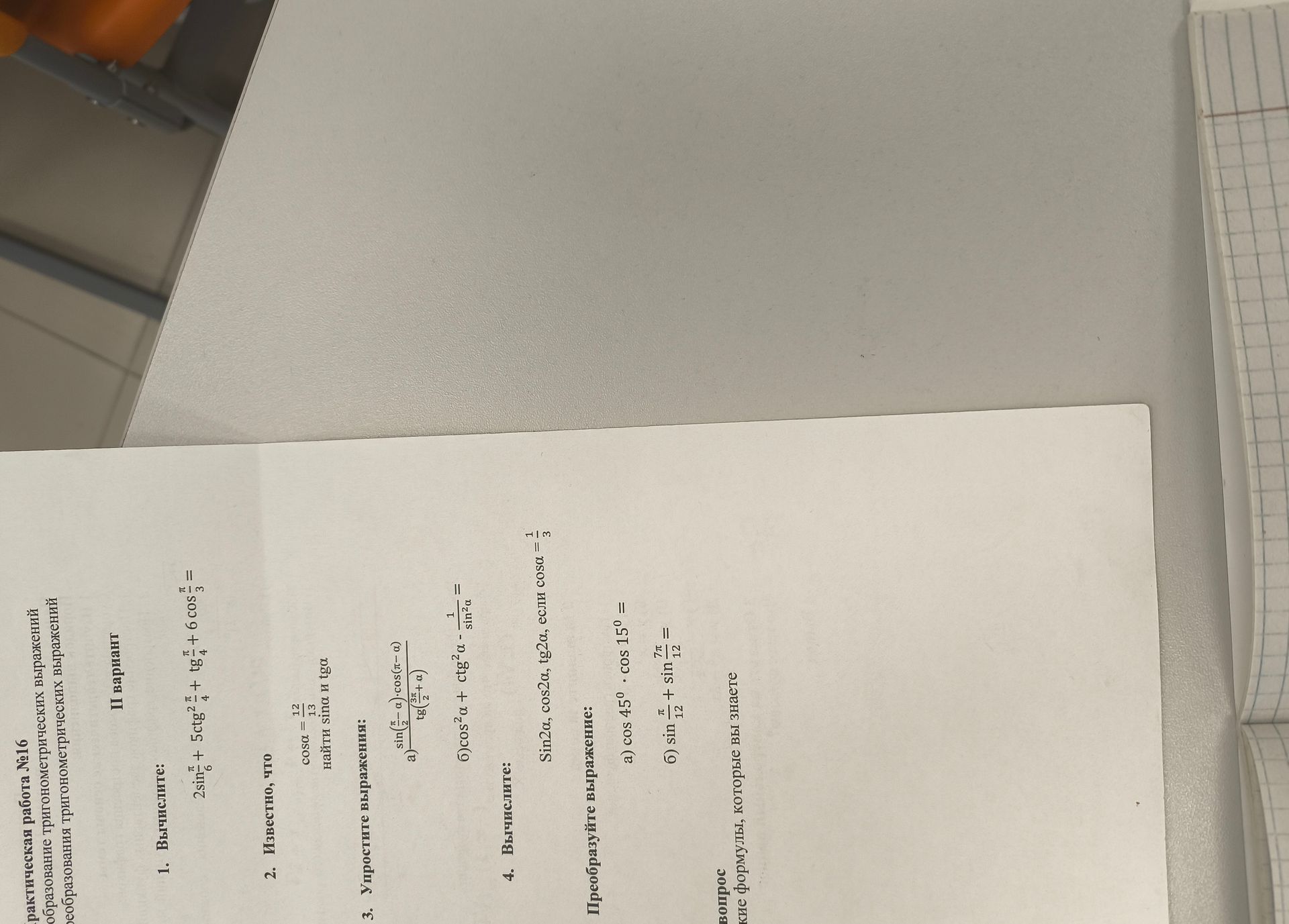
По условию \(\cos\alpha=\frac{1}{3}\). Тогда \(\sin^2\alpha=1-\cos^2\alpha=\frac{8}{9}\), следовательно, \(\sin\alpha=\pm\frac{2\sqrt{2}}{3}\). Знак зависит от четверти угла α.
\[\sin 2\alpha=2\sin\alpha\cos\alpha=\pm\frac{4\sqrt{2}}{9}.\]
\[\cos 2\alpha=2\cos^2\alpha-1=2\cdot\frac{1}{9}-1=-\frac{7}{9}.\]
\[ g 2\alpha=\frac{\sin 2\alpha}{\cos 2\alpha}=\mp\frac{4\sqrt{2}}{7}.\]
Ответ: \(\sin 2\alpha=\pm\frac{4\sqrt{2}}{9}\), \(\cos 2\alpha=-\frac{7}{9}\), \( g 2\alpha=\mp\frac{4\sqrt{2}}{7}\). Если α — острый угол, то синус двойного угла положителен, а тангенс двойного угла отрицателен.
