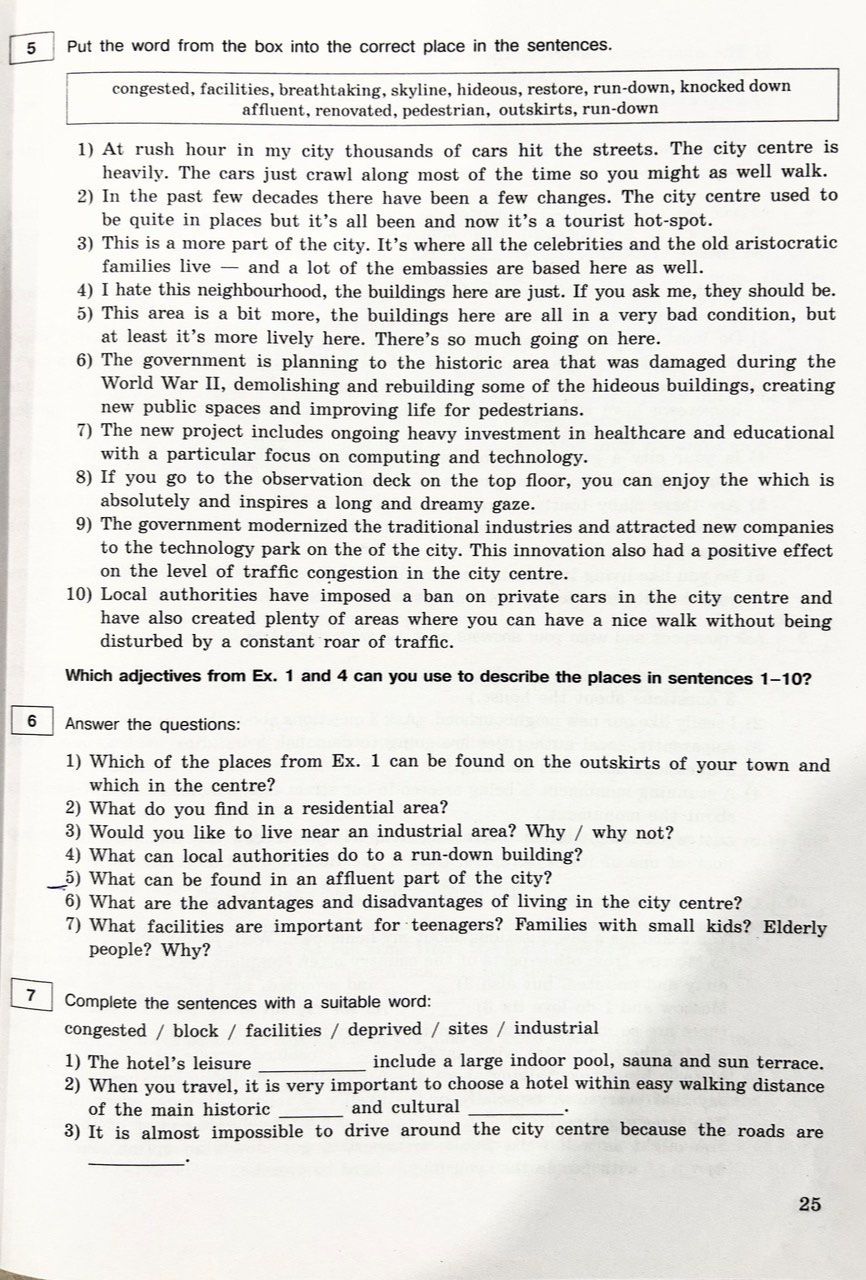
6) Answer the questions: 1) Which of the places from Ex. 1 can be found on the outskirts of your town and which in the centre? 2) What do you find in a residential area? 3) Would you like to live near an industrial area? Why / why not? 4) What can local authorities do to a run-down building? 5) What can be found in an affluent part of the city? 6) What are the advantages and disadvantages of living in the city centre? 7) What facilities are important for teenagers? Families with small kids? Elderly people? Why?
- On the outskirts of my town there are usually industrial areas, warehouses and large shopping centres. In the centre there are offices, shops, cafés, museums, historic buildings and entertainment venues.
- A residential area has houses or blocks of flats, schools, parks, playgrounds, supermarkets and other local services.
- No, I would not like to live near an industrial area because it can be noisy and polluted, and there may be heavy traffic. However, it can be convenient for people who work there.
- Local authorities can renovate or restore it, improve its appearance and use it for a new purpose. If it is unsafe, they can knock it down.
- An affluent part of the city may have expensive houses, luxury shops, fashionable restaurants, private schools, embassies and well-maintained parks.
- Advantages include good transport, many shops and facilities, cultural attractions and plenty of entertainment. Disadvantages include traffic congestion, noise, pollution, high prices and crowds.
- Teenagers need sports centres, cinemas, cafés, libraries, schools, youth clubs and places to meet friends. Families with small children need schools, nurseries, playgrounds, parks, clinics and safe pedestrian areas. Elderly people need medical centres, pharmacies, supermarkets, benches, parks and convenient public transport. These facilities make everyday life safer, easier and more comfortable.

 Алгебра
 Английский
 Биология
 География
 Геометрия
 История
 Русский
 Обществознание
 Физика
 Химия
Химия Информатика
 Литература
 Математика