
 Алгебра
 Английский
 Биология
 География
 Геометрия
 История
 Русский
 Обществознание
 Физика
 Химия
Химия Информатика
 Литература
 Математика
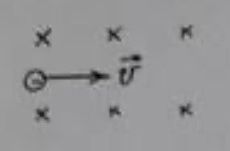
A charged particle with velocity \( \vec{v} \) enters a magnetic field directed into the page. What is the direction of the magnetic force on the particle?
Ответ:
The image shows a charged particle moving with velocity \( \vec{v} \) to the right, entering a magnetic field that is directed into the page (represented by the crosses).
To determine the direction of the magnetic force, we use the right-hand rule for the magnetic force on a moving charge:
- Point your fingers in the direction of the velocity \( \vec{v} \) (to the right).
- Curl your fingers towards the direction of the magnetic field \( \vec{B} \) (into the page).
- Your thumb will point in the direction of the magnetic force \( \vec{F} \) if the charge is positive, or in the opposite direction if the charge is negative.
Assuming the particle is positively charged:
- Fingers point right.
- Curl fingers into the page.
- Thumb points upwards.
Assuming the particle is negatively charged:
- Fingers point right.
- Curl fingers into the page.
- Thumb points downwards (opposite of the positive charge case).
Without knowing the sign of the charge, we can only determine the direction relative to the velocity and magnetic field.
If the charge is positive, the force is upwards.
If the charge is negative, the force is downwards.
Note: The image itself does not specify the sign of the charge. However, if we assume a standard convention where the circle with a dot represents a positive charge and the arrow is its velocity, then the force would be upwards.
