
 Алгебра
 Английский
 Биология
 География
 Геометрия
 История
 Русский
 Обществознание
 Физика
 Химия
Химия Информатика
 Литература
 Математика
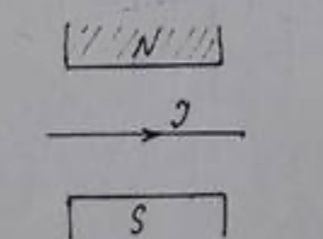
A current-carrying conductor is placed between the North (N) and South (S) poles of a magnet. What happens to the conductor?
Ответ:
Analysis:
The image shows a bar magnet with its North (N) and South (S) poles indicated. Between these poles, a conductor is placed, and an arrow indicates the direction of current flow through it. This setup describes a scenario where a current-carrying conductor is placed in a magnetic field.
According to the principles of electromagnetism, specifically the Lorentz force, a current-carrying conductor placed in a magnetic field experiences a force. The direction of this force is perpendicular to both the direction of the current and the direction of the magnetic field. This phenomenon is often demonstrated by the motor effect.
The magnetic field lines travel from the North pole to the South pole. The current is flowing from left to right. Using Fleming's Left-Hand Rule (which relates the direction of magnetic field, current, and the resulting force), we can determine the direction of the force on the conductor.
Fleming's Left-Hand Rule:
- First finger: Direction of the magnetic field (North to South).
- Second finger: Direction of the current (left to right).
- Thumb: Direction of the force.
Applying this rule, with the magnetic field going downwards (from N to S) and the current going to the right, the thumb points outwards from the plane of the image (or upwards, depending on the orientation of the magnet relative to the plane of the image).
Conclusion:
The current-carrying conductor will experience a force and move. The direction of the force can be determined by Fleming's Left-Hand Rule.
Answer: The conductor will experience a force and move.
