
 Алгебра
 Английский
 Биология
 География
 Геометрия
 История
 Русский
 Обществознание
 Физика
 Химия
Химия Информатика
 Литература
 Математика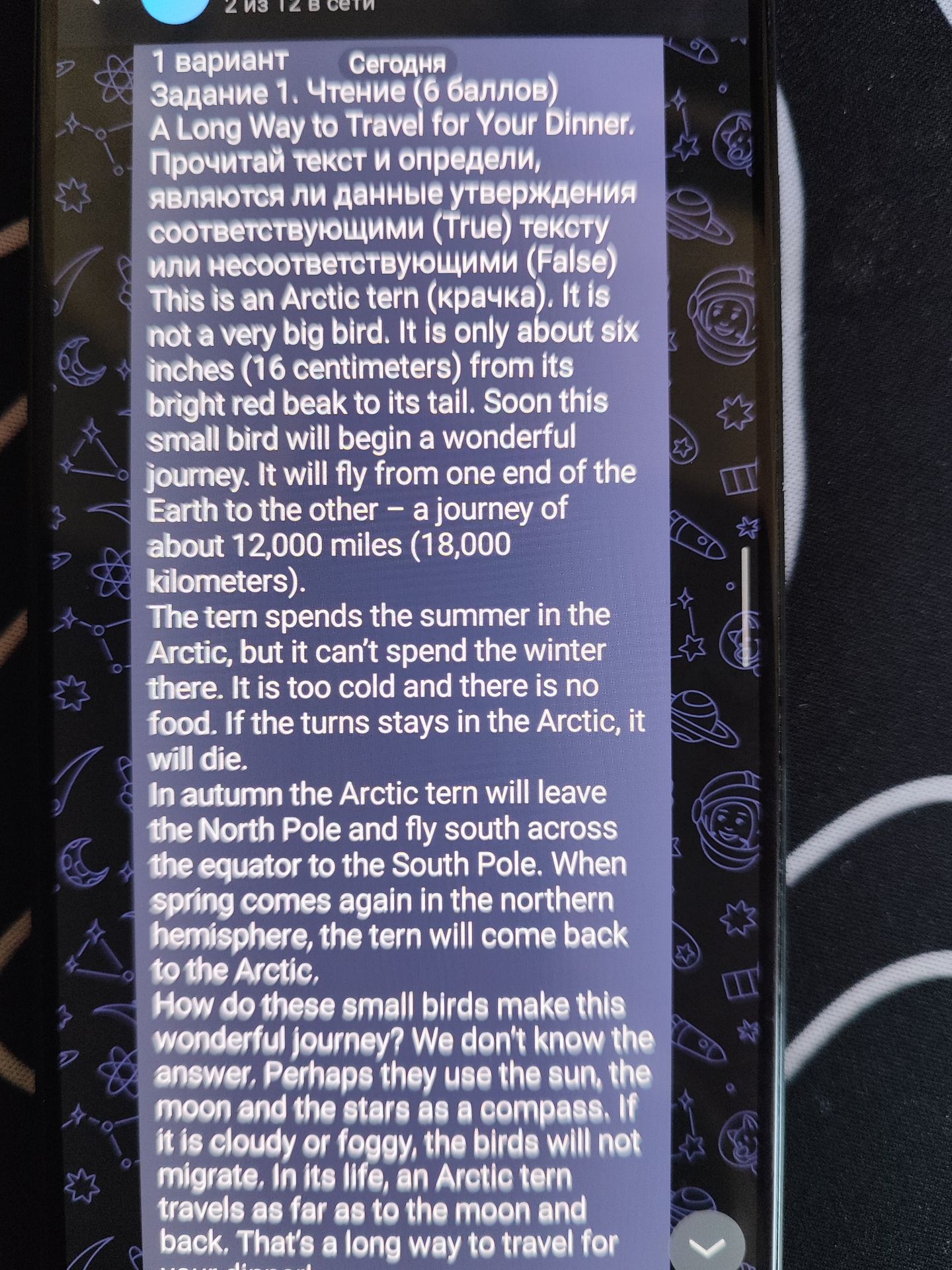
Ответ:
Решение:
Прочитаем текст и определим истинность утверждений.
- Утверждение 1: «Эта птица — полярная крачка (Arctic tern)».
В тексте сказано: «This is an Arctic tern (крачка)». Следовательно, это утверждение True. - Утверждение 2: «Это очень большая птица».
В тексте сказано: «It is not a very big bird». Это означает, что птица не очень большая. Следовательно, это утверждение False. - Утверждение 3: «Длина птицы от клюва до хвоста составляет около 16 сантиметров».
В тексте сказано: «It is only about six inches (16 centimeters) from its bright red beak to its tail». Следовательно, это утверждение True. - Утверждение 4: «Полярная крачка проводит зиму в Арктике, потому что там есть пища».
В тексте сказано: «The tern spends the summer in the Arctic, but it can't spend the winter there. It is too cold and there is no food.» Это означает, что крачка не может проводить зиму в Арктике из-за холода и отсутствия пищи. Следовательно, это утверждение False. - Утверждение 5: «Осенью полярная крачка летит на юг, пересекая экватор, к Южному полюсу».
В тексте сказано: «In autumn the Arctic tern will leave the North Pole and fly south across the equator to the South Pole». Следовательно, это утверждение True. - Утверждение 6: «Полярная крачка использует солнце, луну и звезды как компас».
В тексте сказано: «Perhaps they use the sun, the moon and the stars as a compass.» Это предположение, а не факт. Тем не менее, текст предполагает такую возможность. Следовательно, это утверждение True. - Утверждение 7: «Если облачно или туманно, птицы будут мигрировать».
В тексте сказано: «If it is cloudy or foggy, the birds will not migrate». Это означает, что они НЕ будут мигрировать. Следовательно, это утверждение False. - Утверждение 8: «За всю жизнь полярная крачка пролетает расстояние, равное полету на Луну и обратно».
В тексте сказано: «In its life, an Arctic tern travels as far as to the moon and back.» Следовательно, это утверждение True.
Ответ: 1 - True, 2 - False, 3 - True, 4 - False, 5 - True, 6 - True, 7 - False, 8 - True.
