
 Алгебра
 Английский
 Биология
 География
 Геометрия
 История
 Русский
 Обществознание
 Физика
 Химия
Химия Информатика
 Литература
 Математика
Вопрос:
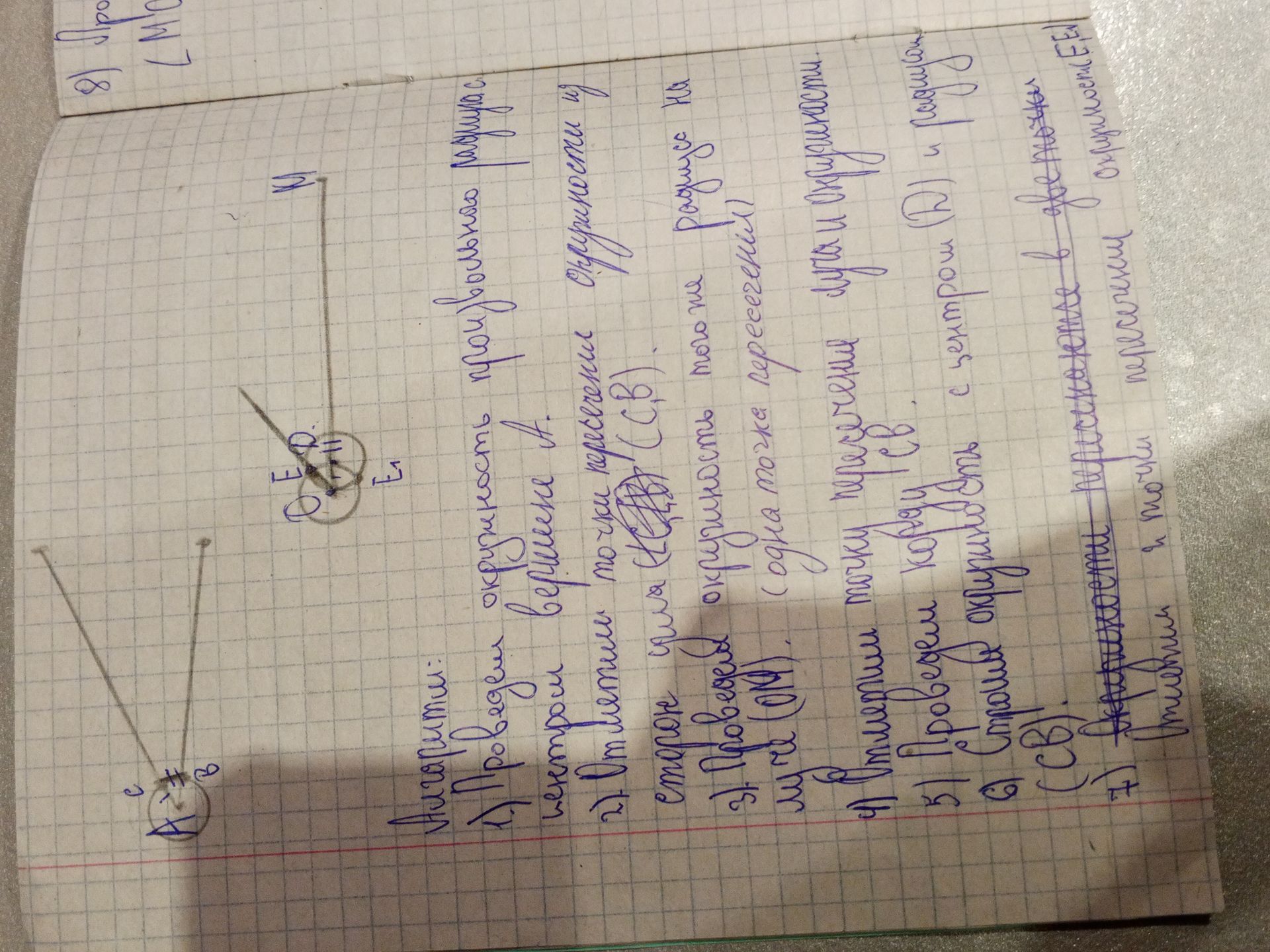
Algorithm: 1) Draw a circle with an arbitrary radius centered at vertex A. 2) Mark the points of intersection of the circle with the rays CA and CB. 3) Draw a circle with center D and radius CB. 4) Mark the point of intersection of the ray and the circle. 5) Draw a chord CB. 6) Construct a circle with center D and radius (CB). 7) The circles intersect at two points.
Ответ:
Algorithm:
- Draw a circle with an arbitrary radius centered at vertex A. This step establishes a consistent distance from point A to points on the circle.
- Mark the points of intersection of the circle with the rays CA and CB. Let's call these points E and F respectively. This ensures that AE = AF, and both are equal to the chosen radius.
- Draw a circle with center D and radius CB. This instruction seems to be part of a different construction or a misunderstanding, as point D is not defined in the preceding steps, and the radius CB is not directly related to the current construction based on point A. Assuming this is a separate or a misstated step, we will proceed with the primary goal of constructing something related to A, C, and B.
- Mark the point of intersection of the ray and the circle. This refers to finding a specific point where a ray (likely from A, C, or B) meets a previously drawn circle. Without knowing which ray and which circle, this step is ambiguous.
- Draw a chord CB. This connects points C and B.
- Construct a circle with center D and radius (CB). Again, point D is undefined. If we assume D is the midpoint of CB, then this step would be constructing a circle passing through C and B.
- The circles intersect at two points. This is a general statement about circle intersections.
Note: The provided text appears to describe steps for geometric constructions, but there are ambiguities and potential errors in the sequence and definition of points (like 'D'). If the goal is to construct an angle bisector, for example, the steps would be different. If it's to construct a perpendicular bisector of CB, point D would be defined differently. Based on the elements present (rays from A, chord CB, circles), it's hard to pinpoint a single, clear construction without further clarification.
