
 Алгебра
 Английский
 Биология
 География
 Геометрия
 История
 Русский
 Обществознание
 Физика
 Химия
Химия Информатика
 Литература
 Математика
Вопрос:
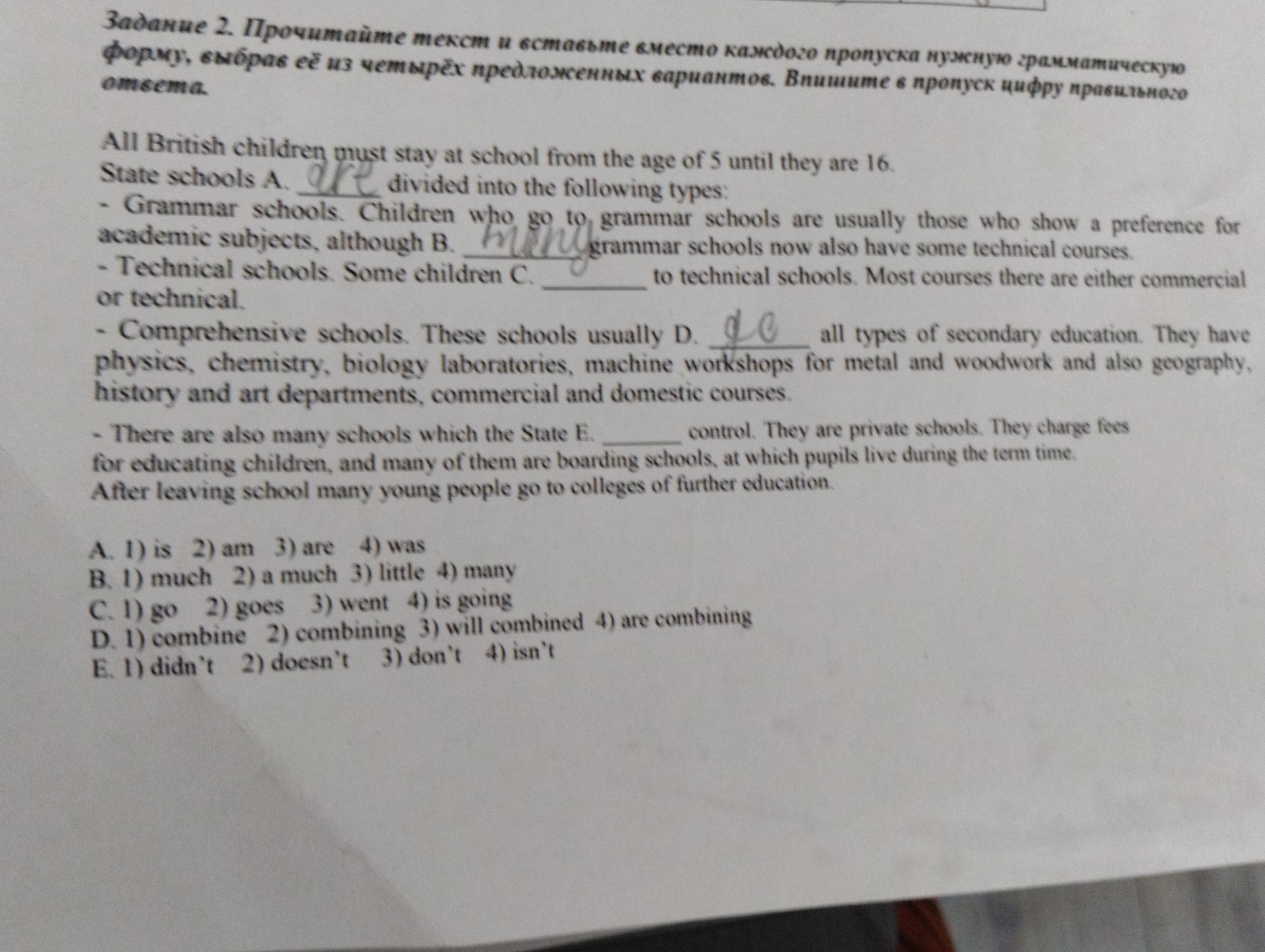
All British children must stay at school from the age of 5 until they are 16. State schools A. ______ divided into the following types: - Grammar schools. Children who go to grammar schools are usually those who show a preference for academic subjects, although B. ____ grammar schools now also have some technical courses. - Technical schools. Some children C. ______ to technical schools. Most courses there are either commercial or technical. - Comprehensive schools. These schools usually D. ______ all types of secondary education. They have physics, chemistry, biology laboratories, machine workshops for metal and woodwork and also geography, history and art departments, commercial and domestic courses. - There are also many schools which the State E. ______ control. They are private schools. They charge fees for educating children, and many of them are boarding schools, at which pupils live during the term time. After leaving school many young people go to colleges of further education. A. 1) is 2) am 3) are 4) was B. 1) much 2) a much 3) little 4) many C. 1) go 2) goes 3) went 4) is going D. 1) combine 2) combining 3) will combined 4) are combining E. 1) didn't 2) doesn't 3) don't 4) isn't
Ответ:
Решение:
Задание требует вставить пропущенные слова в текст, выбирая подходящий вариант из предложенных.
- A. are: Перед нами подлежащее "State schools" (множественное число). Сказуемое "divided" должно согласовываться с ним. Вариант "are" (3) подходит.
- B. many: Речь идет о количестве школ. "Grammar schools" - множественное число. "many" (4) используется для исчисляемых существительных во множественном числе.
- C. go: "Some children" - множественное число. Глагол "go" (1) в настоящем времени, единственном числе, должен согласовываться с подлежащим.
- D. combine: "These schools" - множественное число. Глагол "combine" (1) в настоящем времени, множественном числе, подходит для описания того, что делают школы.
- E. don't: "many schools" - множественное число. Глагол "control" нуждается в вспомогательном глаголе "do" или "does" для отрицания. "don't" (3) подходит для множественного числа.
Ответ: A. 3, B. 4, C. 1, D. 1, E. 3
