
 Алгебра
 Английский
 Биология
 География
 Геометрия
 История
 Русский
 Обществознание
 Физика
 Химия
Химия Информатика
 Литература
 Математика
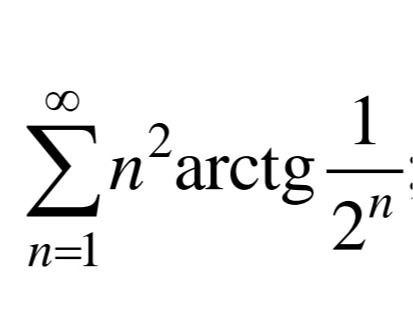
Analyze the following mathematical expression: \( \sum_{n=1}^{\infty} n^2 \arctan \frac{1}{2^n} \)
Ответ:
Analysis of the Series:
The given expression is an infinite series:
\( S = \sum_{n=1}^{\infty} n^2 \arctan \frac{1}{2^n} \)
This series involves a term that includes a power of \( n \) multiplied by the arctangent of a function of \( n \). Determining the exact sum of such a series can be complex and often requires advanced techniques, such as integral representations, generating functions, or specific summation methods. For many such series, a closed-form solution may not exist or be easily obtainable.
To analyze the convergence, we can consider the behavior of the terms as \( n \to \infty \). Since \( \frac{1}{2^n} \to 0 \) as \( n \to \infty \), we can use the approximation \( \arctan(x) \approx x \) for small \( x \). Therefore, for large \( n \), the terms behave approximately as:
\( a_n \approx n^2
\cdot \frac{1}{2^n} = \frac{n^2}{2^n} \)
We can use the Ratio Test to check for convergence of \( \sum \frac{n^2}{2^n} \):
\( \lim_{n \to \infty} \left| \frac{a_{n+1}}{a_n} \right| = \lim_{n \to \infty} \left| \frac{(n+1)^2}{2^{n+1}}
\cdot \frac{2^n}{n^2} \right| = \lim_{n \to \infty} \frac{(n+1)^2}{2n^2} = \lim_{n \to \infty} \frac{n^2 + 2n + 1}{2n^2} = \lim_{n \to \infty} \left( \frac{1}{2} + \frac{1}{n} + \frac{1}{2n^2} \right) = \frac{1}{2} \)
Since the limit is \( \frac{1}{2} < 1 \), the series \( \sum \frac{n^2}{2^n} \) converges. By the Limit Comparison Test, the original series \( \sum_{n=1}^{\infty} n^2 \arctan \frac{1}{2^n} \) also converges.
Finding the precise value of the sum is beyond standard calculus techniques. It might involve Fourier series, complex analysis, or special functions.
Conclusion: The series converges. A closed-form expression for the sum is not straightforwardly obtainable through elementary methods.
