
 Алгебра
 Английский
 Биология
 География
 Геометрия
 История
 Русский
 Обществознание
 Физика
 Химия
Химия Информатика
 Литература
 Математика
Вопрос:
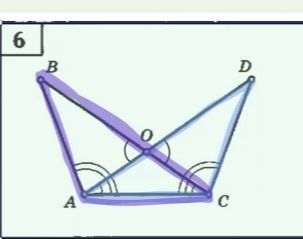
Analyze the given image and provide a detailed geometric analysis of the figure. The image contains a quadrilateral ABCD with diagonals AC and BD intersecting at point O. Angles BAC and CAD are marked with a single arc, indicating they are equal. Angles ACB and ACD are marked with a double arc, indicating they are equal.
Ответ:
Geometric Analysis:
The image displays a quadrilateral ABCD where the diagonals AC and BD intersect at point O.
Given angle markings:
- \(\angle BAC = \angle CAD\) (marked with a single arc)
- \(\angle ACB = \angle ACD\) (marked with a double arc)
From these markings, we can deduce the following:
- Angle Bisectors: Diagonal AC bisects \(\angle BAD\) and \(\angle BCD\) if AC were the angle bisector of these angles. However, the markings indicate that AC is the angle bisector of \(\angle BAD\) and \(\angle BCD\) only if O lies on AC and these angles are specified. The given markings indicate that AC itself is the angle bisector of \(\angle BAD\) and \(\angle BCD\) if A, O, C are collinear. The current markings imply that the diagonal AC bisects \(\angle BAD\) and \(\angle BCD\).
- Congruent Triangles: Consider \(\triangle ABO\) and \(\triangle ADO\). We have \(\angle BAO = \angle DAO\) and \(\angle OAB = \angle OAD\). We also have \(\angle BAC = \angle DAC\).
- Consider \(\triangle CBO\) and \(\triangle CDO\). We have \(\angle BCO = \angle DCO\) and \(\angle OCB = \angle OCD\). We also have \(\angle ACB = \angle ACD\).
- Properties of the Quadrilateral: Since the diagonal AC bisects \(\angle BAD\) and \(\angle BCD\), the quadrilateral ABCD has the property that one of its diagonals is an angle bisector of two opposite angles. This implies that the quadrilateral is a kite if the other diagonal is perpendicular to this one and bisects it, or if two pairs of adjacent sides are equal. However, based solely on the angle bisector property of one diagonal, we can conclude that \(\triangle ABD\) and \(\triangle CBD\) are isosceles triangles if AC is also the perpendicular bisector of BD.
- If \(\angle BAC = \angle CAD\) and \(\angle BCA = \angle DCA\), then \(\triangle ABC \cong \triangle ADC\) by ASA congruence if \(AC=AC\) is common side. This is not the case here.
- Consider \(\triangle ABC\) and \(\triangle ADC\). We have \(\angle BAC = \angle DAC\) and \(\angle BCA = \angle DCA\). If AC is a common side, then by ASA, \(\triangle ABC \cong \triangle ADC\). This would imply AB=AD and CB=CD. Therefore, ABCD is a kite.
- In a kite, the diagonals are perpendicular. Thus, \(\angle AOB = 90^{\circ}\). Also, one diagonal is the perpendicular bisector of the other. In this case, AC is the axis of symmetry.
- Angles at O: \(\angle AOB = \angle COB\) if AC is perpendicular bisector of BD. \(\angle AOD = \angle COD\) if AC is perpendicular bisector of BD.
- The vertically opposite angles are \(\angle AOB = \angle COD\) and \(\angle BOC = \angle AOD\).
- Given \(\angle BAC = \angle DAC\) and \(\angle BCA = \angle DCA\). In \(\triangle ABC\) and \(\triangle ADC\), we have AC as a common side. By ASA criterion, \(\triangle ABC \cong \triangle ADC\). This implies AB = AD and BC = DC. Thus, ABCD is a kite.
- In a kite, the diagonal AC is the axis of symmetry, and it bisects the angles \(\angle BAD\) and \(\angle BCD\). This is consistent with the given information.
- Also, in a kite, the diagonals are perpendicular. Therefore, \(\angle AOB = 90^{\circ}\).
Conclusion: Based on the given angle markings, the quadrilateral ABCD is a kite. The diagonal AC bisects \(\angle BAD\) and \(\angle BCD\), and the diagonals AC and BD are perpendicular.
