
 Алгебра
 Английский
 Биология
 География
 Геометрия
 История
 Русский
 Обществознание
 Физика
 Химия
Химия Информатика
 Литература
 Математика
Вопрос:
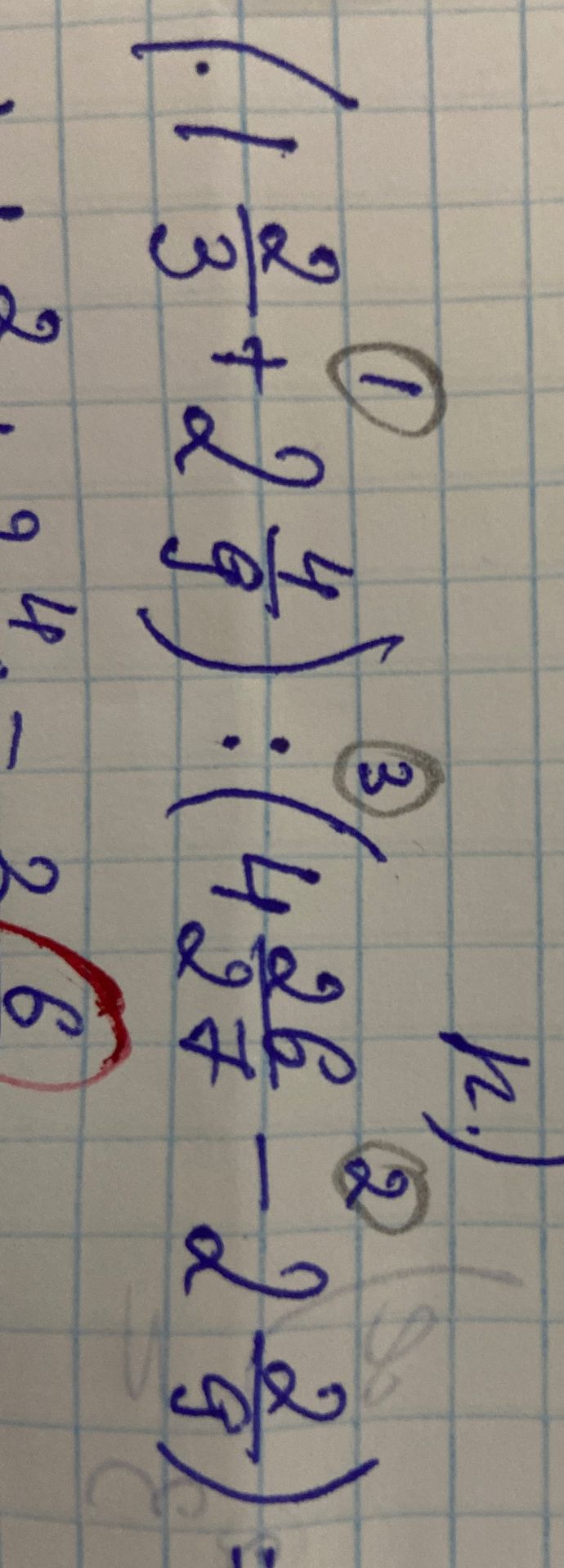
Analyze the mathematical expressions in the image and provide a structured breakdown of each, including any associated numbering or symbols.
Ответ:
Mathematical Expressions Analysis
The image contains several mathematical expressions and notations, seemingly from a math assignment or notes.
Expression 1:
- The expression is labeled with the number
①. - It begins with a fraction:
\( \frac{1}{3} \). - This is followed by an addition symbol:
+. - The next term is a fraction:
\( \frac{2}{9} \). - The entire expression is enclosed in parentheses:
( \( \frac{1}{3} \) + \( \frac{2}{9} \) ). - This parenthesized expression is followed by a division symbol:
\(\cdot\)(appears to be a multiplication dot, but context suggests division).
Expression 2:
- This expression is labeled with the number
③. - It starts with a fraction:
\( \frac{4}{9} \). - This fraction is enclosed in parentheses:
( \( \frac{4}{9} \) ). - This is followed by a division symbol:
\(\cdot\)(appears to be a multiplication dot, but context suggests division). - The next part is a fraction:
\( \frac{4}{26} \)which simplifies to\( \frac{2}{13} \). - This is followed by a subtraction symbol:
-. - Finally, there is a fraction:
\( \frac{1}{6} \). - The entire expression is enclosed in parentheses:
( \( \frac{4}{9} \) \(\cdot\) \( \frac{4}{26} \) - \( \frac{1}{6} \) ).
Expression 3:
- This expression is labeled with the number
②. - It starts with a fraction:
\( \frac{5}{21} \). - This fraction is enclosed in parentheses:
( \( \frac{5}{21} \) ).
Other Notations:
- A number
6is circled in red. - The Roman numeral
XIis written to the right, with a curved line underneath. - There are other handwritten numbers and symbols that are less clear or potentially part of other problems (e.g.,
2,4,1).
