
 Алгебра
 Английский
 Биология
 География
 Геометрия
 История
 Русский
 Обществознание
 Физика
 Химия
Химия Информатика
 Литература
 Математика
Вопрос:
Analyze the provided image and extract the key instructions and concepts related to physics experiments.
Ответ:
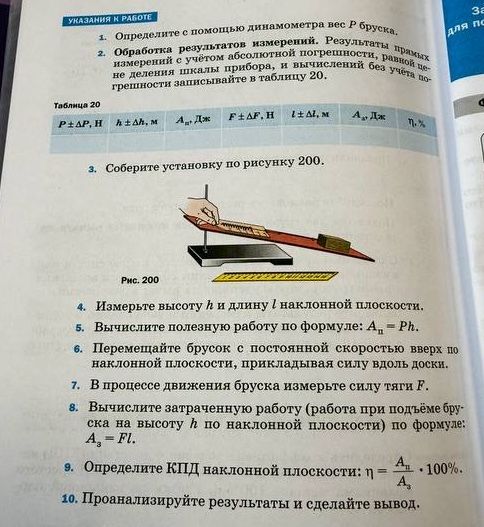
This document outlines a physics experiment focused on understanding inclined planes and efficiency.
Instructions for the Experiment:
- Determine the weight of the object (Р бруска) using a dynamometer.
- Process measurement results: Record results of direct measurements, including absolute error (equal to the smallest scale division of the instrument), and calculations without considering error, in Table 20.
- Set up the experiment according to Figure 200.
- Measure the height (h) and length (l) of the inclined plane.
- Calculate the useful work done using the formula: \( A_{\text{n}} = P \times h \)
- Move the object at a constant speed up the inclined plane, applying force parallel to the plane.
- Measure the pulling force (F) during the object's movement.
- Calculate the work done (work to lift the object to height h along the inclined plane) using the formula: \( A_{3} = F \times l \)
- Determine the efficiency (КПД) of the inclined plane using the formula: \( \eta = \frac{A_{\text{n}}}{A_{3}} \times 100\% \)
- Analyze the results and draw a conclusion.
Table 20 Headers:
- \( P \pm \Delta P, \text{ H} \)
- \( h \pm \Delta h, \text{ m} \)
- \( A_{\text{n}}, \text{ Дж} \)
- \( F \pm \Delta F, \text{ H} \)
- \( l \pm \Delta l, \text{ m} \)
- \( A_{3}, \text{ Дж} \)
- \( \eta, \% \)
