
 Алгебра
 Английский
 Биология
 География
 Геометрия
 История
 Русский
 Обществознание
 Физика
 Химия
Химия Информатика
 Литература
 Математика
Based on the image, identify the angles and their measurements, and determine which statement is true.
Ответ:
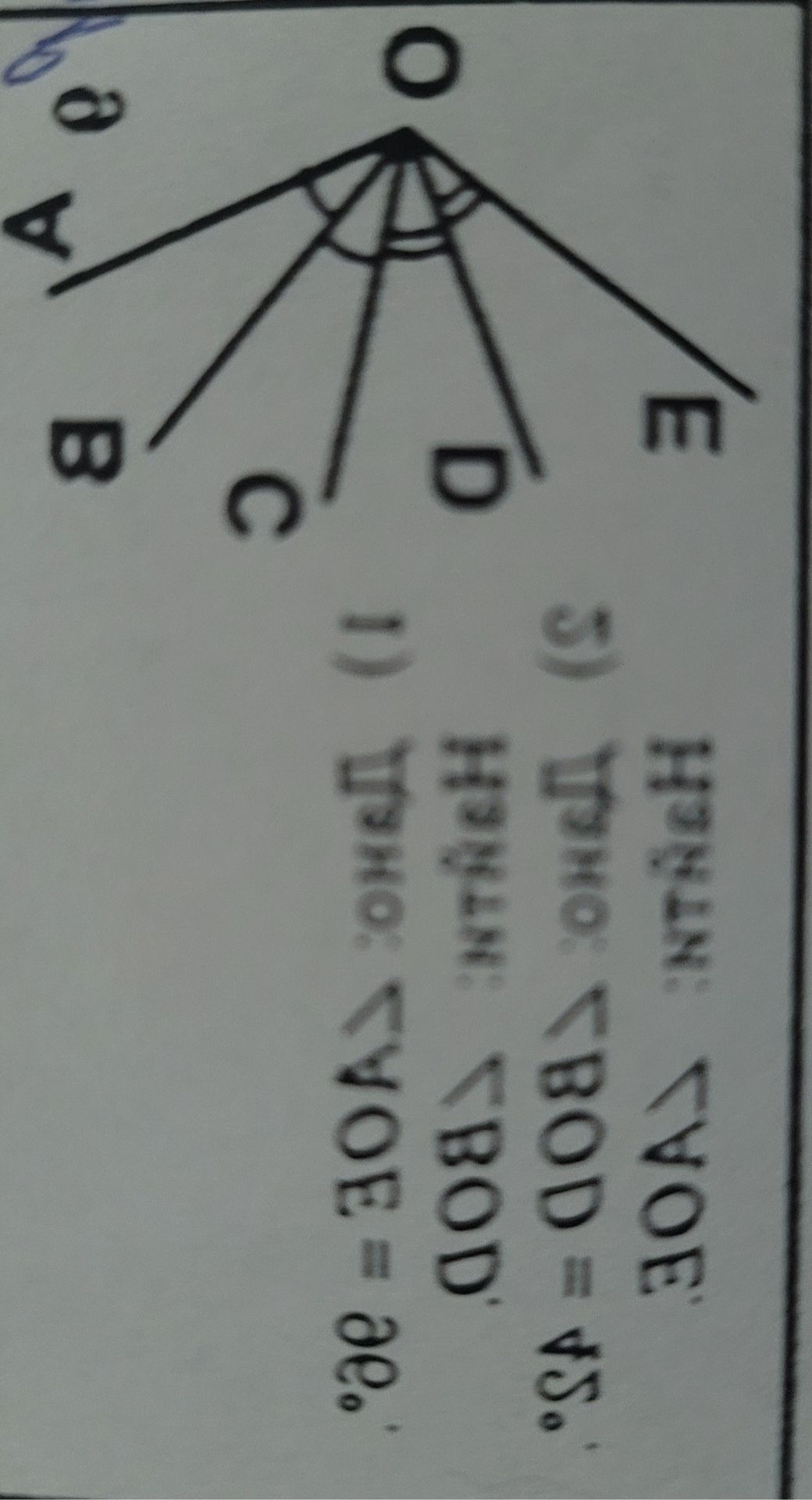
Analysis of the image:
The image displays a diagram of angles originating from point O. Several rays OA, OB, OC, OD, and OE are shown. Arcs indicate the measures of some angles. Text below the diagram provides two statements with angle measurements.
Given Information:
- Statement 1: \( \angle VOE = 90^{\circ} \)
- Statement 2: \( \angle BOD = 45^{\circ} \)
Note: The text contains symbols that appear to be Cyrillic letters and numbers, which have been interpreted based on their visual representation in the context of angles and measurements.
Solving the problem:
From the diagram, we observe the following angle markings:
- The angle between OC and OD appears to be equal to the angle between OD and OE. Let's denote this angle as \( x \).
- The angle between OB and OC appears to be equal to the angle between OC and OD. Thus, the angle between OB and OC is also \( x \).
- The angle between OA and OB appears to be equal to the angle between OB and OC. Thus, the angle between OA and OB is also \( x \).
This implies that the angles \( \angle AOB \), \( \angle BOC \), \( \angle COD \), and \( \angle DOE \) are all equal.
Let's analyze the given statements:
- Statement 1: \( \angle VOE = 90^{\circ} \)
Assuming the angle is \( \angle AOE \) as there is no ray 'V' and the text might be a misinterpretation, and given that \( \angle AOB = \angle BOC = \angle COD = \angle DOE = x \), then \( \angle AOE = \angle AOB + \angle BOC + \angle COD + \angle DOE = x + x + x + x = 4x \). If \( \angle AOE = 90^{\circ} \), then \( 4x = 90^{\circ} \), which means \( x = 22.5^{\circ} \). - Statement 2: \( \angle BOD = 45^{\circ} \)
From the diagram, \( \angle BOD = \angle BOC + \angle COD \). Since \( \angle BOC = x \) and \( \angle COD = x \), then \( \angle BOD = x + x = 2x \). If \( \angle BOD = 45^{\circ} \), then \( 2x = 45^{\circ} \), which means \( x = 22.5^{\circ} \).
Both statements lead to the same value for \( x \) which is \( 22.5^{\circ} \). This indicates consistency.
Let's re-examine the text carefully. The text seems to be in a language other than English. Based on the visual cues and common mathematical notation:
- The first line of text under the diagram reads: `1) (1) ТЯНО: ∠VOE = 90°` . Assuming 'ТЯНО' is some sort of label or identifier and 'VOE' is a typo for 'AOE', and the degree symbol is correctly interpreted, this statement is \( \angle AOE = 90^{\circ} \).
- The second line reads: `3) ТЯНО: ∠BOD = 45°` . Assuming 'ТЯНО' is again a label and 'BOD' is interpreted correctly, this statement is \( \angle BOD = 45^{\circ} \).
If we assume that the angles \( \angle AOB, \angle BOC, \angle COD, \angle DOE \) are all equal (as suggested by the tick marks on the arcs), let each of these angles be \( y \).
Then \( \angle BOD = \angle BOC + \angle COD = y + y = 2y \).
And \( \angle AOE = \angle AOB + \angle BOC + \angle COD + \angle DOE = y + y + y + y = 4y \).
According to Statement 2, \( \angle BOD = 45^{\circ} \). Therefore, \( 2y = 45^{\circ} \), which gives \( y = 22.5^{\circ} \).
According to Statement 1, \( \angle AOE = 90^{\circ} \). Let's check if this is consistent with \( y = 22.5^{\circ} \).
If \( y = 22.5^{\circ} \), then \( \angle AOE = 4y = 4 \times 22.5^{\circ} = 90^{\circ} \).
Since both statements are consistent with the assumption that the four angles \( \angle AOB, \angle BOC, \angle COD, \angle DOE \) are equal, we can conclude that both statements are true based on the visual representation and the provided measurements.
Conclusion: Based on the diagram and the provided statements, both \( \angle AOE = 90^{\circ} \) and \( \angle BOD = 45^{\circ} \) are consistent with the equal division of the angles as shown by the markings.
