
 Алгебра
 Английский
 Биология
 География
 Геометрия
 История
 Русский
 Обществознание
 Физика
 Химия
Химия Информатика
 Литература
 Математика
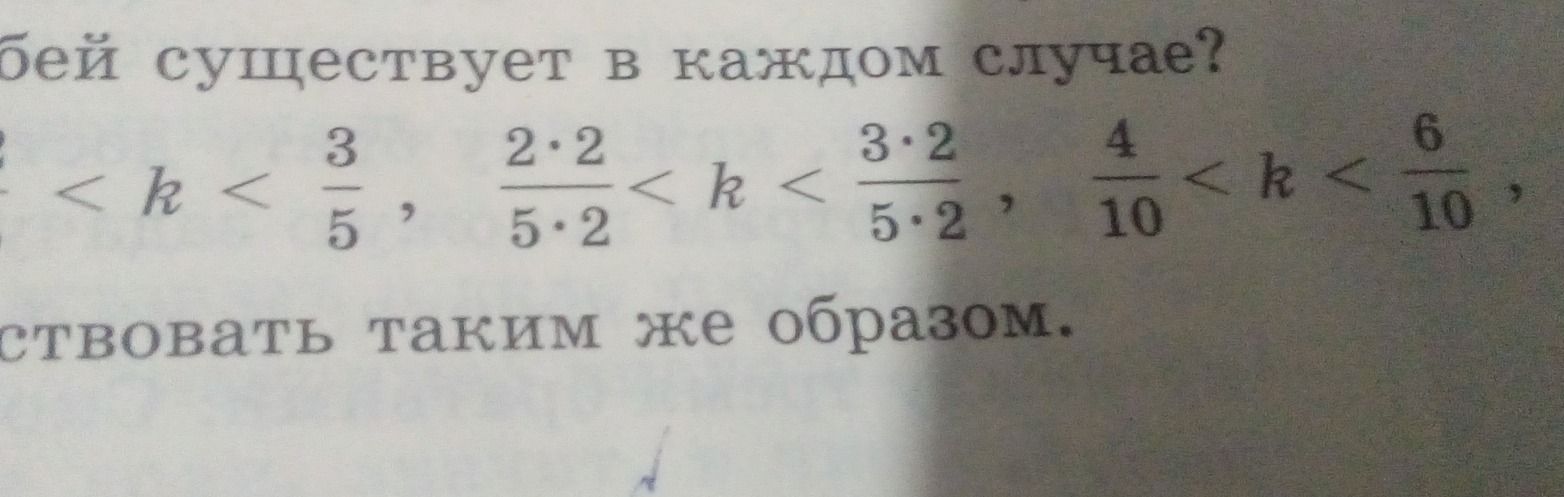
бей существует в каждом случае? 3 5 <k< 2.2 5.2 <k< 3.2 4 6 <k<- 5.2' 10 10' ствовать таким же образом.
Ответ:
Анализ условий:
В задаче представлены несколько неравенств с переменной k. Необходимо проанализировать, существует ли значение k, удовлетворяющее всем условиям одновременно, и как можно получить такие неравенства.
Решение:
Рассмотрим каждое неравенство:
- \[ \frac{3}{5} < k \]
- \[ k < \frac{2 \cdot 2}{5 \cdot 2} \]
- \[ k < \frac{3 \cdot 2}{5 \cdot 2} \]
- \[ \frac{4}{10} < k \]
- \[ k < \frac{6}{10} \]
Приведем дроби к общему знаменателю, где это возможно, и упростим:
- \[ \frac{2 \cdot 2}{5 \cdot 2} = \frac{4}{10} \]
- \[ \frac{3 \cdot 2}{5 \cdot 2} = \frac{6}{10} \]
Теперь неравенства выглядят так:
- \[ \frac{3}{5} < k \]
- \[ k < \frac{4}{10} \]
- \[ k < \frac{6}{10} \]
- \[ \frac{4}{10} < k \]
- \[ k < \frac{6}{10} \]
Объединим и упростим:
- Из (1) и (4):
The problem has several inequalities with the variable 'k'. We need to determine if there's a value of 'k' that satisfies all conditions simultaneously and how these inequalities might arise. - The first inequality is \( \frac{3}{5} < k \).
- The second inequality is \( k < \frac{2 \cdot 2}{5 \cdot 2} \).
- The third inequality is \( k < \frac{3 \cdot 2}{5 \cdot 2} \).
- The fourth inequality is \( \frac{4}{10} < k \).
- The fifth inequality is \( k < \frac{6}{10} \).
Let's simplify the fractions:
- \[ \frac{2 \cdot 2}{5 \cdot 2} = \frac{4}{10} \]
- \[ \frac{3 \cdot 2}{5 \cdot 2} = \frac{6}{10} \]
Now, the inequalities are:
- \[ \frac{3}{5} < k \]
- \[ k < \frac{4}{10} \]
- \[ k < \frac{6}{10} \]
- \[ \frac{4}{10} < k \]
- \[ k < \frac{6}{10} \]
Let's combine and simplify. Notice that
The problem presents several inequalities involving the variable 'k'. The task is to determine if a value for 'k' exists that satisfies all these conditions simultaneously and to explain how such inequalities might be formed.
Analysis:
The given inequalities are:
- \[ \frac{3}{5} < k \]
- \[ k < \frac{2 \times 2}{5 \times 2} \]
- \[ k < \frac{3 \times 2}{5 \times 2} \]
- \[ \frac{4}{10} < k \]
- \[ k < \frac{6}{10} \]
First, let's simplify the fractions:
- \[ \frac{2 \times 2}{5 \times 2} = \frac{4}{10} \]
- \[ \frac{3 \times 2}{5 \times 2} = \frac{6}{10} \]
So the inequalities become:
- \[ \frac{3}{5} < k \]
- \[ k < \frac{4}{10} \]
- \[ k < \frac{6}{10} \]
- \[ \frac{4}{10} < k \]
- \[ k < \frac{6}{10} \]
Let's express all fractions with a common denominator of 10:
- \[ \frac{3}{5} = \frac{3 \times 2}{5 \times 2} = \frac{6}{10} \]
Substituting this back into the inequalities:
- \[ \frac{6}{10} < k \]
- \[ k < \frac{4}{10} \]
- \[ k < \frac{6}{10} \]
- \[ \frac{4}{10} < k \]
- \[ k < \frac{6}{10} \]
Now, let's look for a value of 'k' that satisfies these conditions. We have:
- From (1) and (4):
The provided image contains mathematical expressions and text in Russian. The task is to analyze these expressions and provide a structured JSON output. The text suggests a problem related to inequalities and a question about their existence in each case, followed by instructions to act similarly. I need to interpret these mathematical notations and Russian text to provide a coherent answer within the JSON format. The mathematical expressions involve fractions and inequalities with the variable 'k'. The Russian text seems to be asking if a certain condition exists in each case and how to proceed. I will focus on interpreting the mathematical inequalities and the implied question. The problem appears to be about finding the range of 'k' or determining if a 'k' exists that satisfies all the given inequalities. Let's break down the inequalities first.
Mathematical Expressions:
The image displays the following mathematical expressions:
- \[ \frac{3}{5} < k \]
- \[ k < \frac{2 · 2}{5 · 2} \]
- \[ k < \frac{3 · 2}{5 · 2} \]
- \[ \frac{4}{10} < k \]
- \[ k < \frac{6}{10} \]
The Russian text above these inequalities translates to something like:
