
 Алгебра
 Английский
 Биология
 География
 Геометрия
 История
 Русский
 Обществознание
 Физика
 Химия
Химия Информатика
 Литература
 Математика
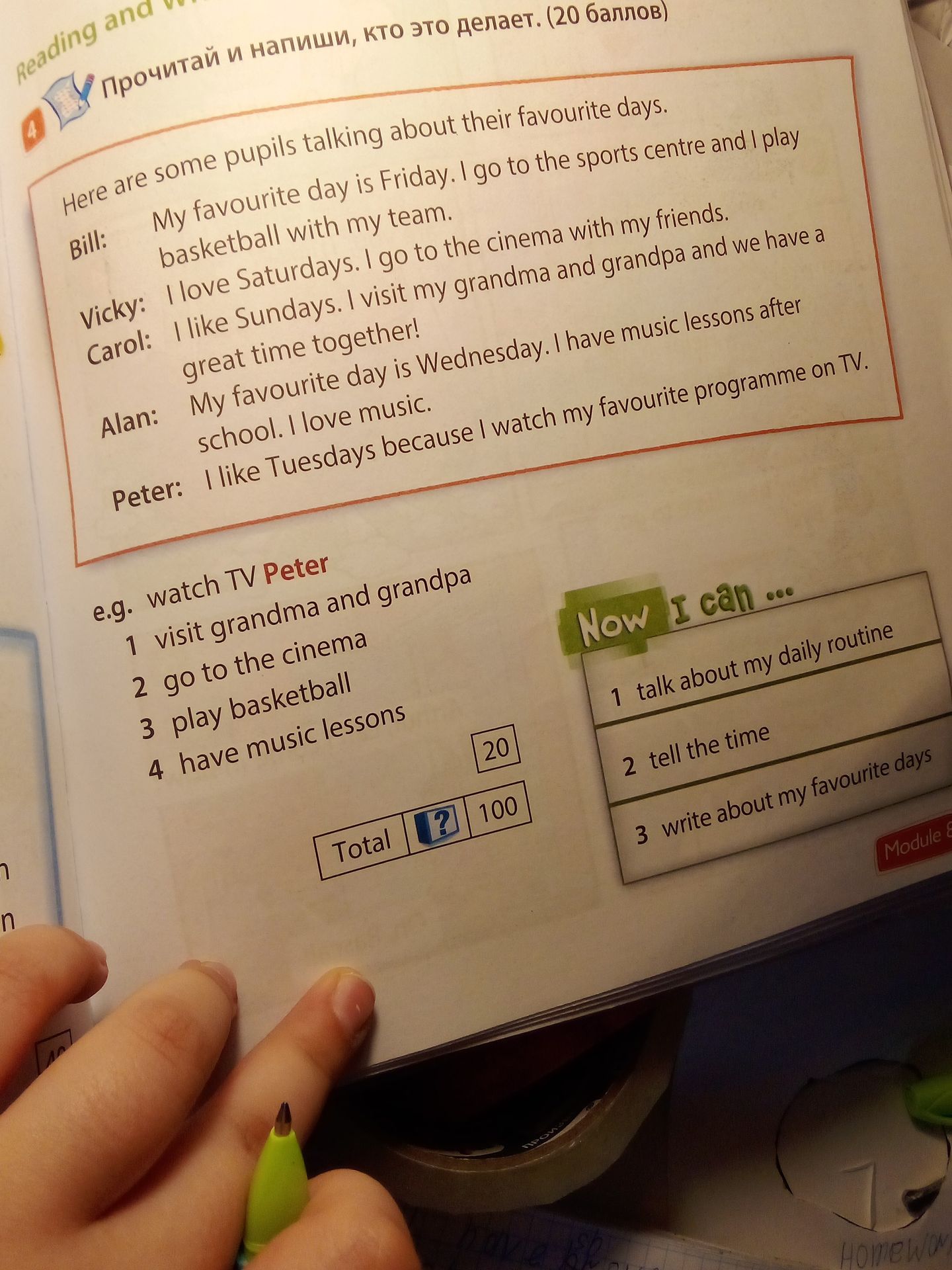
Bill: My favourite day is Friday. I go to the sports centre and I play basketball with my team. Vicky: I love Saturdays. I go to the cinema with my friends. Carol: I like Sundays. I visit my grandma and grandpa and we have a great time together! Alan: My favourite day is Wednesday. I have music lessons after school. I love music. Peter: I like Tuesdays because I watch my favourite programme on TV. e.g. watch TV Peter 1 visit grandma and grandpa 2 go to the cinema 3 play basketball 4 have music lessons
Ответ:
Ответ (EN)
- 1. She visits her grandma and grandpa. (Peter likes Tuesdays because he watches TV, so this is not about Peter)
- 2. She goes to the cinema. (Peter likes Tuesdays because he watches TV, so this is not about Peter)
- 3. She plays basketball. (Peter likes Tuesdays because he watches TV, so this is not about Peter)
- 4. She has music lessons. (Alan has music lessons on Wednesday, so this is not about Peter)
The text does not specify what Vicky or Carol do on their favorite days. Only Peter's favorite day is specified, which is Tuesday, and what he does on Tuesdays. The example "watch TV Peter" suggests that we should match activities to people. However, without further information for Vicky or Carol, and knowing Peter watches TV on Tuesdays, it's impossible to definitively match activities 1-4 to specific people based solely on the provided text. The question "e.g. watch TV Peter" implies a matching exercise, but the activities 1-4 do not directly correlate with Peter's stated preference for watching TV on Tuesdays, nor are they explicitly linked to Vicky or Carol. Therefore, based on the given information, it is not possible to correctly complete the matching exercise for activities 1-4 with the individuals mentioned.
