
 Алгебра
 Английский
 Биология
 География
 Геометрия
 История
 Русский
 Обществознание
 Физика
 Химия
Химия Информатика
 Литература
 Математика
Вопрос:
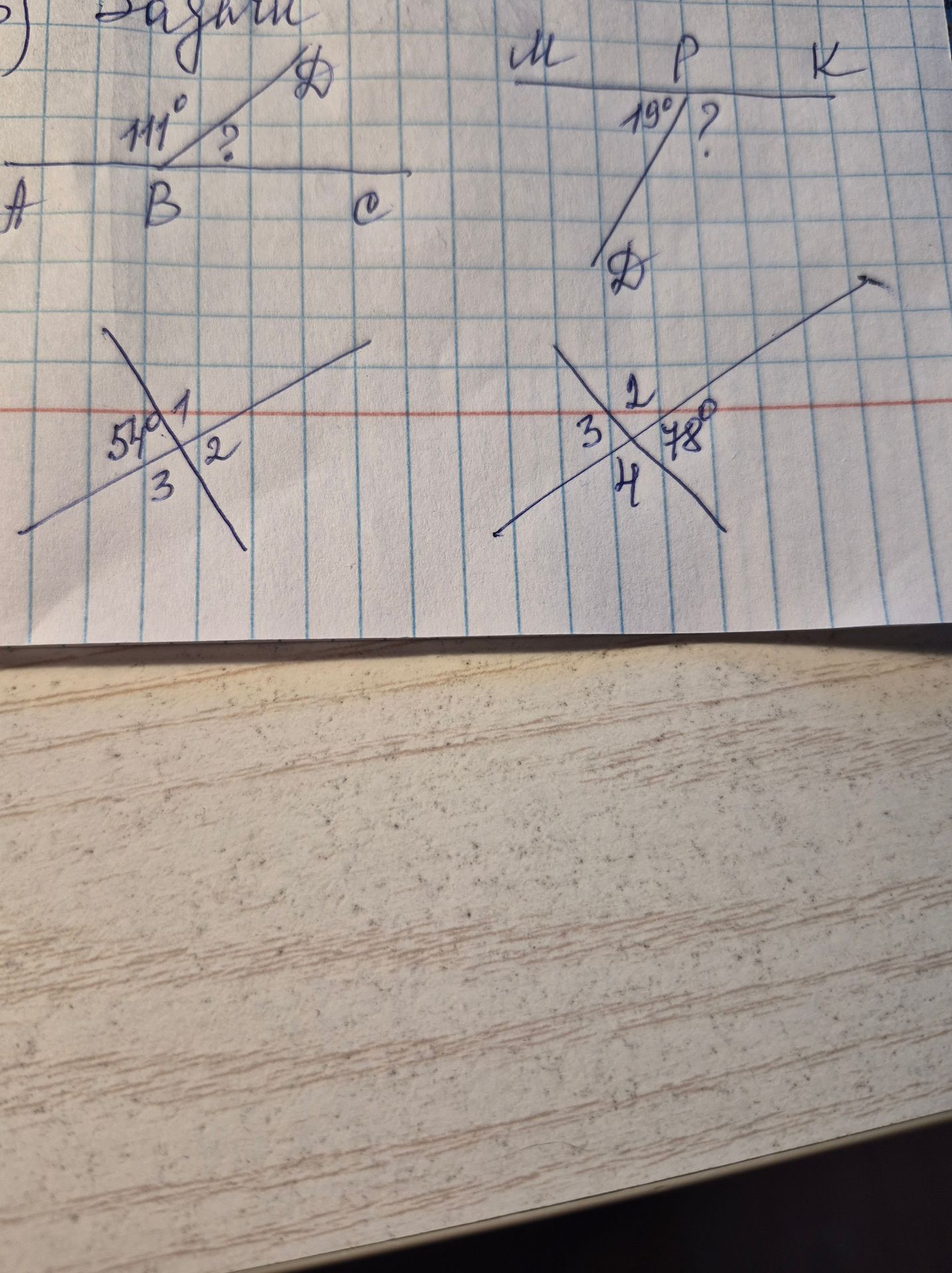
Calculate the unknown angles in the image.
Ответ:
Let's break down these geometry problems step by step!
Problem 1: Top Left Diagram
We have a straight line AC and a ray BD intersecting it at point B.
- We are given that one angle is 111°. Let's assume this is the angle formed by line AC and ray BD on one side.
- Angles on a straight line add up to 180°. So, the angle adjacent to the 111° angle (on the straight line AC) would be 180° - 111° = 69°.
- The diagram shows two intersecting lines, forming four angles around point B.
- The angle marked 111° and the angle opposite to it (marked with 'D' symbol) are vertically opposite angles, so they are equal. However, the 111° is shown as an obtuse angle, and the angle with 'D' symbol looks acute. This suggests the 111° might be an exterior angle or the diagram is not perfectly to scale.
- Let's assume the 111° is the angle as shown. The angle adjacent to it on the straight line AC is 180° - 111° = 69°.
- The angle marked with '?' is vertically opposite to this 69° angle. Therefore, the angle marked with '?' is also 69°.
- The angle marked with 'D' symbol is adjacent to the 111° angle and together they form a straight line if they were on line AC. However, they are formed by the intersecting ray BD and another ray. If we consider the ray BD and the line AC, the angle is 111°. The angle adjacent to it on the line AC is 69°. The angle marked 'D' appears to be vertically opposite to an angle that, when added to 111°, forms an angle on a straight line. This is confusing without further labels.
- Let's reconsider. If AC is a straight line, and BD is a ray: The angle 111° is given. The angle marked '?' is adjacent to it and forms a straight line with it on the line AC. So, ? = 180° - 111° = 69°. The symbol 'D' is above the line and seems to represent another angle. Without a clear indication of what the 'D' angle refers to (e.g., if it's vertically opposite to another angle or adjacent to another angle), it's hard to determine precisely.
- However, if the intention was that the line passing through A, B, C is a straight line, and another line passes through B, then the angle 111° and the angle marked '?' are supplementary.
- Assuming the 111° is formed by line AC and ray BD: The angle adjacent to 111° on the line AC is 180° - 111° = 69°. The angle marked '?' is vertically opposite to this 69° angle. So, ? = 69°.
- The angle marked with the 'D' symbol is vertically opposite to the 111° angle if we consider two intersecting lines. But here we have a straight line AC and a ray BD. Let's assume there's another line passing through B and forming the angle D. If so, the angle marked 'D' would be vertically opposite to 111°, so D = 111°. But this doesn't match the visual representation.
- Let's assume the question implies that line AB is part of a line and BD is another line segment. In that case, the angle 111° and the angle marked '?' are supplementary. So, ? = 180° - 111° = 69°.
Conclusion for Problem 1: Based on the common convention of angles on a straight line, the angle marked '?' is 69°.
Problem 2: Bottom Left Diagram
We have two intersecting lines. The angles are numbered 1, 2, 3, and another angle is marked 57°.
- The angle marked 57° and angle 1 are adjacent angles on a straight line.
- Therefore, Angle 1 = 180° - 57° = 123°.
- Angle 3 is vertically opposite to the 57° angle. So, Angle 3 = 57°.
- Angle 2 is vertically opposite to Angle 1. So, Angle 2 = Angle 1 = 123°.
Conclusion for Problem 2: Angle 1 = 123°, Angle 2 = 123°, Angle 3 = 57°.
Problem 3: Top Right Diagram
We have a straight line MK and a ray PD intersecting it at point P.
- We are given an angle of 19°.
- The angle marked '?' is adjacent to the 19° angle on the straight line MK.
- Therefore, ? = 180° - 19° = 161°.
- The symbol 'D' is shown above the line. Similar to problem 1, without clear indication, its relation to other angles is ambiguous. If we assume 'D' refers to the vertically opposite angle to 19°, then D = 19°. But the visual suggests otherwise.
- Assuming the 19° is formed by line MK and ray PD: The angle adjacent to 19° on the line MK is 180° - 19° = 161°. The angle marked '?' is vertically opposite to this 161° angle. So, ? = 161°.
Conclusion for Problem 3: Based on angles on a straight line, the angle marked '?' is 161°.
Problem 4: Bottom Right Diagram
We have two intersecting lines. The angles are numbered 2, 3, 4, and another angle is marked 78°.
- The angle marked 78° and angle 2 are adjacent angles on a straight line.
- Therefore, Angle 2 = 180° - 78° = 102°.
- Angle 4 is vertically opposite to the 78° angle. So, Angle 4 = 78°.
- Angle 3 is vertically opposite to Angle 2. So, Angle 3 = Angle 2 = 102°.
Conclusion for Problem 4: Angle 2 = 102°, Angle 3 = 102°, Angle 4 = 78°.
Summary of Unknown Angles:
- Top Left ('?'): 69°
- Bottom Left (Angles 1, 2, 3): Angle 1 = 123°, Angle 2 = 123°, Angle 3 = 57°
- Top Right ('?'): 161°
- Bottom Right (Angles 2, 3, 4): Angle 2 = 102°, Angle 3 = 102°, Angle 4 = 78°
