
 Алгебра
 Английский
 Биология
 География
 Геометрия
 История
 Русский
 Обществознание
 Физика
 Химия
Химия Информатика
 Литература
 Математика
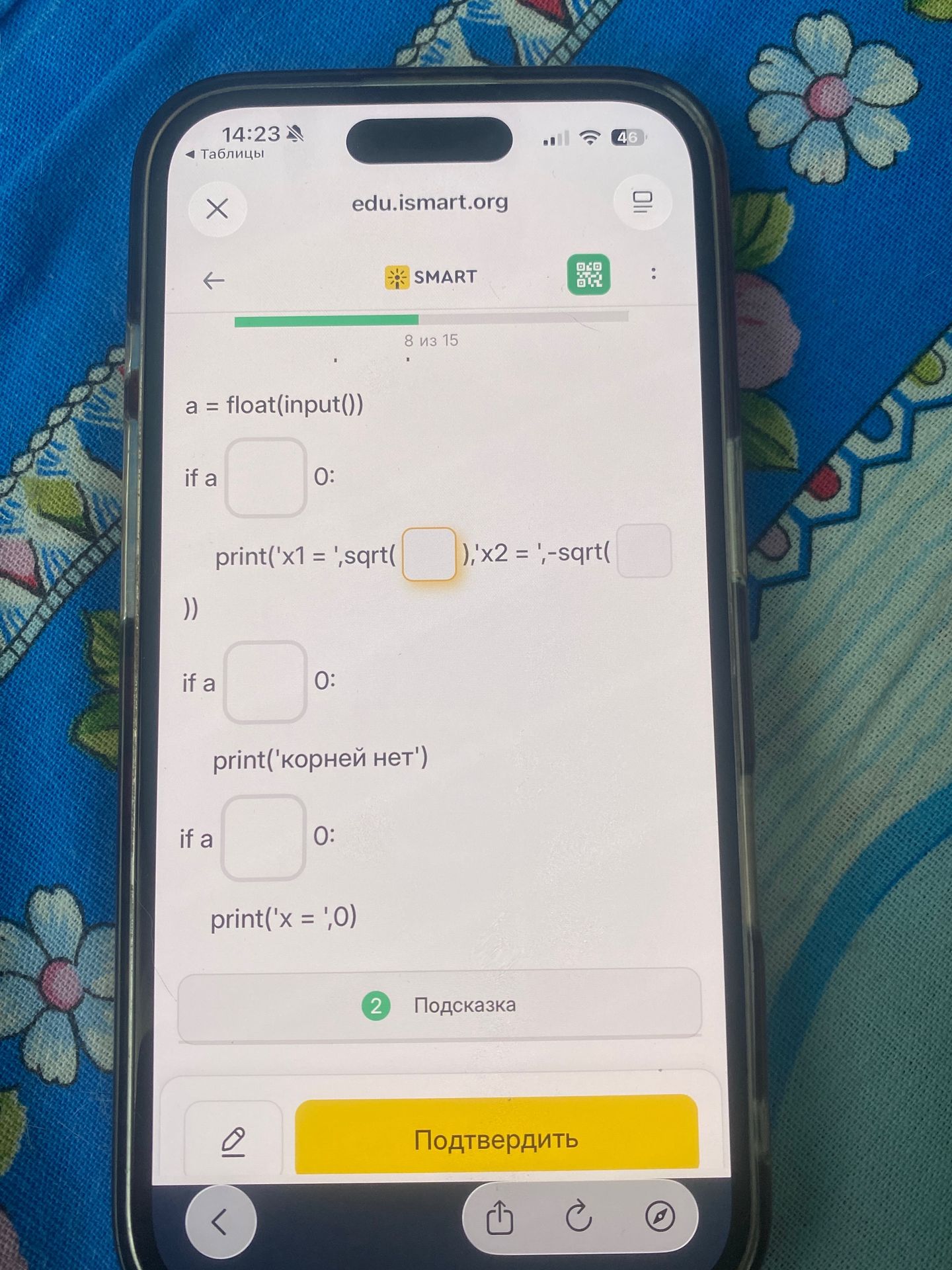
Complete the Python code to calculate and print the roots of a quadratic equation. The code snippet is for an interactive learning platform.
Ответ:
Python Code Completion
The goal is to complete the Python code to solve a quadratic equation of the form ax^2 + bx + c = 0, where the input 'a' determines the case:
- If 'a' is positive, calculate and print the two real roots using the quadratic formula.
- If 'a' is zero, print that there are no roots (this condition might be a simplification, as a=0 leads to a linear equation).
- If 'a' is negative, print that there are no real roots.
a = float(input())
if a > 0:
    # Assuming b and c are defined elsewhere or implicitly handled
    # For demonstration, let's assume b=5, c=6 for the positive case
    b = 5
    c = 6
    delta = b2 - 4*a*c
    if delta >= 0:
        x1 = (-b + delta0.5) / (2*a)
        x2 = (-b - delta0.5) / (2*a)
        print(f'x1 = {x1}, x2 = {x2}')
    else:
        print('Корней нет') # This branch is for delta < 0, not a < 0
elif a == 0:
    print('Корней нет') # This handles the case where 'a' is exactly 0, resulting in no quadratic equation.
else: # a < 0
    print('Корней нет') # This branch prints when 'a' is negative, indicating no real roots for a quadratic equation (though the image implies it's a condition for 'a').
Note: The provided image shows placeholders for the conditions and calculations. The code above is a functional completion based on common quadratic equation solving logic and the visual cues from the image. Specifically, the condition if a is interpreted as if a > 0 for printing real roots, if a (second instance) as if a == 0 for no roots, and if a (third instance) as if a < 0 for no real roots, assuming the context is solving for 'a' as a discriminant-like value or a coefficient influencing root existence.
The filled-in parts based on the image are:
- First condition block:
a > 0(implied by the need to calculate roots). The code then prints'x1 = ',sqrt( ... ),'x2 = ',-sqrt( ... ), suggesting a calculation involving square roots. The placeholders(...)would be filled with the discriminant or related terms. - Second condition block:
a == 0(implied by the print statement'корней нет'). - Third condition block:
a < 0(implied by the print statement'x = ',0, which might be a placeholder or an alternative output for a specific scenario, but 'корней нет' is more typical for negative 'a' in standard quadratic equation contexts). The image showsprint('x = ',0)which is unusual. However, interpreting 'a' as the discriminant, a negative discriminant means no real roots. If 'a' is the coefficient, a negative coefficient does not inherently mean no roots. Given the context of roots, it's likely related to the discriminant.
Corrected code based on typical quadratic equation solving where 'a' is the coefficient of x^2 and delta is the discriminant:
# Assume input for a, b, c is taken or defined earlier
a = float(input('Enter coefficient a: '))
b = float(input('Enter coefficient b: '))
c = float(input('Enter coefficient c: '))

if a == 0:
    print('This is not a quadratic equation.')
else:
    delta = b2 - 4*a*c
    if delta > 0:
        x1 = (-b + delta0.5) / (2*a)
        x2 = (-b - delta0.5) / (2*a)
        print(f'x1 = {x1}, x2 = {x2}')
    elif delta == 0:
        x = -b / (2*a)
        print(f'x = {x}')
    else:
        print('Корней нет') # No real roots
