
 Алгебра
 Английский
 Биология
 География
 Геометрия
 История
 Русский
 Обществознание
 Физика
 Химия
Химия Информатика
 Литература
 Математика
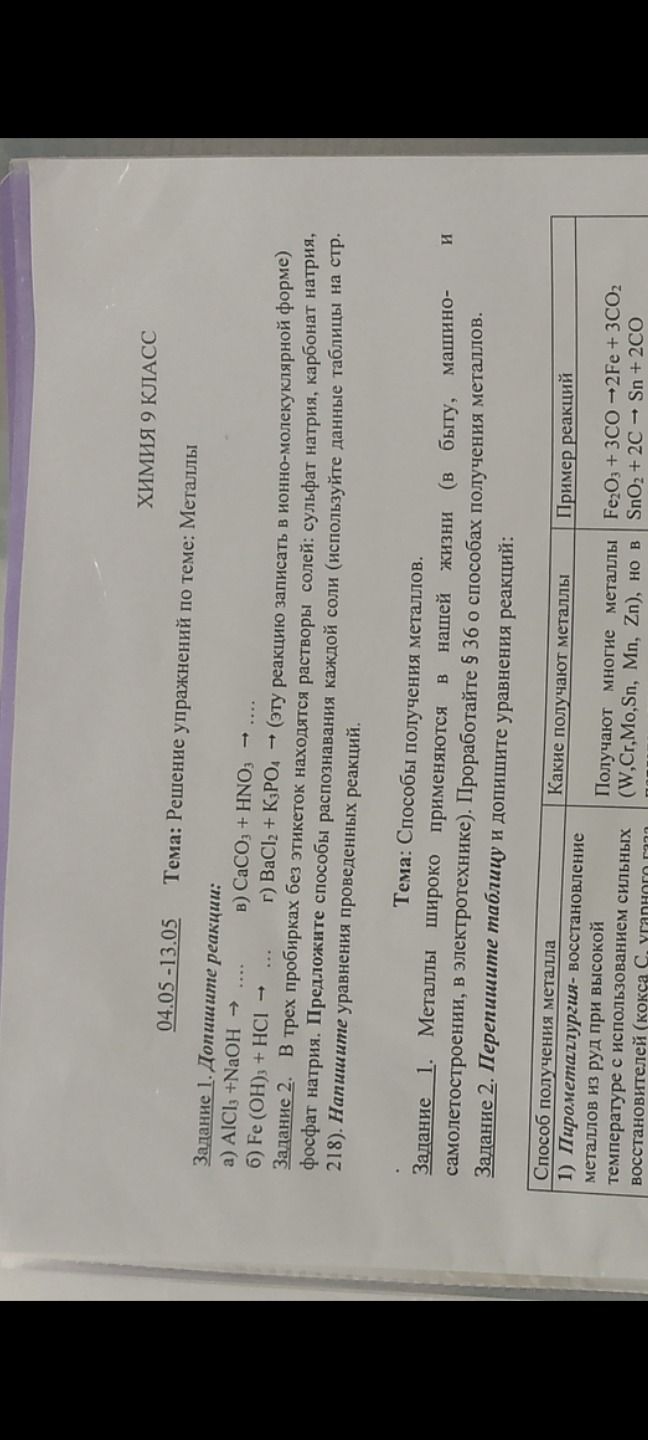
Complete the reactions: a) AlCl3 +NaOH → b) Fe (OH)3 + HCl → c) CaCO3 + HNO3 → d) BaCl2 + K3PO4 → (write this reaction in ionic-molecular form) Task 2. In three test tubes without labels, there are salt solutions: sodium sulfate, sodium carbonate, sodium phosphate. Suggest ways to identify each salt (use the data in the table on p. 218). Write the equations for the reactions that occurred.
Ответ:
Solution:
- Task 1. Completing the reactions:
- a) \( \text{AlCl}_3 + 3\text{NaOH} \rightarrow \text{Al(OH)}_3 \downarrow + 3\text{NaCl} \)
- b) \( \text{Fe(OH)}_3 + 3\text{HCl} \rightarrow \text{FeCl}_3 + 3\text{H}_2\text{O} \)
- c) \( \text{CaCO}_3 + 2\text{HNO}_3 \rightarrow \text{Ca(NO}_3)_2 + \text{H}_2\text{O} + \text{CO}_2 \uparrow \)
- d) \( \text{BaCl}_2 + \text{K}_3\text{PO}_4 \rightarrow \text{Ba}_3\text{(PO}_4)_2 \downarrow + 6\text{KCl} \)
Ionic-molecular equation for d):
\[ 3\text{Ba}^{2+} + 6\text{Cl}^- + 6\text{K}^+ + 2\text{PO}_4^{3-} \rightarrow \text{Ba}_3\text{(PO}_4)_2 \downarrow + 6\text{K}^+ + 6\text{Cl}^- \]
Complete ionic equation:
\[ 3\text{Ba}^{2+} + 2\text{PO}_4^{3-} \rightarrow \text{Ba}_3\text{(PO}_4)_2 \downarrow \]
- Task 2. Identifying salts:
To identify the salts, we can use reactions that produce a precipitate or gas with one of the salts.
- Sodium sulfate (Na2SO4)
- Sodium carbonate (Na2CO3)
- Sodium phosphate (Na3PO4)
Proposed Identification Method:
- Add a solution of barium chloride (BaCl2) to each test tube.
- With sodium carbonate, a white precipitate of barium carbonate (BaCO3) will form:
- With sodium phosphate, a white precipitate of barium phosphate (Ba3(PO4)2) will form:
- With sodium sulfate, a white precipitate of barium sulfate (BaSO4) will form:
- With sodium carbonate, a gas (CO2) will be released:
- With sodium phosphate, there will be no gas evolution, and the precipitate of barium phosphate will remain (or dissolve in excess acid to form soluble phosphates).
- Test tube 1 (e.g., containing Na2CO3): Add BaCl2, observe effervescence (gas release). This is sodium carbonate.
- Test tube 2 (e.g., containing Na3PO4): Add BaCl2, a white precipitate forms. Then add HCl, the precipitate does not dissolve, and no gas evolves. This is sodium phosphate.
- Test tube 3 (e.g., containing Na2SO4): Add BaCl2, a white precipitate forms. Then add HCl, the precipitate does not dissolve, and no gas evolves. This is sodium sulfate.
\[ \text{Na}_2\text{CO}_3 + \text{BaCl}_2 \rightarrow \text{BaCO}_3 \downarrow + 2\text{NaCl} \]
\[ 3\text{Na}_2\text{SO}_4 + \text{BaCl}_2 \rightarrow \text{BaSO}_4 \downarrow + 2\text{NaCl} \]
\[ 3\text{Na}_3\text{PO}_4 + 2\text{BaCl}_2 \rightarrow \text{Ba}_3\text{(PO}_4)_2 \downarrow + 6\text{NaCl} \]
Distinguishing between BaCO3 and Ba3(PO4)2:
To distinguish between sodium carbonate and sodium phosphate, we can add an acid, for example, hydrochloric acid (HCl).
\[ \text{Na}_2\text{CO}_3 + 2\text{HCl} \rightarrow 2\text{NaCl} + \text{H}_2\text{O} + \text{CO}_2 \uparrow \]
Summary of identification:
Note: To definitively distinguish between sodium sulfate and sodium phosphate using barium chloride, it is important to note that barium sulfate (BaSO4) is insoluble in acids, while barium phosphate (Ba3(PO4)2) is also insoluble in water but can react with strong acids. However, the primary distinguishing feature with carbonate is gas evolution. If further distinction is needed between sulfate and phosphate, one could use a solution of calcium chloride (CaCl2). Calcium phosphate is insoluble, while calcium sulfate is sparingly soluble.
Answer: The reactions and identification steps are provided above.
