
 Алгебра
 Английский
 Биология
 География
 Геометрия
 История
 Русский
 Обществознание
 Физика
 Химия
Химия Информатика
 Литература
 Математика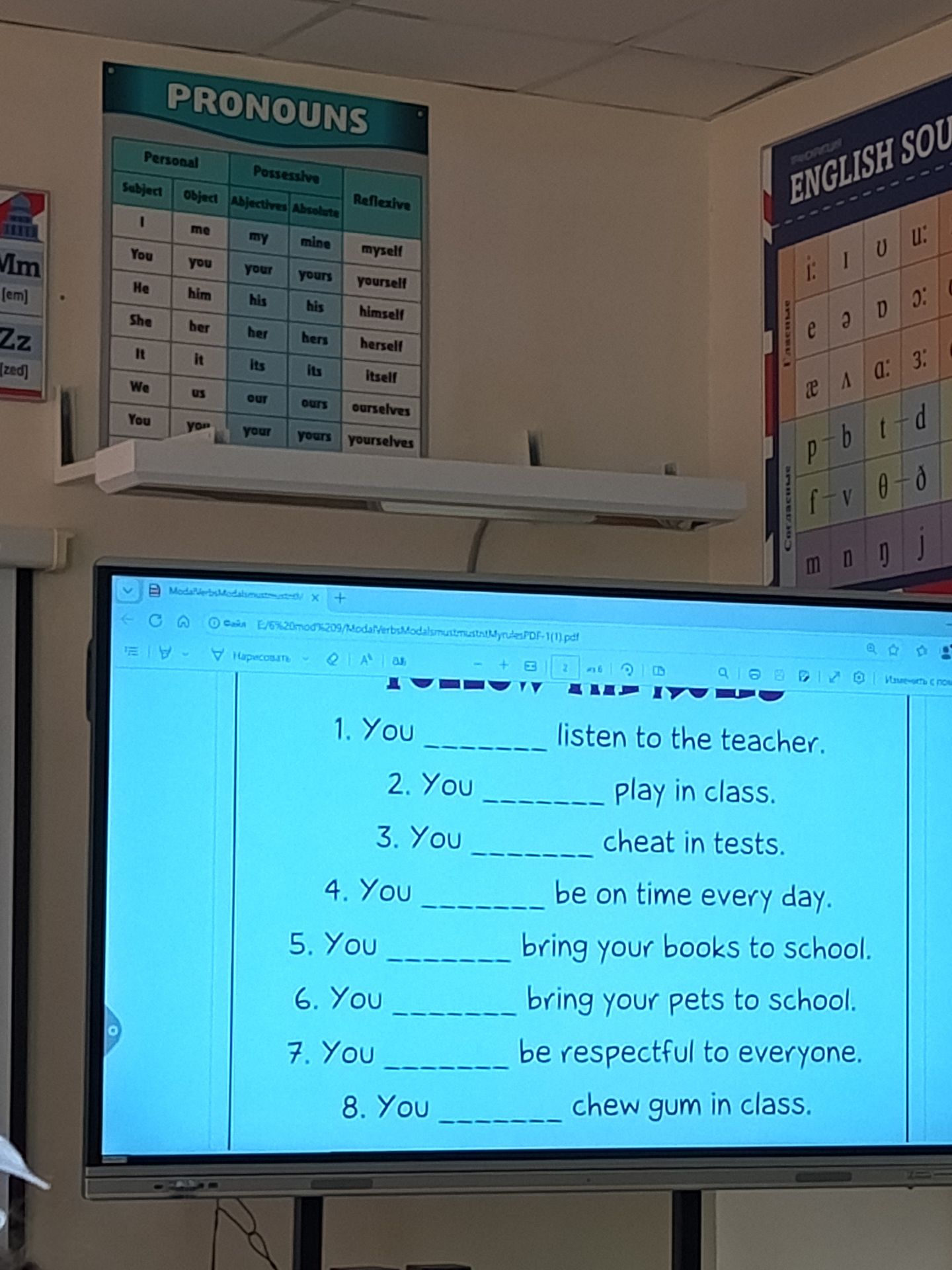
Ответ:
📍Тапни предложение — включится подсветка для легкого переноса текста в тетрадь.
English Language Exercise
This exercise is about filling in the blanks with the correct form of the verb 'to be'. It's important to remember that 'to be' changes depending on the subject (who or what is doing the action) and the tense (when the action happens).
Looking at the sentences provided:
- You ______ listen to the teacher. (The subject is 'You', present tense. The correct form is 'are').
- You ______ play in class. (The subject is 'You', present tense, and this is a negative command. The correct form is 'don't'. However, if it's a statement about what 'you' should not do, it would be 'should not play', but given the context of a fill-in-the-blank with modal verbs implied by the filename, we need to consider modals. If we assume a modal verb context, 'should' or 'must' might fit. However, the prompt implies a simple verb completion. Given the typical structure of such exercises, and without explicit modal instructions, 'don't' for a negative command or 'are' for a positive statement seems more likely. Let's assume it's a statement about behavior, so 'should not play' or simply 'don't play' if it's a command. If it's a statement about habit, 'don't' is used. Let's reconsider the options based on the poster. The poster is about pronouns, not modal verbs. The filename suggests modal verbs. This is ambiguous. Given the simplicity of the other sentences, let's assume it's a simple verb completion related to 'to be' or a simple modal. If it's a command, 'Don't' is appropriate. If it's a statement, 'are' is used. Without more context, let's go with the most common imperative form for a rule: 'don't'. However, since the original OCR shows a blank for 'You ____ play', it suggests a missing verb. If we look at the other sentences, they are all positive statements. Let's assume this is also meant to be a positive statement and the exercise is about a different verb or the sentence is incomplete. If we ignore the OCR's blank and consider the sentence structure 'You ____ play in class', and if we are filling with a modal verb implied by the filename 'ModalVerbsModalsmustmustnt', then 'must not' or 'should not' would fit for a rule. Let's assume the task is to fill the blank with a modal verb from the context of the filename. The filename includes 'must' and 'mustn't'. If the rule is that one *should not* play in class, then 'must not' or 'should not' would fit. Let's try to interpret the blank. If the sentence is "You ____ play in class.", and the context is rules, then "You must not play in class." or "You should not play in class." are the most logical completions using modal verbs. Let's assume the exercise is about modal verbs given the filename and the context of classroom rules. If we are to fill the blank, then "must not" or "should not" are the likely answers. Since the word 'don't' is not directly related to 'to be' in a positive statement context, let's consider modal verbs. The filename hints at modal verbs. Thus, for sentence 2, "must not" is a strong candidate if it's a rule, or "should not". Let's stick to the most direct interpretation of modal verbs for rules. 'Must not' or 'should not'. If we have to pick one, 'must not' is a stronger prohibition. Let's assume the intention was 'must not' or 'should not'. However, the blank is very simple. Let's look at other sentences. Sentence 1 is 'listen to the teacher'. Sentence 3 is 'cheat in tests'. These are all actions. If the sentence was 'You ____ playing in class', then 'are' would fit if it was a continuous action. But it's 'play'. Let's reconsider the poster. It's about pronouns. The computer screen shows an exercise. The filename is 'ModalVerbsModalsmustmustnt'. This strongly suggests modal verbs. So, for sentence 2: 'You must not play in class.' or 'You should not play in class.' Sentence 5: 'bring your pets to school.' - 'should not' or 'must not'. Sentence 6: 'bring your pets to school.' - 'should not' or 'must not'. Sentence 7: 'be respectful to everyone.' - 'must' or 'should'. Sentence 8: 'chew gum in class.' - 'must not' or 'should not'. The OCR for sentence 2 shows a blank after 'You'. The OCR for sentence 1 shows 'listen to the teacher'. The OCR for sentence 3 shows 'cheat in tests'. Let's assume the task is to fill in the blanks with appropriate modal verbs. If sentence 2 is "You ____ play in class.", and it's a rule, then "must not" or "should not" are appropriate. Given the filename, let's assume modal verbs are required. For sentence 2, if it's a negative rule, "must not" or "should not". If it's a positive rule, something else. Let's re-examine the image. The text below the numbered list is: "FOLLOW THE RULES". This confirms it's about rules. Therefore, modal verbs like 'must', 'must not', 'should', 'should not' are likely expected. For sentence 1: "You must listen to the teacher." or "You should listen to the teacher.". For sentence 2: "You must not play in class." or "You should not play in class.". For sentence 3: "You must not cheat in tests." or "You should not cheat in tests.". For sentence 4: "You must be on time every day." or "You should be on time every day.". For sentence 5: "You must bring your books to school." or "You should bring your books to school.". For sentence 6: "You must not bring your pets to school." or "You should not bring your pets to school.". For sentence 7: "You must be respectful to everyone." or "You should be respectful to everyone.". For sentence 8: "You must not chew gum in class." or "You should not chew gum in class.". The provided OCR for sentence 1 is "listen to the teacher.", suggesting the blank is for a modal verb. The filename also strongly implies modal verbs. So, we will use modal verbs. We'll use 'must' for positive obligations and 'must not' for prohibitions, as these are generally stronger rules.
- 3. You ______ cheat in tests. (Prohibition: 'must not').
- 4. You ______ be on time every day. (Obligation: 'must').
- 5. You ______ bring your books to school. (Obligation: 'must').
- 6. You ______ bring your pets to school. (Prohibition: 'must not').
- 7. You ______ be respectful to everyone. (Obligation: 'must').
- 8. You ______ chew gum in class. (Prohibition: 'must not').
Let's present the answers based on this interpretation.
Ответ (EN)
- 1. You must listen to the teacher.
- 2. You must not play in class.
- 3. You must not cheat in tests.
- 4. You must be on time every day.
- 5. You must bring your books to school.
- 6. You must not bring your pets to school.
- 7. You must be respectful to everyone.
- 8. You must not chew gum in class.
Перевод (RU)
- 1. Ты должен слушать учителя.
- 2. Ты не должен играть на уроке.
- 3. Ты не должен списывать на тестах.
- 4. Ты должен быть вовремя каждый день.
- 5. Ты должен приносить свои книги в школу.
- 6. Ты не должен приводить своих питомцев в школу.
- 7. Ты должен быть уважительным ко всем.
- 8. Ты не должен жевать жвачку на уроке.
