
 Алгебра
 Английский
 Биология
 География
 Геометрия
 История
 Русский
 Обществознание
 Физика
 Химия
Химия Информатика
 Литература
 Математика
Вопрос:
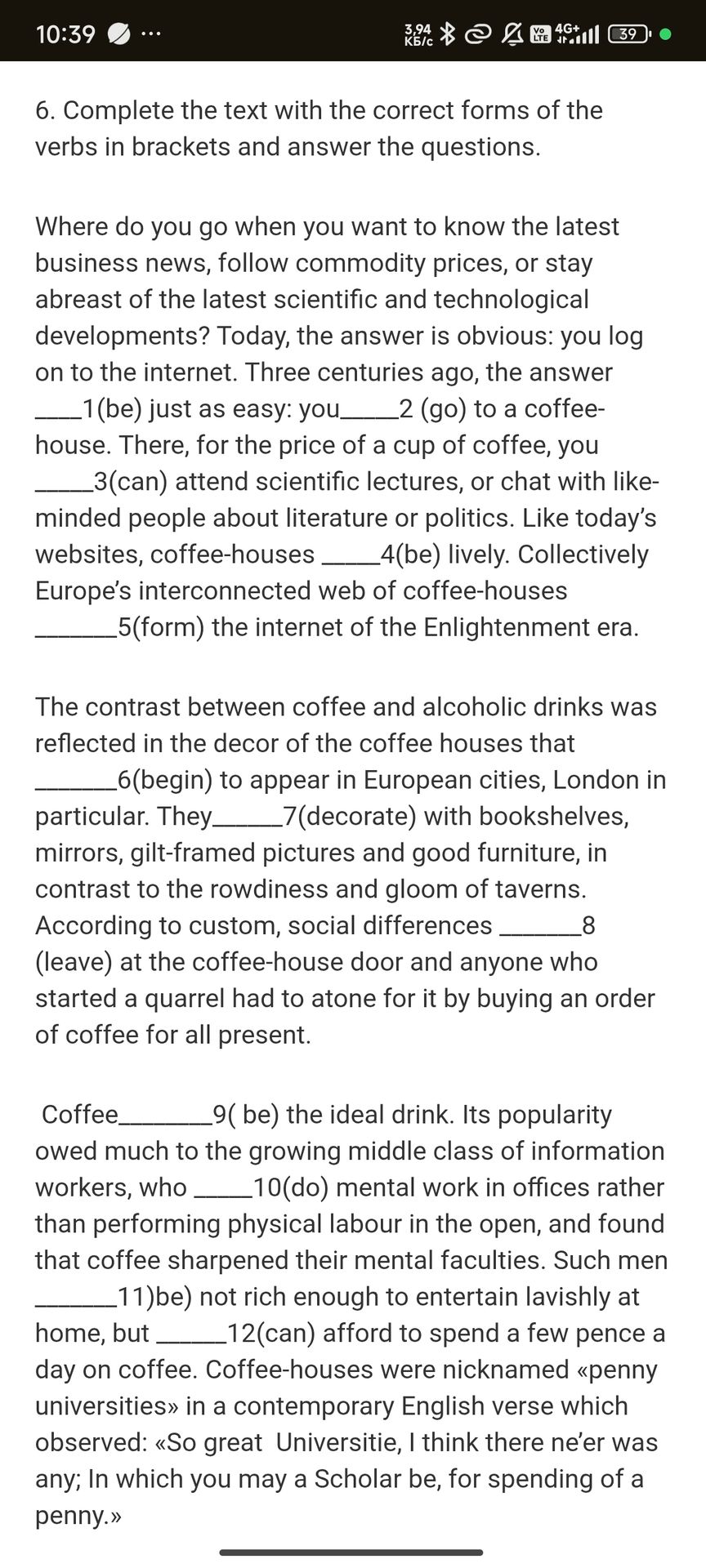
6. Complete the text with the correct forms of the verbs in brackets and answer the questions. Where do you go when you want to know the latest business news, follow commodity prices, or stay abreast of the latest scientific and technological developments? Today, the answer is obvious: you log on to the internet. Three centuries ago, the answer _1(be) just as easy: you_2 (go) to a coffee-house. There, for the price of a cup of coffee, you _3(can) attend scientific lectures, or chat with like-minded people about literature or politics. Like today's websites, coffee-houses _4(be) lively. Collectively Europe's interconnected web of coffee-houses _5(form) the internet of the Enlightenment era. The contrast between coffee and alcoholic drinks was reflected in the decor of the coffee houses that _6(begin) to appear in European cities, London in particular. They_7(decorate) with bookshelves, mirrors, gilt-framed pictures and good furniture, in contrast to the rowdiness and gloom of taverns. According to custom, social differences _8 (leave) at the coffee-house door and anyone who started a quarrel had to atone for it by buying an order of coffee for all present. Coffee_9(be) the ideal drink. Its popularity owed much to the growing middle class of information workers, who_10(do) mental work in offices rather than performing physical labour in the open, and found that coffee sharpened their mental faculties. Such men _11)be) not rich enough to entertain lavishly at home, but _12(can) afford to spend a few pence a day on coffee. Coffee-houses were nicknamed «penny universities» in a contemporary English verse which observed: «So great Universitie, I think there ne'er was any; In which you may a Scholar be, for spending of a penny.»
Ответ:
6. Complete the text with the correct forms of the verbs in brackets and answer the questions.
I. Заполните текст, используя правильные формы глаголов в скобках.
Три века назад ответ was так же прост.
Ты went в кофейню.
Ты can посещать научные лекции.
Кофейни were оживлёнными.
Кофейни formed интернет эпохи Просвещения.
Отражалось в убранстве кофеен, которые began появляться в европейских городах.
Они were decorated книжными полками.
Социальные различия were left у дверей кофейни.
Кофе was идеальным напитком.
Кто did умственную работу в офисах.
Такие люди were недостаточно богаты.
Но could позволить себе потратить несколько пенсов в день на кофе.
Ответ: смотри решение
