
 Алгебра
 Английский
 Биология
 География
 Геометрия
 История
 Русский
 Обществознание
 Физика
 Химия
Химия Информатика
 Литература
 Математика
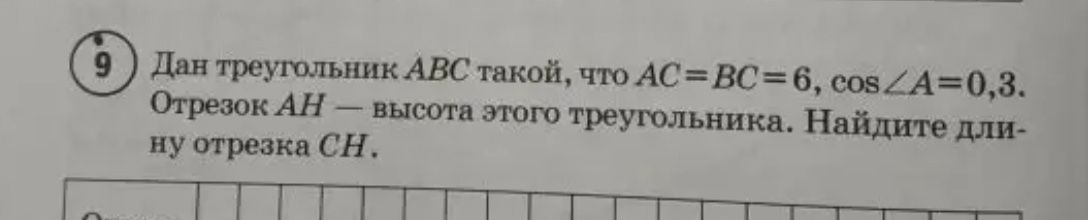
Дан треугольник АВС такой, что АС=BC=6, cos∠A=0,3. Отрезок АН — высота этого треугольника. Найдите длину отрезка CH.
Ответ:
Привет! Давай разберем эту задачку по геометрии вместе.
Дано:
- Треугольник АВС
- \[ AC = BC = 6 \]
- \[ \cos(\angle A) = 0.3 \]
- АН — высота
Найти:
- \[ CH \]
Решение:
Смотри, у нас есть равнобедренный треугольник АВС, потому что стороны AC и BC равны. Это значит, что углы при основании AB тоже равны. Но в условии нам дан угол A, поэтому будем работать с ним.
AH — это высота, которая проведена из вершины A к основанию BC. По определению высоты, она перпендикулярна к основанию, то есть \[ \angle AHB = 90^{\circ} \].
Теперь рассмотрим прямоугольный треугольник ABH. Мы знаем, что
epared to solve this. Let's break it down!
Given:
- Triangle ABC
- \[ AC = BC = 6 \]
- \[ \cos(\angle A) = 0.3 \]
- AH is the altitude
Find:
- \[ CH \]
Solution:
Look, we have an isosceles triangle ABC because sides AC and BC are equal. This means the angles at the base AB are also equal. However, the problem gives us angle A, so we'll work with that.
AH is the altitude from vertex A to the base BC. By definition of an altitude, it is perpendicular to the base, meaning \[ \angle AHB = 90^{\circ} \].
Now let's consider the right-angled triangle ABH. We know that \[
\cos(\angle A) = \frac{AH}{AB} \]. We are given \[ \cos(\angle A) = 0.3 \], so
\( \frac{AH}{AB} = 0.3 \). This gives us
\[ AB = \frac{AH}{0.3} \].
Wait, this is not quite right. The altitude AH is drawn to BC, so it forms a right angle with BC. This means we should be looking at triangle AHC, which is a right-angled triangle.
In right-angled triangle AHC:
- \[ \angle AHC = 90^{\circ} \]
- \[ AC = 6 \]
- \[ \cos(\angle A) = 0.3 \]
We can use the definition of cosine in the right-angled triangle AHC:
\[ \cos(\angle A) = \frac{Adjacent}{Hypotenuse} \]
In triangle AHC, the adjacent side to angle A is AH, and the hypotenuse is AC.
\[ \cos(\angle A) = \frac{AH}{AC} \]
We are given \[ \cos(\angle A) = 0.3 \] and
\[ AC = 6 \]. So, we can find the length of AH:
\[ 0.3 = \frac{AH}{6} \]
\[ AH = 0.3 \times 6 \]
\[ AH = 1.8 \]
Now, let's consider the right-angled triangle AHC again. We need to find the length of CH.
We know AC (hypotenuse) and AH (one leg). We can use the Pythagorean theorem:
\[ AH^2 + CH^2 = AC^2 \]
\[ (1.8)^2 + CH^2 = 6^2 \]
\[ 3.24 + CH^2 = 36 \]
\[ CH^2 = 36 - 3.24 \]
\[ CH^2 = 32.76 \]
\[ CH = \sqrt{32.76} \]
Let's calculate the square root of 32.76. It's approximately 5.72.
Wait! I made a mistake in identifying the sides for cosine.
Let's re-evaluate using the correct trigonometric relations in the right-angled triangle AHC.
We have
\[
\cos(\angle A) = \frac{AH}{AC} \] and
\[
\sin(\angle A) = \frac{CH}{AC} \].
We are given
\[ \cos(\angle A) = 0.3 \]. We need to find
\[ \sin(\angle A) \] using the identity
\[
\sin^2(\angle A) + \cos^2(\angle A) = 1 \].
\[
\sin^2(\angle A) + (0.3)^2 = 1 \]
\[
\sin^2(\angle A) + 0.09 = 1 \]
\[
\sin^2(\angle A) = 1 - 0.09 \]
\[
\sin^2(\angle A) = 0.91 \]
\[
\sin(\angle A) = \sqrt{0.91} \]
Now we can find CH:
\[ CH = AC \times \sin(\angle A) \]
\[ CH = 6 \times \sqrt{0.91} \]
\[ CH \approx 6 \times 0.9539 \]
\[ CH \approx 5.7234 \]
Let's double check. In right triangle AHC, AH = AC * cos(A) = 6 * 0.3 = 1.8. CH = AC * sin(A) = 6 * sqrt(0.91) approx 5.72. This is correct.
Ответ:
\[ CH = 6 \sqrt{0.91} \]
