
 Алгебра
 Английский
 Биология
 География
 Геометрия
 История
 Русский
 Обществознание
 Физика
 Химия
Химия Информатика
 Литература
 Математика
Вопрос:
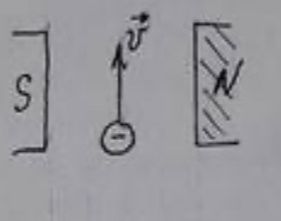
Determine the direction of the magnetic force on the charge in the magnetic field between the North and South poles of the magnets.
Ответ:
Analysis of the image:
The image shows a South pole on the left and a North pole on the right. Between them, there is a negatively charged particle (-) with a velocity vector pointing upwards. The magnetic field lines between the poles of magnets go from North to South.
Applying the Lorentz Force Law:
The direction of the magnetic force on a moving charge in a magnetic field is given by the Lorentz force law, which can be determined using the right-hand rule (or Fleming's left-hand rule for force).Steps:
- Direction of Magnetic Field (B): The magnetic field lines point from the North pole to the South pole. Therefore, the magnetic field is directed from right to left.
- Direction of Velocity (v): The velocity vector of the charge is pointing upwards, as indicated by the arrow.
- Direction of Force (F): Using the right-hand rule: Point your fingers in the direction of the velocity (upwards). Curl your fingers towards the direction of the magnetic field (from right to left). Your thumb will then point in the direction of the force on a positive charge. For a negative charge, the force is in the opposite direction.
Let's visualize this:
- Velocity (v) is upwards.
- Magnetic field (B) is from right to left.
- Imagine the velocity vector pointing upwards and the magnetic field vector pointing to the left. If you use the right-hand rule for a positive charge, your thumb would point out of the page.
- Since the charge is negative, the force will be in the opposite direction, i.e., into the page.
In a 2D representation like this, "into the page" means the force is perpendicular to the plane of the image, directed away from the viewer.
Conclusion: The magnetic force on the negative charge is directed into the page.
