
 Алгебра
 Английский
 Биология
 География
 Геометрия
 История
 Русский
 Обществознание
 Физика
 Химия
Химия Информатика
 Литература
 Математика
Determine the solution to the problem from the image.
Ответ:
Solution:
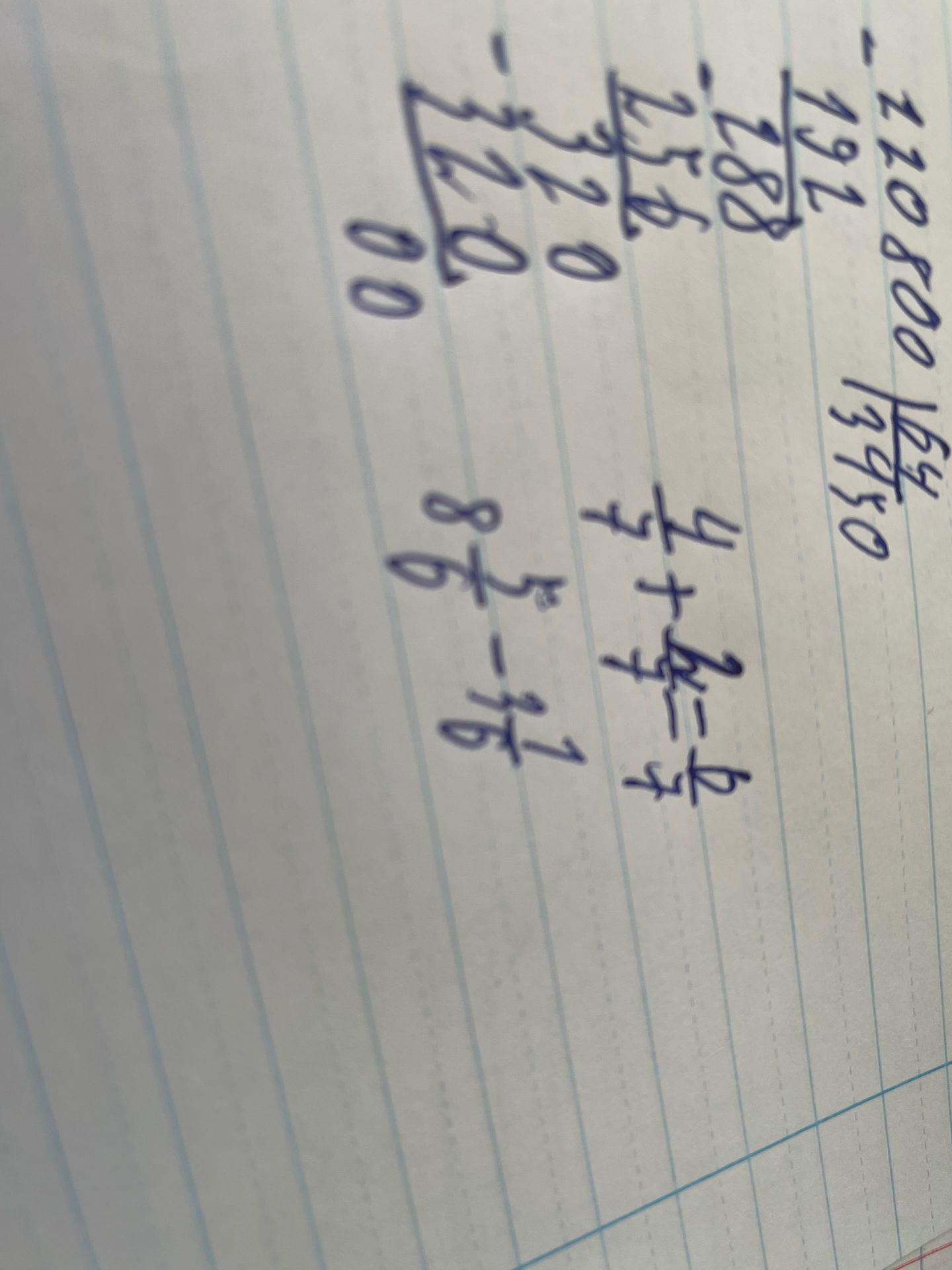
The image contains handwritten mathematical calculations. These appear to be related to division and possibly fraction operations.
- The first section shows a division problem that looks like \( 220800 \div 164 \). The steps shown are: \( 220 \div 164 = 1 \) with a remainder. Then \( 568 \div 164 = 3 \) with a remainder. Finally \( 440 \div 164 = 2 \) with a remainder. The partial calculation suggests a result of \( 1342 \), with a remainder, or \( 1342.68 \) if calculated further. However, the numbers \( 192 \) and \( 320 \) below \( 568 \) and \( 440 \) might indicate a different approach or a mistake. The final written part of this calculation is \( 13450 \) which is not directly derived from \( 220800 \div 164 \) in a straightforward manner.
- The second section shows \( \frac{4}{7} + \frac{2}{7} = \frac{6}{7} \). This is a simple addition of fractions with a common denominator.
- The third section shows \( 8 \frac{5}{6} - 7 \frac{1}{6} \). This is a subtraction of mixed numbers. \( 8 \frac{5}{6} - 7 \frac{1}{6} = (8-7) + (\frac{5}{6} - \frac{1}{6}) = 1 + \frac{4}{6} = 1 \frac{2}{3} \). The calculation in the image shows \( 1 \frac{4}{6} \) and \( 1 \). This could be the intermediate step or the final answer depending on simplification.
- The fourth section shows \( 00 \) below a division calculation, likely indicating a remainder of zero in a previous step.
Given the ambiguity and potential errors in the first division problem, and the clear calculations in the fraction problems, it's best to present the solutions to the latter.
Fraction Addition:
\( \frac{4}{7} + \frac{2}{7} = \frac{4+2}{7} = \frac{6}{7} \)
Mixed Number Subtraction:
\( 8 \frac{5}{6} - 7 \frac{1}{6} = \frac{8 \times 6 + 5}{6} - \frac{7 \times 6 + 1}{6} = \frac{53}{6} - \frac{43}{6} = \frac{53-43}{6} = \frac{10}{6} = 1 \frac{4}{6} = 1 \frac{2}{3} \)
The image also contains steps of a long division: \( 220800 \div 164 \). The visible part shows \( 1 \) as the first digit of the quotient, then \( 3 \) and \( 2 \), leading to \( 1342 \) with a remainder. The number \( 13450 \) written at the end of this division line is unclear in its derivation or may be an intended result of a different problem.
Answer: The calculations shown are: \( \frac{4}{7} + \frac{2}{7} = \frac{6}{7} \) and \( 8 \frac{5}{6} - 7 \frac{1}{6} = 1 \frac{2}{3} \). The long division \( 220800 \div 164 \) is partially shown with steps indicating a quotient starting with \( 1342 \).
