
 Алгебра
 Английский
 Биология
 География
 Геометрия
 История
 Русский
 Обществознание
 Физика
 Химия
Химия Информатика
 Литература
 Математика
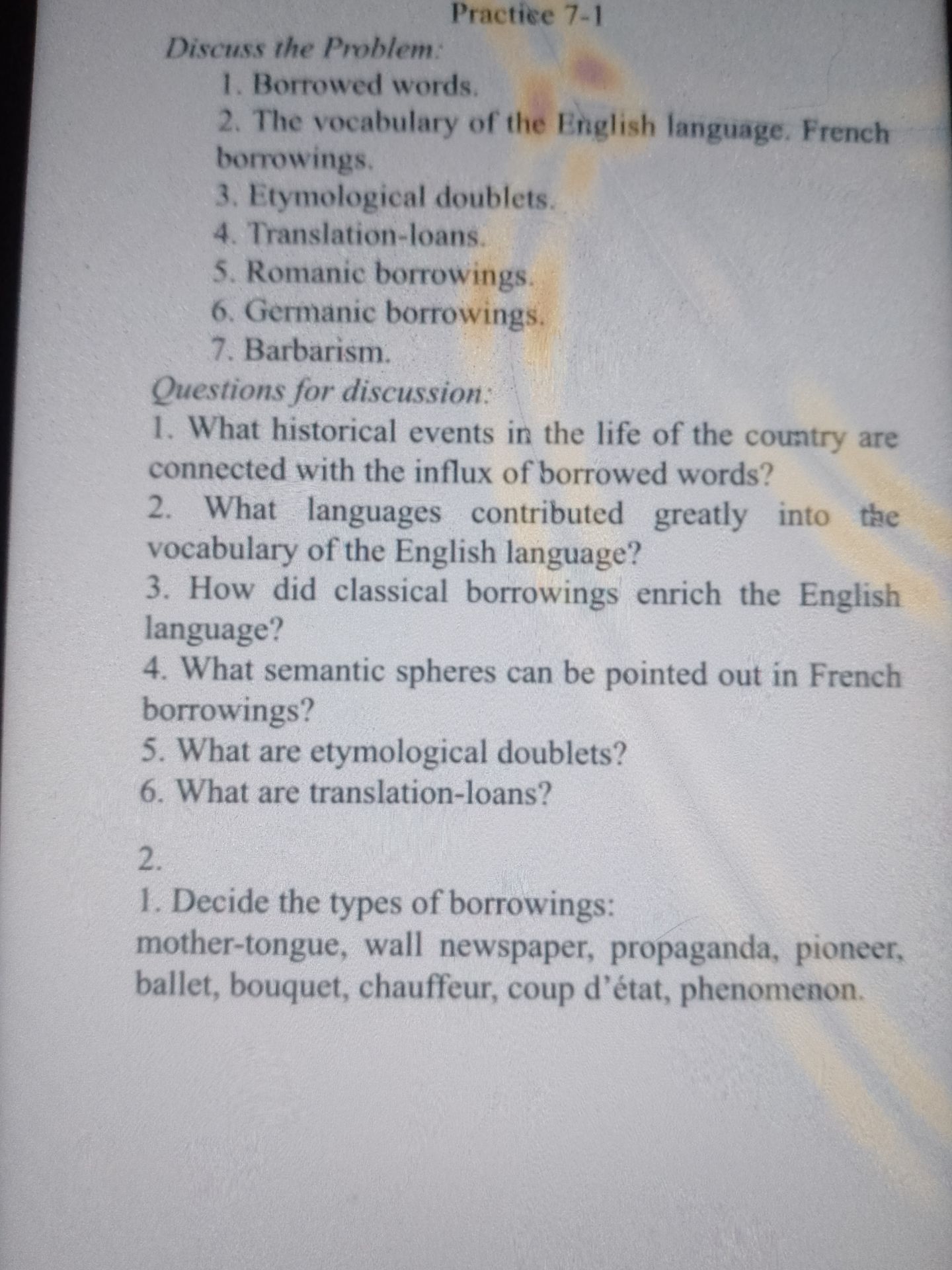
Discuss the Problem: 1. Borrowed words. 2. The vocabulary of the English language. French borrowings. 3. Etymological doublets. 4. Translation-loans. 5. Romanic borrowings. 6. Germanic borrowings. 7. Barbarism.
Ответ:
1. Borrowed words
Borrowed words are words adopted from one language into another. They are a natural part of language evolution and reflect historical, cultural, and economic contacts between different peoples.
2. The vocabulary of the English language. French borrowings
The English vocabulary has been significantly enriched by French borrowings, especially after the Norman Conquest of 1066. These words span various domains, including government, law, cuisine, fashion, and art.
3. Etymological doublets
Etymological doublets are two or more words in the same language that share the same origin but have evolved into different forms. This often happens when a word is borrowed more than once or when a word is borrowed and also develops from a native root.
4. Translation-loans
Translation-loans, or calques, are words or phrases whose meaning is borrowed from another language but are translated word-for-word into the borrowing language. For example, 'skyscraper' is a translation-loan from German 'Wolkenkratzer' (cloud-scraper).
5. Romanic borrowings
Romanic borrowings refer to words that entered English from Romance languages, primarily French and Latin. These are a substantial part of the English lexicon.
6. Germanic borrowings
Germanic borrowings are words that English inherited from its Proto-Germanic roots or borrowed from other Germanic languages (like Old Norse). These often form the core vocabulary of the language (e.g., 'house', 'man', 'eat').
7. Barbarism
In linguistics, a barbarism is a word or expression considered to be incorrect or foreign, often seen as an abuse of language. In the context of borrowings, it might refer to words that are not fully assimilated or are considered inappropriate.
Похожие
- Questions for discussion: 1. What historical events in the life of the country are connected with the influx of borrowed words? 2. What languages contributed greatly into the vocabulary of the English language? 3. How did classical borrowings enrich the English language? 4. What semantic spheres can be pointed out in French borrowings? 5. What are etymological doublets? 6. What are translation-loans?
- 2. 1. Decide the types of borrowings: mother-tongue, wall newspaper, propaganda, pioneer, ballet, bouquet, chauffeur, coup d'état, phenomenon.
