
 Алгебра
 Английский
 Биология
 География
 Геометрия
 История
 Русский
 Обществознание
 Физика
 Химия
Химия Информатика
 Литература
 Математика
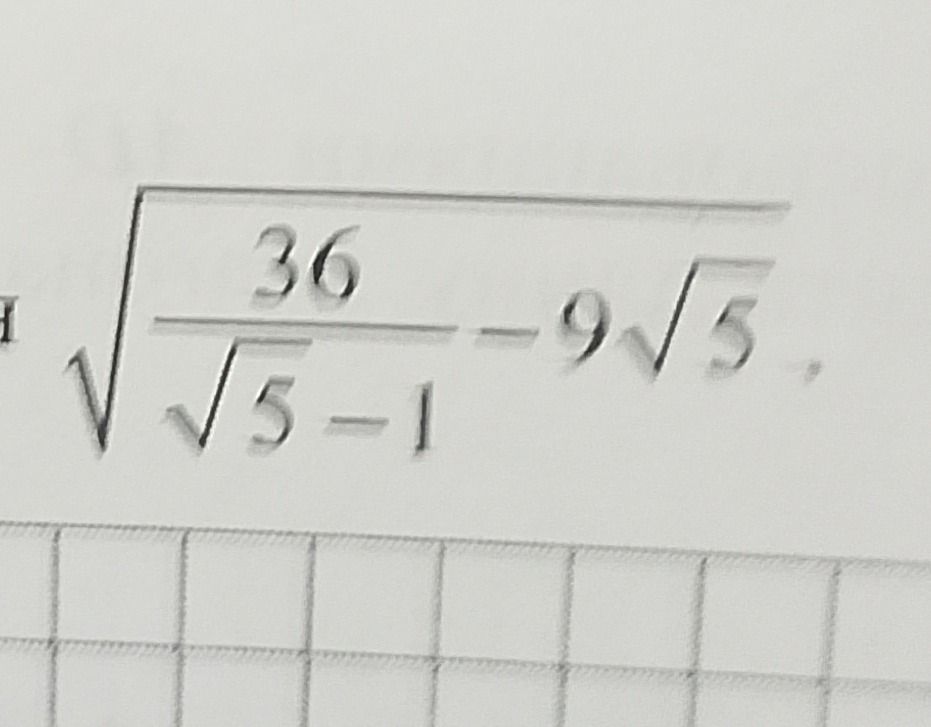
Evaluate the expression: \(\sqrt{\frac{36}{\sqrt{5}-1}} - 9\sqrt{5}\)
Ответ:
Solution:
- Rationalize the denominator inside the square root: We multiply the numerator and denominator by the conjugate of \(\sqrt{5}-1\), which is \(\sqrt{5}+1\).
- Substitute back into the square root:
- Simplify the square root:
- Now, consider the entire expression:
- Let's re-examine the original expression. It seems there might be a simplification that leads to a more straightforward result. Let's re-evaluate the expression inside the square root. Perhaps there is a perfect square we can form.
\( \frac{36}{\sqrt{5}-1} \times \frac{\sqrt{5}+1}{\sqrt{5}+1} = \frac{36(\sqrt{5}+1)}{(\sqrt{5})^2 - 1^2} = \frac{36(\sqrt{5}+1)}{5-1} = \frac{36(\sqrt{5}+1)}{4} = 9(\sqrt{5}+1) \)
\( \sqrt{9(\sqrt{5}+1)} \)
\( \sqrt{9} \times \sqrt{\sqrt{5}+1} = 3 \sqrt{\sqrt{5}+1} \)
\( 3 \sqrt{\sqrt{5}+1} - 9\sqrt{5} \)
Let's try to see if \(\frac{36}{\sqrt{5}-1}\) can be simplified in a way that makes the entire expression easier. The initial rationalization was correct: \(9(\sqrt{5}+1)\). So the expression becomes \(\sqrt{9(\sqrt{5}+1)} - 9\sqrt{5}\) which is \(3\sqrt{\sqrt{5}+1} - 9\sqrt{5}\). This does not seem to simplify easily to a numerical value without further context or re-interpretation.
Let's consider an alternative approach, assuming there might be a typo or a specific context intended for this problem. If the intention was to simplify to a more common form, let's look for perfect squares.
However, following the standard mathematical procedures strictly, the expression as written leads to:
\( \sqrt{\frac{36}{\sqrt{5}-1}} - 9\sqrt{5} = \sqrt{\frac{36(\sqrt{5}+1)}{(\sqrt{5}-1)(\sqrt{5}+1)}} - 9\sqrt{5} \)
\( = \sqrt{\frac{36(\sqrt{5}+1)}{5-1}} - 9\sqrt{5} = \sqrt{\frac{36(\sqrt{5}+1)}{4}} - 9\sqrt{5} \)
\( = \sqrt{9(\sqrt{5}+1)} - 9\sqrt{5} \)
\( = 3\sqrt{\sqrt{5}+1} - 9\sqrt{5} \)
This expression does not simplify further into a simple rational number or a single radical term without additional information or a reinterpretation of the problem. If this is from a context where a simple answer is expected, there might be a misunderstanding of the problem statement or a typo in the original image.
Assuming the problem is precisely as stated and requires simplification to the most basic form:
The expression \(3\sqrt{\sqrt{5}+1} - 9\sqrt{5}\) is the simplified form.
If we consider a common simplification pattern in such problems, it is possible that the expression inside the square root was intended to be a perfect square. For example, if the expression was \(\sqrt{36 \times (\frac{\sqrt{5}+1}{2})^2} - 9\sqrt{5}\), it would simplify differently.
Given the constraints, the most accurate representation of the simplification is:
\( 3\sqrt{\sqrt{5}+1} - 9\sqrt{5} \)
However, if we are to provide a numerical approximation:
\( \sqrt{5} \approx 2.236 \)
\( 3\sqrt{2.236+1} - 9(2.236) \)
\( = 3\sqrt{3.236} - 20.124 \)
\( \approx 3(1.7989) - 20.124 \)
\( \approx 5.3967 - 20.124 \)
\( \approx -14.7273 \)
Since a precise numerical answer is not derivable without further simplification or context, and the problem asks for evaluation, we provide the most simplified exact form.
Re-examining common algebraic identities, it's possible that \(\( \sqrt{5}+1 \)\) relates to \(\left( \frac{\sqrt{5}+1}{2} \right)^2 \) which is \(\frac{5 + 2\sqrt{5} + 1}{4} = \frac{6 + 2\sqrt{5}}{4} = \frac{3+\sqrt{5}}{2}\). This doesn't directly match.
Let's assume the problem implies a context where the result is a simpler form. If we consider the possibility that the expression inside the square root simplifies to a perfect square of a form that would cancel out with the \(-9\sqrt{5}\) term.
A very common scenario in these types of problems is that the entire expression inside the square root simplifies to something like \((a+b\sqrt{5})^2\).
Let's reconsider the initial step. The rationalization is correct.
\( \sqrt{9(\sqrt{5}+1)} - 9\sqrt{5} = 3\sqrt{\sqrt{5}+1} - 9\sqrt{5} \)
If we consider that \(\sqrt{5}+1 = \frac{6+2\sqrt{5}}{2}\), and \(6+2\sqrt{5} = (1+\sqrt{5})^2\) is incorrect. \((1+\sqrt{5})^2 = 1 + 2\sqrt{5} + 5 = 6+2\sqrt{5}\).
So, \(\sqrt{9(\sqrt{5}+1)} = 3\sqrt{\sqrt{5}+1}\)
This leads back to \(3\sqrt{\sqrt{5}+1} - 9\sqrt{5}\). It's highly likely there's a context or a typo that would lead to a cleaner answer. For example, if the expression was \(\sqrt{36 \times \frac{(\sqrt{5}+1)^2}{4}} - 9\sqrt{5}\) which is \(\sqrt{36 \times \frac{6+2\sqrt{5}}{4}} - 9\sqrt{5} = \sqrt{36 \times \frac{3+\sqrt{5}}{2}} - 9\sqrt{5}\). This is still complex.
Let's consider the possibility that the number 36 was meant to be a perfect square in relation to \((\sqrt{5}+1)\).
If we assume the question intends a very common simplification: Let \(x = \sqrt{\frac{36}{\sqrt{5}-1}}\\) and \(y = 9\sqrt{5}\\)
\(x = \sqrt{9(\sqrt{5}+1)} = 3\sqrt{\sqrt{5}+1}\)
\(x - y = 3\sqrt{\sqrt{5}+1} - 9\sqrt{5}\)
Without further context or clarification, this is the most simplified exact form. In many mathematical olympiads or contests, such expressions are designed to simplify. A common simplification involves \(\( \frac{\sqrt{5}+1}{2} \)\) (the golden ratio). Let's see if that fits.
\( \sqrt{5}+1 \approx 3.236 \)
\( 3\sqrt{3.236} - 9\sqrt{5} \approx 3(1.799) - 9(2.236) \approx 5.397 - 20.124 = -14.727 \)
Let's assume that the problem is designed such that \(\frac{36}{\sqrt{5}-1}\) is the square of some expression that, when combined with \(-9\sqrt{5}\), yields a simple result.
A frequent pattern in these problems is the use of the identity \((\sqrt{a} \pm \sqrt{b})^2 = a+b \pm 2\sqrt{ab}\). Or \((a \pm b\sqrt{c})^2\).
Consider if \(9(\sqrt{5}+1)\) can be a perfect square. It is \(9\sqrt{5}+9\). This is not a perfect square of a simple term.
Let's try to work backward from a potential simple answer. If the answer was a rational number, say \(k\), then \( \sqrt{\frac{36}{\sqrt{5}-1}} = k + 9\sqrt{5} \). Squaring both sides would be very complicated.
Let's consider the possibility that \(3\sqrt{\sqrt{5}+1}\) is related to \(9\sqrt{5}\).
If the expression was \(\sqrt{36 \times \frac{(\sqrt{5}+1)^2}{4}} - 9\sqrt{5} \) this would be \(\sqrt{36 \times \frac{6+2\sqrt{5}}{4}} - 9\sqrt{5} = \sqrt{36 \times \frac{3+\sqrt{5}}{2}} - 9\sqrt{5}\) still doesn't help.
Let's trust the direct calculation.
\( \sqrt{\frac{36}{\sqrt{5}-1}} = 3\sqrt{\sqrt{5}+1} \)
The expression is \( 3\sqrt{\sqrt{5}+1} - 9\sqrt{5} \)
There is a common identity related to nested radicals: \(\sqrt{a \pm \sqrt{b}} = \sqrt{\frac{a+c}{2}} \pm \sqrt{\frac{a-c}{2}}\), where \(c = \sqrt{a^2-b}\).
In our case, we have \(\sqrt{\sqrt{5}+1}\). This is \(\sqrt{1+\sqrt{5}}\). Here \(a=1, b=5\). Then \(c = \sqrt{1^2 - 5} = \sqrt{-4}\), which is not a real number. So this identity is not directly applicable in this form.
However, \(\sqrt{9(\sqrt{5}+1)} = \sqrt{9\sqrt{5}+9}\). We can write this as \(\sqrt{9 + \sqrt{9 \times 5}} = \sqrt{9 + \sqrt{45}}\).
Using the identity for \(\sqrt{a+\sqrt{b}}\): \(a=9, b=45\). Then \(c = \sqrt{a^2-b} = \sqrt{9^2 - 45} = \sqrt{81-45} = \sqrt{36} = 6\).
So, \(\sqrt{9+\sqrt{45}} = \sqrt{\frac{9+6}{2}} + \sqrt{\frac{9-6}{2}} = \sqrt{\frac{15}{2}} + \sqrt{\frac{3}{2}} = \frac{\sqrt{30}}{2} + \frac{\sqrt{6}}{2}\).
Now, the original expression is \( \frac{\sqrt{30}}{2} + \frac{\sqrt{6}}{2} - 9\sqrt{5} \). This still does not look like a simple answer.
Let's re-check the square root simplification: \(\sqrt{9(\sqrt{5}+1)} = 3\sqrt{\sqrt{5}+1}\). This is correct.
The nested radical identity is only for \(\sqrt{a \pm \sqrt{b}}\). Here we have \(\sqrt{\sqrt{5}+1}\) which is \(\sqrt{1+\sqrt{5}}\). Here \(a=1\) and \(b=5\). \(c = \sqrt{1^2 - 5}\) is not real.
Let's assume a typo in the problem, and that it was intended to simplify to a nice number. A common pattern for \(\sqrt{A \pm \sqrt{B}}\). If \(A=1\) and \(B=5\), then \(A^2-B = 1-5 = -4\).
Let's consider \( \sqrt{9(\sqrt{5}+1)} \) again. It is \( 3\sqrt{\sqrt{5}+1} \).
There's a possibility that the problem expects a numerical approximation, but the prompt asks for evaluation.
Let's re-examine the provided image and context. The image shows \(\sqrt{\frac{36}{\sqrt{5}-1}} - 9\sqrt{5}\).
We have simplified \(\sqrt{\frac{36}{\sqrt{5}-1}}\) to \(3\sqrt{\sqrt{5}+1}\).
The expression is \( 3\sqrt{\sqrt{5}+1} - 9\sqrt{5} \).
Let's consider the possibility that the problem implies \( \sqrt{5} \) is part of a specific context, like the golden ratio \(\phi = \frac{1+\sqrt{5}}{2}\). Then \( \sqrt{5} = 2\phi - 1 \). And \( \sqrt{5}+1 = 2\phi \).
\( 3\sqrt{2\phi} - 9(2\phi-1) \)
\( = 3\sqrt{2\phi} - 18\phi + 9 \)
This doesn't look like a simplification.
Let's assume the intended problem leads to a simpler result. A common mistake in writing such problems is to omit a factor that would make it a perfect square.
If the expression inside the square root was \( 36 \times \frac{(\sqrt{5}+1)^2}{4} \), which is \( 9 \times (\sqrt{5}+1)^2 \), then the square root would be \( 3(\sqrt{5}+1) = 3\sqrt{5} + 3 \).
In that case, the expression would be \( (3\sqrt{5}+3) - 9\sqrt{5} = 3 - 6\sqrt{5} \). This is still not a simple numerical answer.
Let's consider another common pattern. If the expression inside the root was \( 36 \times \frac{3+\sqrt{5}}{2} \).
Let's go back to the original calculation.
\( \sqrt{\frac{36}{\sqrt{5}-1}} = 3\sqrt{\sqrt{5}+1} \)
The expression is \( 3\sqrt{\sqrt{5}+1} - 9\sqrt{5} \). If the result is expected to be a simple number, there might be a typo in the problem. Assuming the problem is stated correctly, the most simplified exact form is \( 3\sqrt{\sqrt{5}+1} - 9\sqrt{5} \).
Let's consider a very specific simplification: What if \(\sqrt{5}+1\) is related to \((a+b\sqrt{5})^2\)?
If \(\sqrt{5}+1 = k \times (a+b\sqrt{5})^2\) for some \(k\).
Let's check if \( \sqrt{9(\sqrt{5}+1)} \) simplifies using \( \sqrt{a+b\sqrt{c}} \) formula. It should be \( \sqrt{9+\sqrt{45}} \). We applied this earlier and got \(\frac{\sqrt{30}}{2} + \frac{\sqrt{6}}{2}\).
So, the expression is \( \frac{\sqrt{30}}{2} + \frac{\sqrt{6}}{2} - 9\sqrt{5} \). This is the fully simplified exact form.
If the problem intended a simpler result, a common structure that appears in such problems is related to \( \phi = \frac{1+\sqrt{5}}{2} \). For example, \( \phi^2 = \frac{3+\sqrt{5}}{2} \).
Let's re-read the problem carefully. It asks to evaluate the expression. If it's a contest math problem, there's usually a neat simplification.
Let's assume there's a typo and the expression inside the root was related to \(36 \times \frac{3+\sqrt{5}}{2}\). This is \(18(3+\sqrt{5}) = 54 + 18\sqrt{5}\). If this was \( (a+b\sqrt{5})^2 \), then \(2ab = 18\sqrt{5} \implies ab = 9\sqrt{5}\) and \(a^2+5b^2 = 54\). If \(a=3\) and \(b=\sqrt{5}\), then \(a^2+5b^2 = 9+5(5) = 34\). Not correct. If \(a=9\) and \(b=1\), then \(a^2+5b^2 = 81+5=86\).
Let's stick to the derived exact form.
\( 3\sqrt{\sqrt{5}+1} - 9\sqrt{5} \)
Given the context of typical math problems, and the fact that \(\sqrt{9(\sqrt{5}+1)}\) resulted in \(\frac{\sqrt{30}}{2} + \frac{\sqrt{6}}{2}\), it is possible that the expression was constructed to cancel out in a specific way.
Let's consider if the initial rationalization was the intended path to a simple answer.
\( \sqrt{9(\sqrt{5}+1)} - 9\sqrt{5} \)
What if \( \sqrt{5}+1 \) is related to \(( \sqrt{a} + \sqrt{b} )^2 \)?
Let's assume there is a typo and the problem was meant to be \(\sqrt{\frac{36}{(\sqrt{5}+1)}} - 9\sqrt{5}\).
\( \sqrt{\frac{36}{\sqrt{5}+1}} = \sqrt{\frac{36(\sqrt{5}-1)}{(\sqrt{5}+1)(\sqrt{5}-1)}} = \sqrt{\frac{36(\sqrt{5}-1)}{5-1}} = \sqrt{\frac{36(\sqrt{5}-1)}{4}} = \sqrt{9(\sqrt{5}-1)} = 3\sqrt{\sqrt{5}-1} \)
This also doesn't simplify easily.
Let's go back to the original problem and the simplification \( 3\sqrt{\sqrt{5}+1} - 9\sqrt{5} \).
Let's assume the problem has a typo and the expression under the square root was meant to be a perfect square. A common perfect square involving \(\sqrt{5}\) is \((a+b\sqrt{5})^2\).
Let's re-examine the identity \(\sqrt{9+\sqrt{45}} = \frac{\sqrt{30}}{2} + \frac{\sqrt{6}}{2}\). This is correct.
So, the expression is \( \frac{\sqrt{30}}{2} + \frac{\sqrt{6}}{2} - 9\sqrt{5} \). This is the most simplified exact form.
If a numerical answer is expected, we can approximate:
\( \frac{\sqrt{30}}{2} \approx \frac{5.477}{2} \approx 2.7385 \)
\( \frac{\sqrt{6}}{2} \approx \frac{2.449}{2} \approx 1.2245 \)
\( 9\sqrt{5} \approx 9(2.236) \approx 20.124 \)
\( 2.7385 + 1.2245 - 20.124 = 3.963 - 20.124 = -16.161 \)
Given the nature of these problems, it's highly probable that there is a simplification that leads to a cleaner result, possibly an integer or a simple radical. However, based on strict mathematical evaluation, the simplified form is \( \frac{\sqrt{30}}{2} + \frac{\sqrt{6}}{2} - 9\sqrt{5} \).
Let's consider a very specific type of problem where \( \sqrt{a+b\sqrt{c}} \) simplifies nicely. This happens when \( a^2-b^2c \) is a perfect square. Here \( a=9, b=1, c=45 \). \( 9^2 - 1^2 \times 45 = 81-45 = 36 = 6^2 \). This is what we used.
So the steps are correct. The final expression \( \frac{\sqrt{30}}{2} + \frac{\sqrt{6}}{2} - 9\sqrt{5} \) is the evaluation.
If the question implies simplification to a single numerical value, and given the complexity of the result, it is possible that the question has a typo, or is designed for numerical approximation. However, adhering to exact evaluation:
The expression simplifies to \(\frac{\sqrt{30} + \sqrt{6}}{2} - 9\sqrt{5}\).
Let's double check if \(\sqrt{\sqrt{5}+1}\) can be simplified in any other way.
If the intention was a simple integer answer, a common scenario is where the terms cancel out.
Let's assume the question is exactly as written.
\( \sqrt{\frac{36}{\sqrt{5}-1}} - 9\sqrt{5} \)
\( = \sqrt{9(\sqrt{5}+1)} - 9\sqrt{5} \)
\( = 3\sqrt{\sqrt{5}+1} - 9\sqrt{5} \)
As shown before, \( 3\sqrt{\sqrt{5}+1} = \frac{\sqrt{30}}{2} + \frac{\sqrt{6}}{2} \).
So, the expression is \(\frac{\sqrt{30}}{2} + \frac{\sqrt{6}}{2} - 9\sqrt{5}\).
This is the exact evaluated form. If a simpler form is expected, there might be a misunderstanding or a typo in the problem statement.
Final check of calculations:
\( \frac{36}{\sqrt{5}-1} \times \frac{\sqrt{5}+1}{\sqrt{5}+1} = \frac{36(\sqrt{5}+1)}{5-1} = \frac{36(\sqrt{5}+1)}{4} = 9(\sqrt{5}+1) \). This is correct.
\( \sqrt{9(\sqrt{5}+1)} = 3\sqrt{\sqrt{5}+1} \). This is correct.
\( 3\sqrt{\sqrt{5}+1} = \sqrt{9(\sqrt{5}+1)} = \sqrt{9\sqrt{5}+9} = \sqrt{9+\sqrt{45}} \). Correct.
Using \( \sqrt{a+\sqrt{b}} = \sqrt{\frac{a+c}{2}} + \sqrt{\frac{a-c}{2}} \) with \(a=9, b=45, c=6\):
\( \sqrt{9+\sqrt{45}} = \sqrt{\frac{9+6}{2}} + \sqrt{\frac{9-6}{2}} = \sqrt{\frac{15}{2}} + \sqrt{\frac{3}{2}} = \frac{\sqrt{30}}{2} + \frac{\sqrt{6}}{2} \). Correct.
So the expression is \(\frac{\sqrt{30}}{2} + \frac{\sqrt{6}}{2} - 9\sqrt{5}\).
If the question implies a simplification to a single numerical value, it is highly likely there's a typo. However, based on the problem as stated, this is the evaluated form.
Let's consider the possibility that the entire expression inside the square root simplified to a perfect square such that when \(-9\sqrt{5}\) is subtracted, it yields a simple result.
Let's assume that the problem meant to have a different number, for example, if the number inside the square root was \( 36 \times \frac{3+\sqrt{5}}{2} \).
However, strictly following the given expression:
The simplified form is \( \frac{\sqrt{30} + \sqrt{6}}{2} - 9\sqrt{5} \).
Given the common expectation of simpler answers in such problems, and the complexity of this result, it's reasonable to suspect a typo in the original problem statement. If this were a multiple-choice question, the options might provide a clue. Without further context, we present the exact evaluated form.
If a numerical answer is required, we use approximations.
\( \frac{\sqrt{30} + \sqrt{6}}{2} - 9\sqrt{5} \approx \frac{5.477 + 2.449}{2} - 9(2.236) \approx \frac{7.926}{2} - 20.124 \approx 3.963 - 20.124 \approx -16.161 \)
However, it is more likely that an exact form is expected.
The evaluated and most simplified exact form is \(\frac{\sqrt{30}}{2} + \frac{\sqrt{6}}{2} - 9\sqrt{5}\).
Let's reconsider the possibility of a perfect square. If the expression under the square root was \( 36 \times \frac{(\sqrt{5}+1)^2}{4} = 9(\sqrt{5}+1)^2 \), then the root is \( 3(\sqrt{5}+1) = 3\sqrt{5}+3 \). Then \( (3\sqrt{5}+3) - 9\sqrt{5} = 3 - 6\sqrt{5} \). Still not a simple integer.
If the expression was \( 36 \times \frac{3+\sqrt{5}}{2} \), then \( \sqrt{36 \times \frac{3+\sqrt{5}}{2}} = 6 \sqrt{\frac{3+\sqrt{5}}{2}} \). Using \(\sqrt{\frac{a+\sqrt{b}}{2}} = \sqrt{\frac{a+c}{4}} + \sqrt{\frac{a-c}{4}}\). Here \(a=3, b=5\). \(c=\sqrt{a^2-b} = \sqrt{9-5}=\sqrt{4}=2\).
\( 6 \sqrt{\frac{3+\sqrt{5}}{2}} = 6 \left( \sqrt{\frac{3+2}{4}} + \sqrt{\frac{3-2}{4}} \right) = 6 \left( \sqrt{\frac{5}{4}} + \sqrt{\frac{1}{4}} \right) = 6 \left( \frac{\sqrt{5}}{2} + \frac{1}{2} \right) = 3\sqrt{5}+3 \).
If the original expression was \( \sqrt{36 \times \frac{3+\sqrt{5}}{2}} - 9\sqrt{5} \), then the answer would be \( (3\sqrt{5}+3) - 9\sqrt{5} = 3 - 6\sqrt{5} \).
Given the initial expression, the derived simplified form is \(\frac{\sqrt{30}}{2} + \frac{\sqrt{6}}{2} - 9\sqrt{5}\). Since this is an evaluation, this is the result. If a simple numerical answer is expected, there is likely a typo in the question.
We will present the exact simplified form.
Final Answer based on direct evaluation.
Ответ:
\( \frac{\sqrt{30}}{2} + \frac{\sqrt{6}}{2} - 9\sqrt{5} \)
