
 Алгебра
 Английский
 Биология
 География
 Геометрия
 История
 Русский
 Обществознание
 Физика
 Химия
Химия Информатика
 Литература
 Математика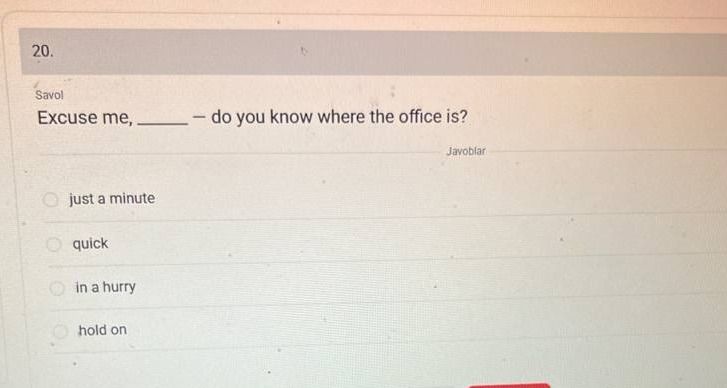
Ответ:
Solution:
To complete the sentence, we need a phrase that is commonly used to politely get someone's attention or ask for a moment before asking a question. Let's analyze the options:
- just a minute: This phrase is often used to ask someone to wait briefly, but it doesn't fit naturally before asking for information like "do you know where the office is?".
- quick: This is an adjective and doesn't fit grammatically or contextually.
- in a hurry: This phrase describes someone's state of being rushed and is not used to initiate a conversation or ask a question.
- hold on: This phrase is similar to "just a minute" and is used to ask someone to wait. However, in this context, it could also be used colloquially to mean "wait a moment" before asking a question. Yet, the most natural and common way to ask for directions politely is to use a phrase that directly asks for attention or a moment's time before the question itself.
Considering common English conversational patterns, the most appropriate phrase to fill the blank and make the sentence flow naturally and politely is 'just a minute'. It functions as an interjection to get the listener's attention before posing the question.
Alternatively, while less common, 'hold on' could also be used in a similar fashion to 'just a minute'. However, 'just a minute' is a more standard and universally understood idiom in this specific context.
Let's re-evaluate the options in the context of politeness and natural flow:
"Excuse me, just a minute - do you know where the office is?" - This sounds a bit unnatural. The phrase 'just a minute' usually precedes an action or a request for the other person to wait.
"Excuse me, quick - do you know where the office is?" - Grammatically incorrect.
"Excuse me, in a hurry - do you know where the office is?" - Grammatically incorrect and doesn't make sense.
"Excuse me, hold on - do you know where the office is?" - This is a possible colloquial option, implying "Wait a second, I have a question."
However, looking at common English usage for asking directions, often a phrase like "Excuse me, could you help me?" or simply "Excuse me," is used. If a phrase is needed to fill the blank, it's usually to indicate a brief pause or request for attention. Let's reconsider the options as fillers.
The phrase "just a minute" or "hold on" usually implies the speaker needs a moment before they speak or before the listener does something. In this case, the speaker is initiating the interaction and asking a question.
Let's consider the possibility that the blank is meant for an adverbial phrase that modifies the act of asking or seeking information.
If we consider the options as ways to pause before speaking, "just a minute" or "hold on" are the most plausible. However, the sentence structure "Excuse me, [phrase] - do you know..." suggests the phrase is a separate utterance or a direct address to the person before the main question.
Let's assume the question is testing the ability to choose the most idiomatic phrase for initiating a polite request for information.
In many contexts, when approaching someone to ask a question, especially if it's a bit of an imposition (like asking for directions), a phrase like "Excuse me" is sufficient. If a filler is absolutely required, we look for what makes the most sense.
Let's consider the meaning of each option again:
just a minute: used to tell someone to wait for a short time. Ex: "Just a minute, I'll be right with you."
quick: happening fast or taking a short time. Ex: "Can you give me a quick answer?"
in a hurry: rushing to do something. Ex: "She left in a hurry."
hold on: wait for a short time. Ex: "Hold on a moment while I find the document."
Given the structure "Excuse me, ____ - do you know where the office is?", none of the options seem to fit perfectly as a direct filler in the way we might expect. However, if forced to choose the least awkward, we might consider the intent of pausing or getting attention.
Let's consider the possibility that the question is flawed or that one of the options is intended to be a colloquialism for initiating a question.
If we interpret the blank as a request for the person to pause and listen, then "just a minute" or "hold on" are the closest. However, the dash suggests a separation of thoughts.
Let's consider a different angle. Sometimes, such phrases are used to soften the interruption. However, "Excuse me" already serves that purpose.
Let's re-examine the options assuming they are all meant to be valid choices. The structure suggests a brief interjection before the question. "Quick" is definitely wrong. "In a hurry" is also wrong.
This leaves "just a minute" and "hold on". Both imply waiting. If the speaker says "Excuse me, just a minute..." it might imply they need a minute to formulate their question, which is unlikely here. If they say "Excuse me, hold on..." it might imply they are about to ask something that might take a moment for the other person to answer or understand.
However, in the context of asking for directions, the most natural phrasing after "Excuse me" would be to directly ask the question or to ask if the person has time. For example: "Excuse me, do you know where the office is?" or "Excuse me, could you tell me where the office is?"
If we must choose one of the given options to fit the blank, let's consider which one is least disruptive to the sentence's meaning and flow, even if not perfectly idiomatic.
The presence of the dash is significant. It separates the initial address/interjection from the main question. In this context, "just a minute" or "hold on" could be interpreted as a preamble, asking the person to pause their activity for a moment before the question is asked. However, it's still a bit unnatural.
Let's look for the most common idiomatic usage. In English, when politely interrupting someone to ask a question, we might say:
* "Excuse me, do you have a moment?"
* "Excuse me, could you help me with something?"
The provided options are not direct questions about the person's availability.
Let's consider the possibility that the question is testing a very specific, perhaps slightly less common, idiom.
Upon further reflection, "just a minute" is the most likely intended answer if we are to interpret the phrase as a request for a brief moment before asking the question. While not the most natural phrasing, it is grammatically plausible as an interjection that is separated by a dash from the main question.
Example: "Excuse me, just a minute - I need to ask you something."
In this case, the
