
 Алгебра
 Английский
 Биология
 География
 Геометрия
 История
 Русский
 Обществознание
 Физика
 Химия
Химия Информатика
 Литература
 Математика
Вопрос:
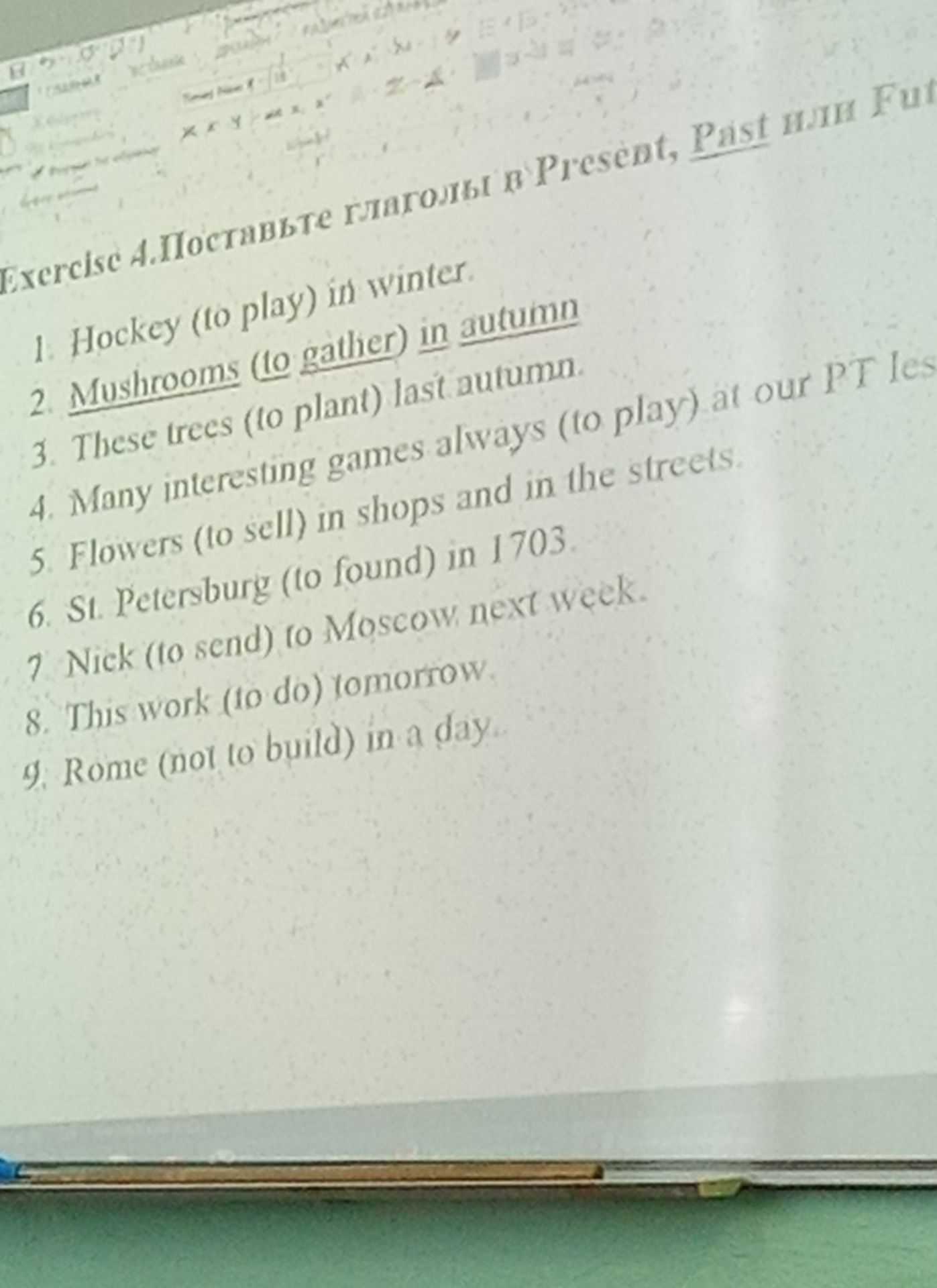
Exercise 4.Поставьте глаголы в Present, Past или Future. 1. Hockey (to play) in winter. 2. Mushrooms (to gather) in autumn 3. These trees (to plant) last autumn. 4. Many interesting games always (to play) at our PT les 5. Flowers (to sell) in shops and in the streets. 6. St. Petersburg (to found) in 1703. 7 Nick (to send) to Moscow next week. 8. This work (to do) tomorrow. 9. Rome (not to build) in a day.
Ответ:
Ответ (EN)
- 1. Hockey plays in winter. (Hockey is a singular noun, so we use the third-person singular present tense).
- 2. Mushrooms (to gather) in autumn. (This sentence is a command or instruction for the reader to gather mushrooms. The infinitive form is used here. If it were a statement about a past or present action, the verb would change. For example, 'We gathered mushrooms in autumn' or 'Mushrooms grow and are gathered in autumn').
- 3. These trees (to plant) last autumn. (This sentence is incomplete. Assuming it's meant to be 'These trees were planted last autumn', the past passive form would be used. If it's an instruction, 'Plant these trees last autumn' would be the imperative. As written, it's a fragment.)
- 4. Many interesting games always (are played) at our PT lessons. (The subject 'games' is plural, and 'always' indicates a habitual action, so the present simple passive is appropriate.)
- 5. Flowers (are sold) in shops and in the streets. (The subject 'flowers' is plural, and the context implies a general statement about where flowers are sold, thus present simple passive.)
- 6. St. Petersburg (was founded) in 1703. (The year 1703 is in the past, and 'found' implies a completed action, so the past simple passive is used.)
- 7. Nick (will be sent) to Moscow next week. (The phrase 'next week' indicates a future event, and the passive voice is implied as Nick is the recipient of the action, not the doer.)
- 8. This work (will be done) tomorrow. (The word 'tomorrow' indicates a future action, and the passive voice is implied as the work is the object of the action.)
- 9. Rome (was not built) in a day. (This is a common idiom expressing that great achievements take time. It refers to the past, so the past simple passive is used.)
Перевод (RU)
- 1. Хоккей играют зимой. (В русском языке часто используется неопределенно-личная форма, где подлежащее не названо, а действие совершается кем-то).
- 2. Грибы (собирать) осенью. (Это инструкция или призыв к действию. Если бы это было повествовательное предложение, то: 'Грибы собирают осенью' или 'Мы собирали грибы осенью').
- 3. Эти деревья (сажать) прошлой осенью. (Предложение не закончено. Если бы это было повествовательное предложение в прошедшем времени, то: 'Эти деревья сажали прошлой осенью' или 'Эти деревья были посажены прошлой осенью'.)
- 4. Много интересных игр всегда (играют) на уроках физкультуры. (В русском языке для общих утверждений часто используется неопределенно-личная форма.)
- 5. Цветы (продаются) в магазинах и на улицах. (Общее утверждение, для которого подходит страдательный залог или неопределенно-личная форма.)
- 6. Санкт-Петербург (был основан) в 1703 году. (Указание на прошедшее время.)
- 7. Ника (отправят) в Москву на следующей неделе. (Указание на будущее время.)
- 8. Эта работа (будет сделана) завтра. (Указание на будущее время.)
- 9. Рим (не был построен) за один день. (Известная пословица, указывающая на прошедшее время.)
