
 Алгебра
 Английский
 Биология
 География
 Геометрия
 История
 Русский
 Обществознание
 Физика
 Химия
 Информатика
 Литература
 Математика
Ответ:
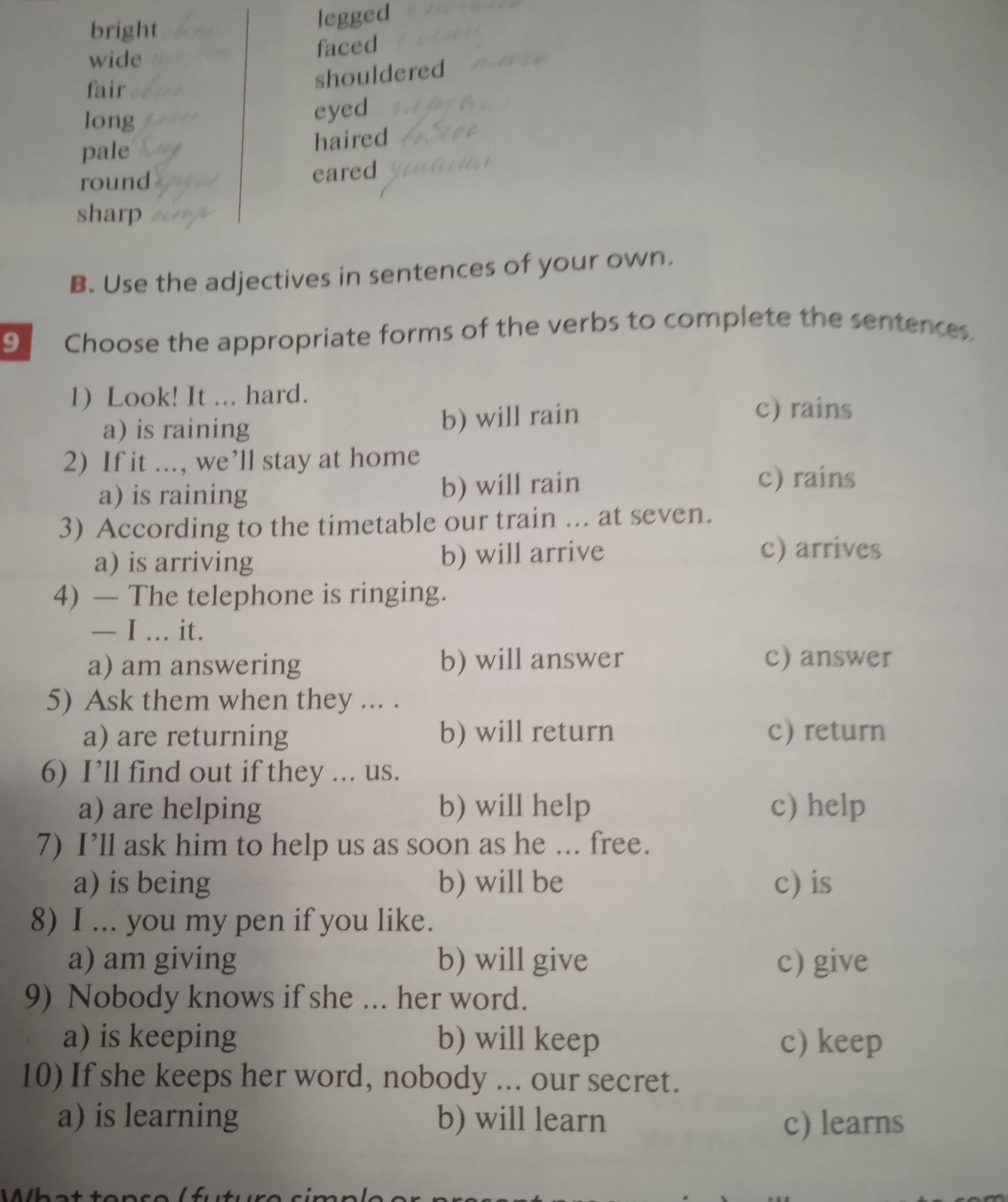
Перевод задания: Выберите подходящие формы глаголов, чтобы закончить предложения.
В придаточных времени и условия о будущем обычно используется Present Simple; в косвенных вопросах о будущем употребляется will. Расписания обычно выражаются Present Simple, а спонтанные решения — Future Simple.
In future time and conditional clauses, Present Simple is generally used; in indirect questions about the future, use will. Timetables are usually expressed with Present Simple, and spontaneous decisions with Future Simple.
В придаточных времени и условия о будущем обычно употребляется Present Simple; в косвенных вопросах о будущем используется will. Расписания обычно выражаются через Present Simple, а спонтанные решения — через Future Simple.
a) is raining — Look! It is raining hard. (Посмотри! Идёт сильный дождь.) Present Continuous describes what is happening now. (Present Continuous описывает то, что происходит сейчас.)
c) rains — If it rains, we’ll stay at home. (Если пойдёт дождь, мы останемся дома.) Use Present Simple in a future conditional clause. (В придаточном условия о будущем используется Present Simple.)
c) arrives — According to the timetable our train arrives at seven. (Согласно расписанию наш поезд прибывает в семь.) Present Simple is used for timetables. (Present Simple используется для расписаний.)
b) will answer — “The telephone is ringing.” “I will answer it.” («Телефон звонит». «Я отвечу».) Future Simple expresses a spontaneous decision. (Future Simple выражает спонтанное решение.)
b) will return — Ask them when they will return. (Спроси их, когда они вернутся.) This is an indirect question about the future. (Это косвенный вопрос о будущем.)
b) will help — I’ll find out if they will help us. (Я выясню, помогут ли они нам.) This is an indirect question, not a conditional clause. (Это косвенный вопрос, а не придаточное условия.)
c) is — I’ll ask him to help us as soon as he is free. (Я попрошу его помочь нам, как только он освободится.) Use Present Simple after as soon as in a future time clause. (После as soon as в придаточном времени о будущем используется Present Simple.)
b) will give — I will give you my pen if you like. (Я дам тебе свою ручку, если хочешь.) The main clause takes Future Simple; the if-clause uses Present Simple. (В главной части используется Future Simple, а в придаточной части с if — Present Simple.)
b) will keep — Nobody knows if she will keep her word. (Никто не знает, сдержит ли она своё слово.) This is an indirect question about the future. (Это косвенный вопрос о будущем.)
b) will learn — If she keeps her word, nobody will learn our secret. (Если она сдержит своё слово, никто не узнает наш секрет.) Use Present Simple in the if-clause and Future Simple in the main clause. (В придаточном с if используется Present Simple, а в главной части — Future Simple.)
