
 Алгебра
 Английский
 Биология
 География
 Геометрия
 История
 Русский
 Обществознание
 Физика
 Химия
Химия Информатика
 Литература
 Математика
Вопрос:
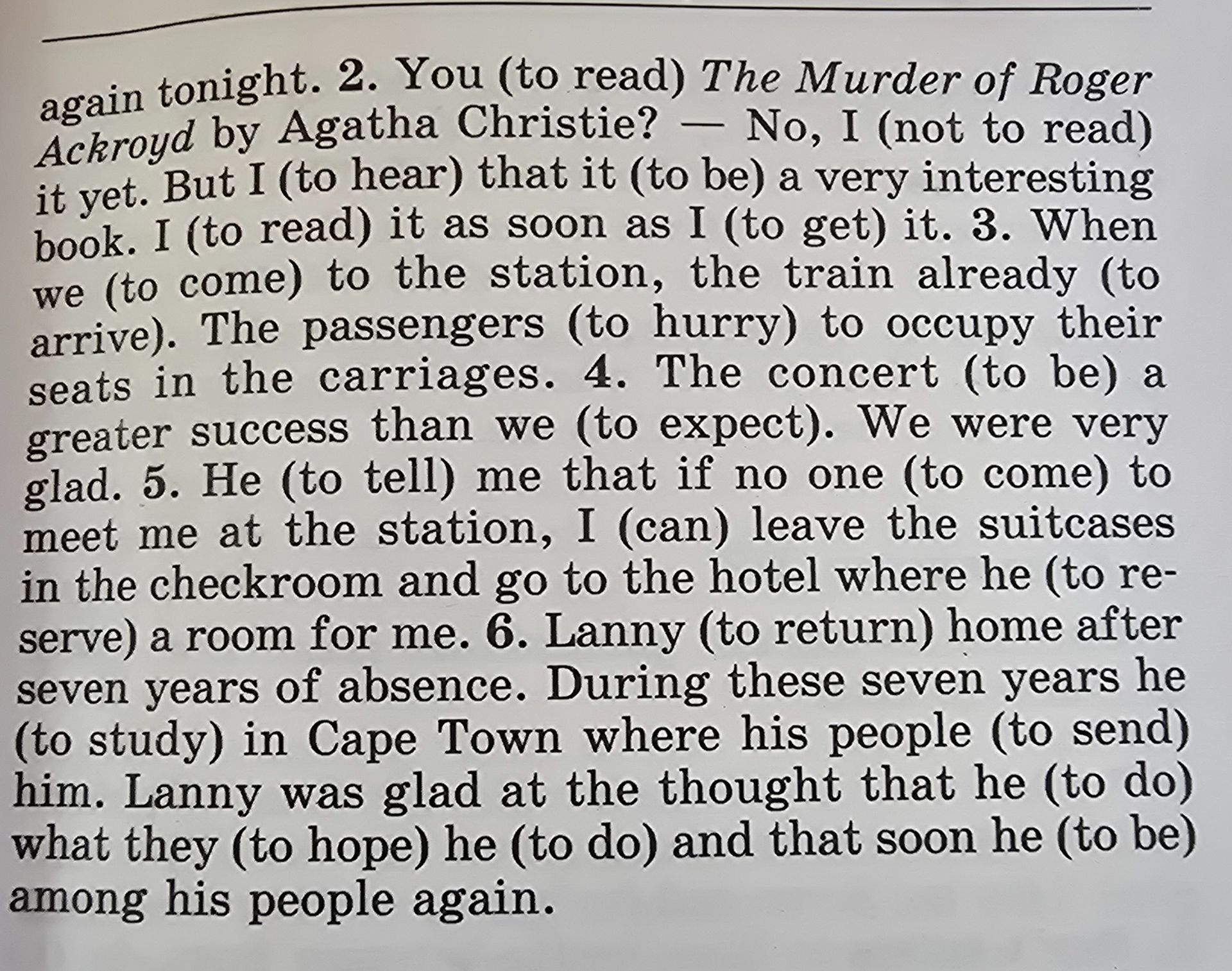
Explain the grammatical structure of the following sentences: 1. You (to read) The Murder of Roger Ackroyd by Agatha Christie? 2. No, I (not to read) it yet. 3. But I (to hear) that it (to be) a very interesting book. 4. I (to read) it as soon as I (to get) it. 5. When we (to come) to the station, the train already (to arrive). 6. The passengers (to hurry) to occupy their seats in the carriages. 7. The concert (to be) a greater success than we (to expect). 8. We were very glad. 9. He (to tell) me that if no one (to come) to meet me at the station, I (can) leave the suitcases in the checkroom and go to the hotel where he (to reserve) a room for me. 10. Lanny (to return) home after seven years of absence. 11. During these seven years he (to study) in Cape Town where his people (to send) him. 12. Lanny was glad at the thought that he (to do) what they (to hope) he (to do) and that soon he (to be) among his people again.
Ответ:
Grammatical Structure Analysis:
The sentences provided are examples of the infinitive construction in English, often used to express future actions or intentions. The parenthetical 'to + verb' indicates the infinitive form which, in these contexts, is being replaced by the appropriate tense or modal verb to form a complete and grammatically correct sentence.
- You (to read) The Murder of Roger Ackroyd by Agatha Christie?
Analysis: This is a question in the present simple tense. The infinitive 'to read' is replaced by 'read'.
Corrected: You read The Murder of Roger Ackroyd by Agatha Christie? - No, I (not to read) it yet.
Analysis: This is a negative statement in the present perfect tense. The infinitive 'not to read' is replaced by 'have not read' or 'haven't read'.
Corrected: No, I have not read it yet. - But I (to hear) that it (to be) a very interesting book.
Analysis: This sentence uses the present simple tense. 'to hear' becomes 'hear' and 'to be' becomes 'is'.
Corrected: But I hear that it is a very interesting book. - I (to read) it as soon as I (to get) it.
Analysis: This sentence uses the present simple tense for both verbs, indicating a general truth or a habitual action.
Corrected: I read it as soon as I get it. - When we (to come) to the station, the train already (to arrive).
Analysis: The first clause uses the present simple tense. The second clause uses the present perfect tense to indicate an action completed before another past action or time.
Corrected: When we come to the station, the train has already arrived. - The passengers (to hurry) to occupy their seats in the carriages.
Analysis: This is a statement in the present simple tense.
Corrected: The passengers hurry to occupy their seats in the carriages. - The concert (to be) a greater success than we (to expect).
Analysis: Both verbs are in the present simple tense.
Corrected: The concert is a greater success than we expect. - We were very glad.
Analysis: This is a simple past tense statement.
Corrected: We were very glad. - He (to tell) me that if no one (to come) to meet me at the station, I (can) leave the suitcases in the checkroom and go to the hotel where he (to reserve) a room for me.
Analysis: 'to tell' is in the present simple. 'to come' is in the present simple (in a conditional clause). 'can' is a modal verb, correctly used here. 'to reserve' is in the present simple.
Corrected: He tells me that if no one comes to meet me at the station, I can leave the suitcases in the checkroom and go to the hotel where he reserves a room for me. - Lanny (to return) home after seven years of absence.
Analysis: This is a statement in the present simple tense.
Corrected: Lanny returns home after seven years of absence. - During these seven years he (to study) in Cape Town where his people (to send) him.
Analysis: The first verb is in the present perfect continuous tense, indicating an action that started in the past and continued up to the present. The second verb is in the present simple.
Corrected: During these seven years he has been studying in Cape Town where his people send him. - Lanny was glad at the thought that he (to do) what they (to hope) he (to do) and that soon he (to be) among his people again.
Analysis: 'to do' in the first instance is in the past simple. 'to hope' is in the past simple. 'to do' in the second instance is in the past simple. 'to be' is in the past simple.
Corrected: Lanny was glad at the thought that he did what they hoped he did and that soon he would be among his people again.
Note: The original sentences use parenthetical infinitives to indicate the intended verb. The corrections provided replace these infinitives with the grammatically appropriate tense or modal verb based on the context of each sentence.
