
 Алгебра
 Английский
 Биология
 География
 Геометрия
 История
 Русский
 Обществознание
 Физика
 Химия
 Информатика
 Литература
 Математика
Ответ:
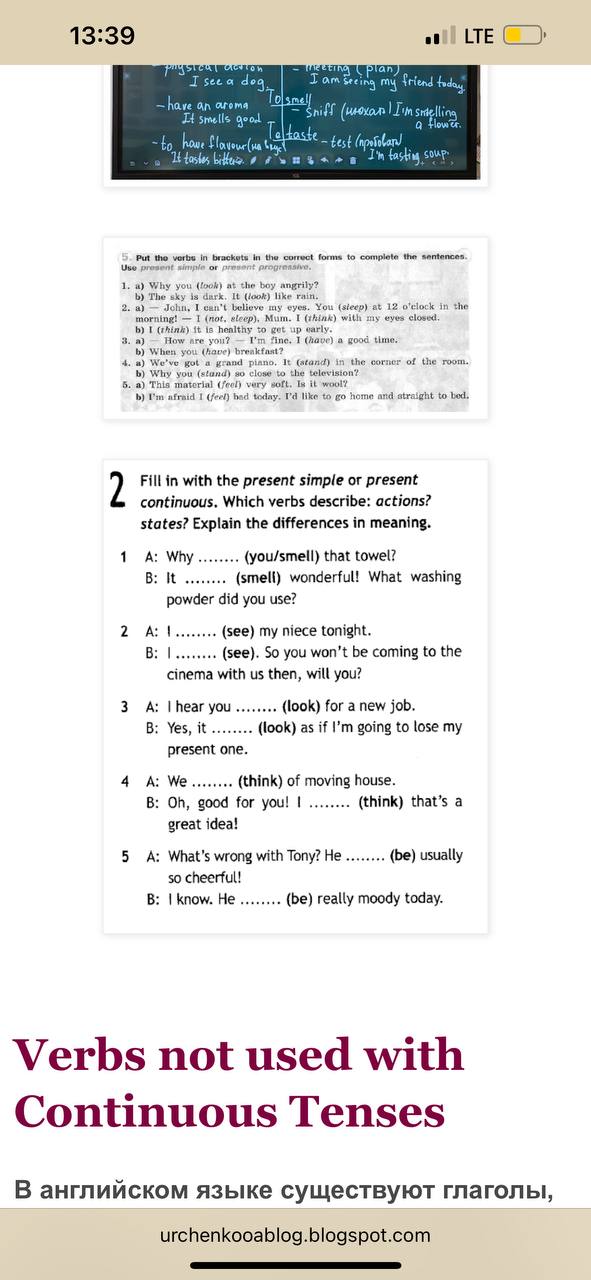
- A: Why are you smelling (you/smell) that towel?
B: It smells (smell) wonderful! What washing powder did you use?
The verb "smell" can describe both an action (the act of smelling something) and a state (the characteristic smell of something). In the first sentence, it describes an action. In the second sentence, it describes a state. - A: I am seeing (see) my niece tonight.
B: I see (see). So you won't be coming to the cinema with us then, will you?
The verb "see" can describe both an action (meeting someone) and a state (understanding). In the first sentence, it describes an action. In the second sentence, it describes a state. - A: I hear you are looking (look) for a new job.
B: Yes, it looks (look) as if I'm going to lose my present one.
The verb "look" can describe both an action (the act of looking) and a state (appearing). In the first sentence, it describes an action. In the second sentence, it describes a state. - A: We are thinking (think) of moving house.
B: Oh, good for you! I think (think) that's a great idea!
The verb "think" can describe both an action (the act of thinking) and a state (having an opinion). In the first sentence, it describes an action. In the second sentence, it describes a state. - A: What's wrong with Tony? He is (be) usually so cheerful!
B: I know. He is being (be) really moody today.
The verb "be" can describe both a state (a permanent condition) and an action (a temporary behavior). In the first sentence, it describes a state. In the second sentence, it describes an action.
