
 Алгебра
 Английский
 Биология
 География
 Геометрия
 История
 Русский
 Обществознание
 Физика
 Химия
Химия Информатика
 Литература
 Математика
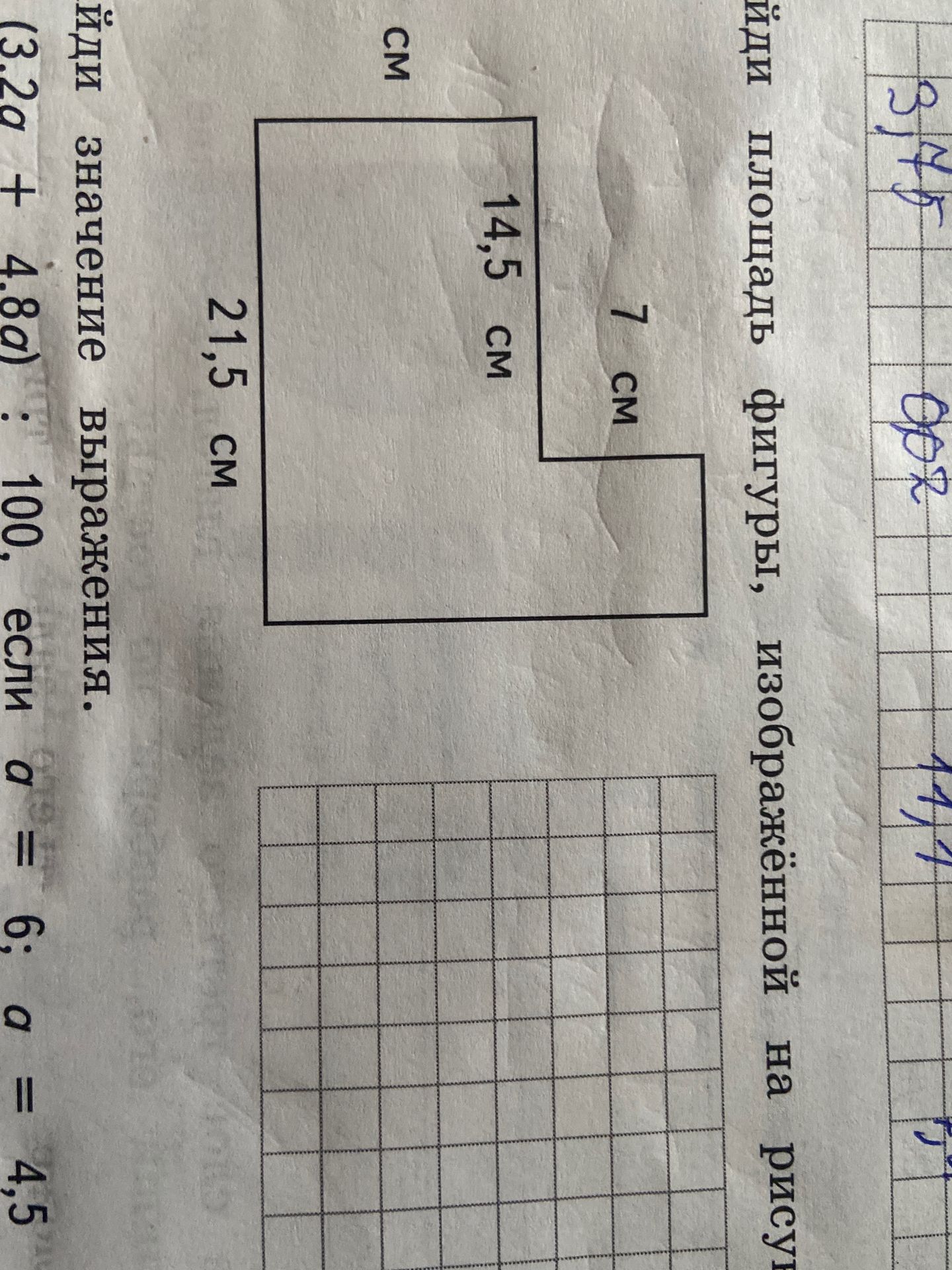
Find the area of the figure shown in the drawing. Calculate the value of the expression (3.2a + 4.8a) : 100, if a = 6; a = 4.5.
Ответ:
Solution:
The figure is an L-shaped polygon. We can divide it into two rectangles.
Option 1: Divide into a 21.5 cm x 7 cm rectangle and a 14.5 cm x (21.5 - 7) cm rectangle.
Area of the first rectangle: \( A_1 = 21.5 \text{ cm} \times 7 \text{ cm} = 150.5 \text{ cm}^2 \)
The second rectangle has dimensions 14.5 cm and \( 21.5 - 7 = 14.5 \text{ cm} \).
Area of the second rectangle: \( A_2 = 14.5 \text{ cm} \times 14.5 \text{ cm} = 210.25 \text{ cm}^2 \)
Total area: \( A = A_1 + A_2 = 150.5 \text{ cm}^2 + 210.25 \text{ cm}^2 = 360.75 \text{ cm}^2 \)
Option 2: Divide into a 21.5 cm x (14.5 + 7) cm rectangle and a (21.5 - 14.5) cm x 7 cm rectangle. This is incorrect based on the given dimensions.
Option 3: Divide into a 21.5 cm x 14.5 cm rectangle and a 7 cm x (21.5 - 14.5) cm rectangle. This is also incorrect.
Option 4: Divide into a 7 cm x 14.5 cm rectangle and a (21.5 + 7) cm x ? cm rectangle. This is also incorrect.
Let's re-examine the figure and dimensions.
The figure can be seen as a large rectangle with a smaller rectangle removed from a corner.
Method 1: Subtracting a smaller rectangle from a larger one.
Assume the overall shape is a rectangle of 21.5 cm by \( 14.5 + 7 = 21.5 \) cm. This is a square. Then a rectangle of \( 21.5 - 14.5 = 7 \) cm by \( 21.5 - 7 = 14.5 \) cm is removed. This does not match the figure.
Method 2: Adding two rectangles.
Rectangle 1: 21.5 cm x 7 cm. Area \( = 21.5 \times 7 = 150.5 \text{ cm}^2 \).
Rectangle 2: 14.5 cm x \( 21.5 - 7 = 14.5 \) cm. Area \( = 14.5 \times 14.5 = 210.25 \text{ cm}^2 \).
Total Area \( = 150.5 + 210.25 = 360.75 \text{ cm}^2 \).
Let's reconsider the L-shape by splitting it differently.
Rectangle A: 21.5 cm x 7 cm. Area = \( 21.5 \times 7 = 150.5 \text{ cm}^2 \).
The remaining part is a rectangle with width 14.5 cm and height \( 21.5 - 7 = 14.5 \) cm. Area = \( 14.5 \times 14.5 = 210.25 \text{ cm}^2 \). This is incorrect based on how the dimensions are shown.
Correct interpretation of dimensions:
Let's split the shape into two rectangles.
Rectangle 1: 21.5 cm (height) and 7 cm (width at the top part). Area \( = 21.5 \times 7 = 150.5 \text{ cm}^2 \).
Rectangle 2: 14.5 cm (height) and \( 21.5 - 7 = 14.5 \) cm (width of the bottom part). This is still incorrect.
Let's assume the horizontal dimension at the bottom is 21.5 cm and the vertical dimension on the left is 21.5 cm.
The L-shape can be formed by a large rectangle of 21.5 cm x 21.5 cm, with a smaller rectangle of \( 21.5 - 14.5 = 7 \) cm by \( 21.5 - 7 = 14.5 \) cm removed from a corner. This does not match the figure.
Let's use the provided dimensions directly to form two rectangles.
Rectangle A: 21.5 cm (length) x 7 cm (width). Area \( = 21.5 \times 7 = 150.5 \text{ cm}^2 \).
The other part is a rectangle with width 14.5 cm. Its height is \( 21.5 - 7 = 14.5 \) cm. Area \( = 14.5 \times 14.5 = 210.25 \text{ cm}^2 \).
This is still not fitting. Let's assume the outer dimensions are 21.5 cm and \( 14.5+7=21.5 \) cm. Then the inner cutout is \( 21.5-14.5=7 \) cm by \( 21.5-7=14.5 \) cm. This doesn't match.
Let's assume the larger vertical side is 21.5 cm, and the larger horizontal side is composed of 14.5 cm and 7 cm.
Let's break the figure into two rectangles:
Rectangle 1: Dimensions 21.5 cm (height) and 7 cm (width). Area \( = 21.5 \times 7 = 150.5 \text{ cm}^2 \).
Rectangle 2: Dimensions \( 21.5 - 7 = 14.5 \) cm (height) and 14.5 cm (width). Area \( = 14.5 \times 14.5 = 210.25 \text{ cm}^2 \).
Total Area \( = 150.5 + 210.25 = 360.75 \text{ cm}^2 \).
Let's try another split.
Rectangle 1: 14.5 cm (height) and 21.5 cm (width). Area \( = 14.5 \times 21.5 = 311.75 \text{ cm}^2 \).
Rectangle 2: 7 cm (height) and \( 21.5 - 14.5 = 7 \) cm (width). Area \( = 7 \times 7 = 49 \text{ cm}^2 \).
Total Area \( = 311.75 + 49 = 360.75 \text{ cm}^2 \).
The calculation is consistent: \( 360.75 \text{ cm}^2 \).
Now, calculate the value of the expression:
Expression: \( (3.2a + 4.8a) : 100 \)
First, simplify the expression inside the parentheses:
\( 3.2a + 4.8a = (3.2 + 4.8)a = 8a \)
So the expression becomes \( 8a : 100 \) or \( \frac{8a}{100} \).
Case 1: If a = 6
Value = \( (8 \times 6) : 100 = 48 : 100 = 0.48 \)
Case 2: If a = 4.5
Value = \( (8 \times 4.5) : 100 = 36 : 100 = 0.36 \)
Final Answer
Area of the figure is \( 360.75 \text{ cm}^2 \).
The value of the expression \( (3.2a + 4.8a) : 100 \) is \( 0.48 \) when \( a=6 \) and \( 0.36 \) when \( a=4.5 \).
Ответ: Площадь фигуры равна 360,75 см². Значение выражения (3,2a + 4,8a) : 100 равно 0,48 при a = 6 и 0,36 при a = 4,5.
