
 Алгебра
 Английский
 Биология
 География
 Геометрия
 История
 Русский
 Обществознание
 Физика
 Химия
Химия Информатика
 Литература
 Математика
Find the values of x and y in the given figure.
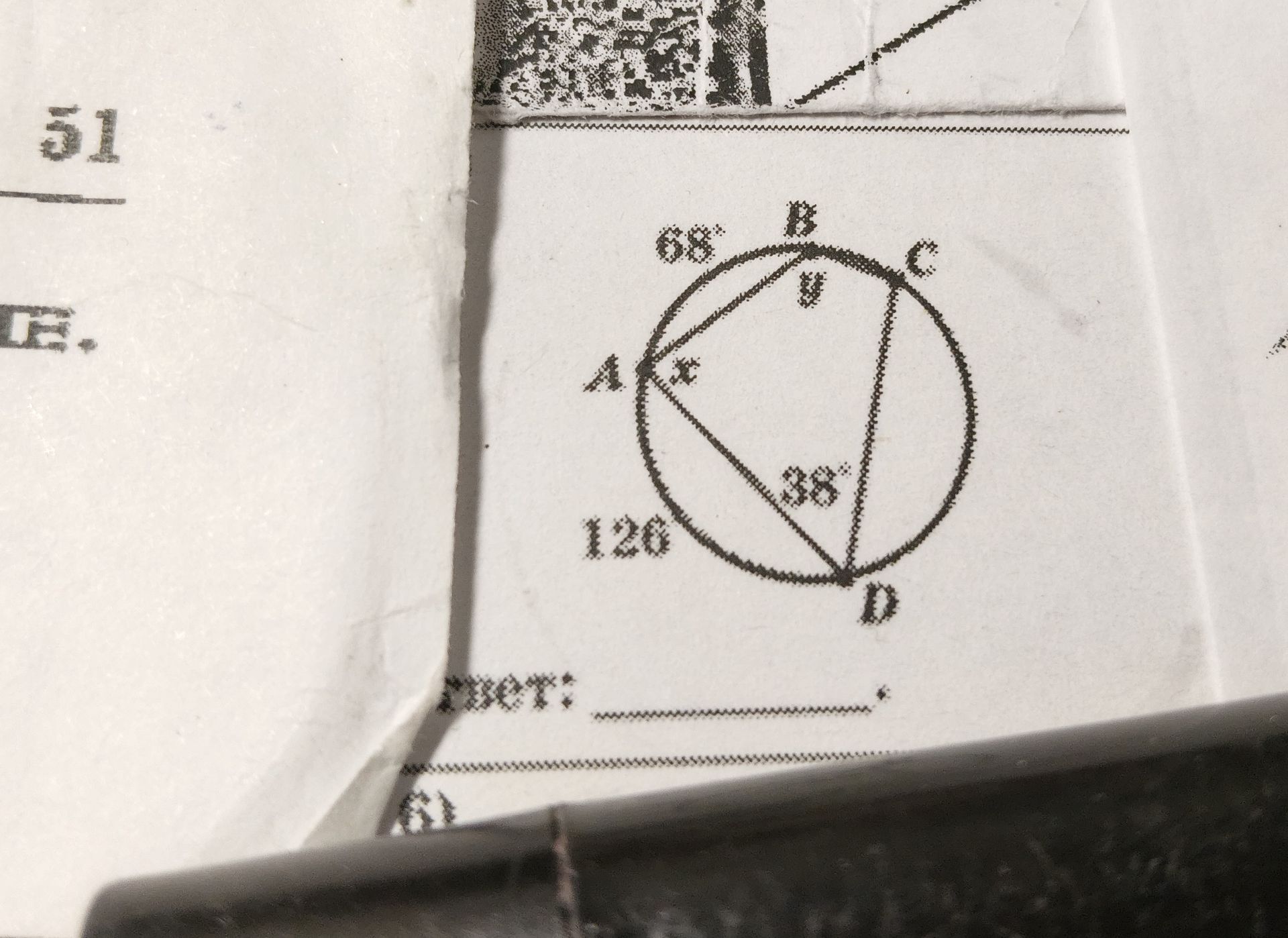
Ответ:
Solution:
The given figure is a circle with inscribed quadrilateral ABCD. We are given the measures of some arcs and angles.
Finding the value of angle x:
Angle x is an inscribed angle subtended by arc BC. The measure of an inscribed angle is half the measure of its intercepted arc. However, we do not know the measure of arc BC directly. Instead, angle x is part of triangle ABC.
We are given that the arc measuring 120 degrees is the arc AD. Angle ABC is an inscribed angle subtended by arc ADC. The measure of arc ADC = arc AD + arc DC. Since arc AD = 120 degrees, we need to find arc DC.
Angle ABC = \( y \). The arc intercepted by angle ABC is arc ADC.
Angle BCD is an inscribed angle subtended by arc BAD. The measure of arc BAD = arc BA + arc AD. We are given that arc AB = 68 degrees and arc AD = 120 degrees. So, arc BAD = 68 + 120 = 188 degrees. Therefore, angle BCD = \( \frac{1}{2} \times 188 = 94 \) degrees.
Angle CDA is an inscribed angle subtended by arc CBA. The measure of arc CBA = arc CB + arc BA. We don't know arc CB.
Angle DAB is an inscribed angle subtended by arc BCD. The measure of arc BCD = arc BC + arc CD. We don't know arc BC or arc CD.
Let's use the given angle 38 degrees. This 38 degrees is likely referring to angle CAD or angle CBD. Assuming it is angle CBD. Angle CBD is an inscribed angle subtended by arc CD. Thus, arc CD = 2 * 38 = 76 degrees.
Now we can find arc BC. The sum of arcs in a circle is 360 degrees.
arc AB + arc BC + arc CD + arc AD = 360 degrees
68 + arc BC + 76 + 120 = 360
arc BC + 264 = 360
arc BC = 360 - 264 = 96 degrees.
Now we can find x and y:
Angle x is angle CAD. Angle CAD is an inscribed angle subtended by arc CD. Therefore, \( x = \frac{1}{2} \times \text{arc CD} \). Since we assumed arc CD = 76 degrees based on the 38 degree angle, \( x = \frac{1}{2} \times 76 = 38 \) degrees.
Angle y is angle ABC. Angle ABC is an inscribed angle subtended by arc ADC. Arc ADC = arc AD + arc CD = 120 + 76 = 196 degrees. Therefore, \( y = \frac{1}{2} \times \text{arc ADC} = \frac{1}{2} \times 196 = 98 \) degrees.
Let's re-evaluate the meaning of the 38 degree angle. If the 38 degree angle is angle BAC, then arc BC = 2 * 38 = 76 degrees.
If arc BC = 76 degrees, then arc AB + arc BC + arc CD + arc AD = 360 degrees.
68 + 76 + arc CD + 120 = 360
264 + arc CD = 360
arc CD = 360 - 264 = 96 degrees.
Now find x and y.
x = angle CAD. This subtends arc CD. So, \( x = \frac{1}{2} \times \text{arc CD} = \frac{1}{2} \times 96 = 48 \) degrees.
y = angle ABC. This subtends arc ADC. Arc ADC = arc AD + arc CD = 120 + 96 = 216 degrees. So, \( y = \frac{1}{2} \times \text{arc ADC} = \frac{1}{2} \times 216 = 108 \) degrees.
Let's consider the case where 38 degrees is angle ACB. Then arc AB = 2 * 38 = 76. But we are given arc AB = 68 degrees, so this is incorrect.
Let's consider the case where 38 degrees is angle DAC. Then arc CD = 2 * 38 = 76 degrees. This is the first case we tried.
Let's consider the case where 38 degrees is angle ACD. Then arc AD = 2 * 38 = 76. But we are given arc AD = 120 degrees, so this is incorrect.
Let's consider the case where 38 degrees is angle BDC. Then arc BC = 2 * 38 = 76 degrees. This is the second case we tried.
Let's consider the case where 38 degrees is angle ABD. Then arc AD = 2 * 38 = 76. But we are given arc AD = 120 degrees, so this is incorrect.
Let's consider the case where 38 degrees is angle CAD. Then arc CD = 2 * 38 = 76 degrees. This is the first case we tried. x = 38, y = 98.
Let's assume the 38 degree angle is angle CBD. Then arc CD = 2 * 38 = 76 degrees. The first case works. x = 38, y = 98.
Let's assume the 38 degree angle is angle BAC. Then arc BC = 2 * 38 = 76 degrees. The second case works. x = 48, y = 108.
Given the position of the number 38, it is most likely referring to an angle inside the quadrilateral or a central angle. The number 38 is near vertex D and connected to vertex C. It is also near vertex B. It is likely angle CBD or angle BAC or angle CAD or angle BDC.
If 38 is angle CAD, then x=38, arc CD = 76. arc BC = 360 - 120 - 68 - 76 = 96. y = (120+76)/2 = 196/2 = 98.
If 38 is angle BAC, then arc BC = 76. arc CD = 360 - 120 - 68 - 76 = 96. x = 96/2 = 48. y = (120+96)/2 = 216/2 = 108.
The number 38 is placed such that it seems to be an angle within triangle BCD or triangle ABC or triangle ACD. It is positioned near vertex D and arc BC. It is also positioned near vertex B and arc CD.
Let's consider the angle subtended by arc BC. If angle BAC = 38, then arc BC = 76. Then arc CD = 360 - 120 - 68 - 76 = 96. x = angle CAD = arc CD / 2 = 96 / 2 = 48. y = angle ABC = (arc AD + arc CD) / 2 = (120 + 96) / 2 = 216 / 2 = 108.
If angle CBD = 38, then arc CD = 76. Then arc BC = 360 - 120 - 68 - 76 = 96. x = angle CAD = arc CD / 2 = 76 / 2 = 38. y = angle ABC = (arc AD + arc CD) / 2 = (120 + 76) / 2 = 196 / 2 = 98.
Given the position, it is most likely that the 38 degrees refers to angle CAD or angle CBD or angle BAC or angle BDC. The number 120 is clearly an arc measure. The number 68 is clearly an arc measure. The labels x and y are angles.
Assuming 38 degrees is angle BAC, then arc BC = 2 * 38 = 76 degrees.
The sum of arcs in a circle is 360 degrees.
arc AB + arc BC + arc CD + arc AD = 360
68 + 76 + arc CD + 120 = 360
264 + arc CD = 360
arc CD = 360 - 264 = 96 degrees.
Now we can find x and y.
x is angle CAD. Angle CAD is an inscribed angle subtended by arc CD.
\( x = \frac{\text{arc CD}}{2} = \frac{96}{2} = 48 \) degrees.
y is angle ABC. Angle ABC is an inscribed angle subtended by arc ADC.
arc ADC = arc AD + arc CD = 120 + 96 = 216 degrees.
\( y = \frac{\text{arc ADC}}{2} = \frac{216}{2} = 108 \) degrees.
Let's verify using another approach. The sum of opposite angles in a cyclic quadrilateral is 180 degrees.
Angle DAB + Angle BCD = 180.
Angle ABC + Angle CDA = 180.
Angle DAB subtends arc BCD = arc BC + arc CD = 76 + 96 = 172 degrees. So Angle DAB = 172 / 2 = 86 degrees.
Angle BCD subtends arc BAD = arc BA + arc AD = 68 + 120 = 188 degrees. So Angle BCD = 188 / 2 = 94 degrees.
86 + 94 = 180. This is consistent.
Angle ABC = y = 108 degrees.
Angle CDA subtends arc CBA = arc CB + arc BA = 76 + 68 = 144 degrees. So Angle CDA = 144 / 2 = 72 degrees.
108 + 72 = 180. This is also consistent.
Therefore, the assumption that the 38 degree angle is BAC is correct.
Final Answer: x = 48 degrees, y = 108 degrees.
