
 Алгебра
 Английский
 Биология
 География
 Геометрия
 История
 Русский
 Обществознание
 Физика
 Химия
Химия Информатика
 Литература
 Математика
Вопрос:
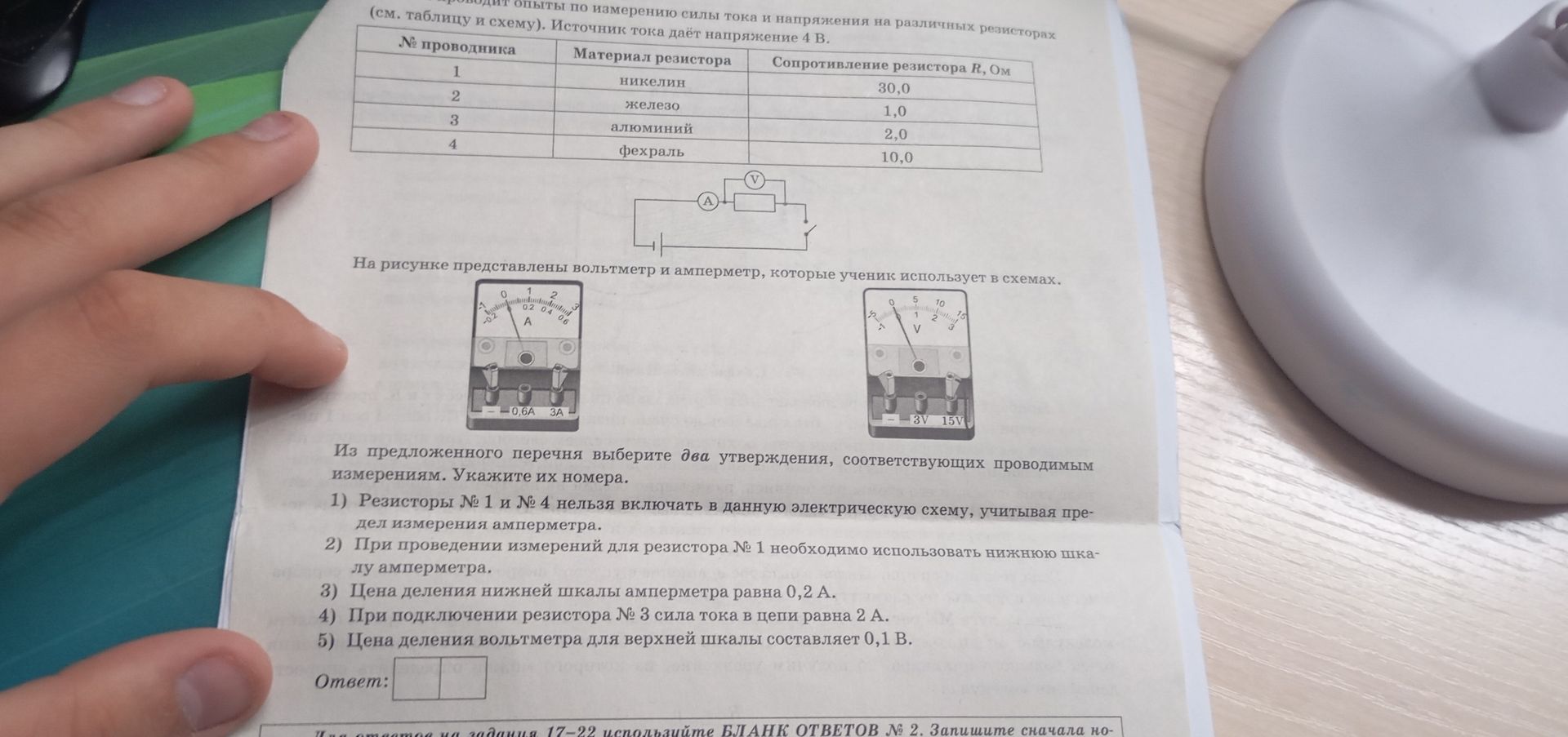
From the proposed list, select two statements corresponding to the conducted measurements. Indicate their numbers. 1) Resistors No. 1 and No. 4 cannot be included in this electrical circuit, considering the ammeter's measurement range. 2) When measuring for resistor No. 1, it is necessary to use the lower ammeter scale. 3) The division value of the lower ammeter scale is 0.2 A. 4) When resistor No. 3 is connected, the current in the circuit is 2 A. 5) The division value of the voltmeter for the upper scale is 0.1 V.
Ответ:
Analysis:
Let's analyze each statement based on the provided information (table, circuit diagram, voltmeter, and ammeter readings).
Table:
- Resistor No. 1: Material - nichrome, Resistance - 30.0 Ohms.
- Resistor No. 2: Material - iron, Resistance - 1.0 Ohm.
- Resistor No. 3: Material - aluminum, Resistance - 2.0 Ohms.
- Resistor No. 4: Material - kanthal, Resistance - 10.0 Ohms.
Circuit Diagram:
The circuit shows a source of voltage (4 V), a switch, a resistor, an ammeter (A), and a voltmeter (V) connected in series with the resistor. The voltmeter is connected in parallel to the resistor.
Voltmeter:
- The voltmeter has two scales: 3V and 15V.
- The needle is pointing to approximately 2V on the upper scale.
- The upper scale is labeled 0, 1, 2, 3, 4, 5 with divisions. It seems to correspond to the 15V range.
- The lower scale is labeled 0, 0.2, 0.4, 0.6. It seems to correspond to the 3V range.
- The needle is pointing to about 2 on the upper scale. If this is the 3V range, it would be around 2V. If it's the 15V range, it would be around 10V. However, the pointer position is closer to the '2' mark on the upper scale, which is labelled 'V'. The scale for 'V' goes up to 5, with markings at 1, 2, 3, 4, 5. The needle is at 2. So, V = 2V.
Ammeter:
- The ammeter has two scales: 0.6A and 3A.
- The lower scale is labeled 0, 0.2, 0.4, 0.6 A.
- The upper scale is labeled 0, 1, 2, 3 A.
- The needle is pointing to approximately 0.4 A on the lower scale.
Analysis of Statements:
- Statement 1: Resistors No. 1 and No. 4 cannot be included in this electrical circuit, considering the ammeter's measurement range.
The voltage source is 4V. We can use Ohm's Law \( I = \frac{V}{R} \) to estimate the current for each resistor.
For Resistor No. 1 (R=30 Ohm): \( I = \frac{4V}{30 \Omega} \approx 0.13A \). This is within the 0.6A range of the ammeter.
For Resistor No. 4 (R=10 Ohm): \( I = \frac{4V}{10 \Omega} = 0.4A \). This is also within the 0.6A range of the ammeter.
Therefore, this statement is FALSE. - Statement 2: When measuring for resistor No. 1, it is necessary to use the lower ammeter scale.
As calculated above, for R=30 Ohm and V=4V, the current is approximately 0.13A. The lower ammeter scale is 0-0.6A. This scale is appropriate for measuring 0.13A accurately.
Therefore, this statement is TRUE. - Statement 3: The division value of the lower ammeter scale is 0.2 A.
The lower ammeter scale is labeled 0, 0.2, 0.4, 0.6 A. The interval between 0 and 0.2 is one division, between 0.2 and 0.4 is one division, and between 0.4 and 0.6 is one division. This means the smallest division is indeed 0.2A. The needle points to 0.4A, which is 2 divisions from 0, and the value is 0.4A. This indicates the division is 0.2A. Let's check the needle position: it is at the '0.4' mark. The division value is (0.6-0)/3 = 0.2A. So, yes, the division value is 0.2A. This statement is TRUE. - Statement 4: When resistor No. 3 is connected, the current in the circuit is 2 A.
For Resistor No. 3 (R=2 Ohm) and V=4V: \( I = \frac{4V}{2 \Omega} = 2A \). The ammeter has a 3A upper scale. So, a current of 2A is possible. However, the statement claims the current *is* 2A. Let's re-examine the provided ammeter readings. The needle is at 0.4A on the lower scale. This doesn't directly tell us the current for resistor 3, but it confirms the ammeter is being used. The question asks to select two statements corresponding to the *conducted measurements*. The image shows a snapshot of a measurement being taken (needle at 0.4A, needle at ~2V). We cannot assume that resistor 3 was used for this specific snapshot. However, if we interpret this statement as a potential scenario, then Ohm's law calculation shows it would be 2A. The question is whether this statement is consistent with *possible* measurements. Given the source voltage of 4V and resistor 3 having 2 Ohms, the current would be 2A. The ammeter's 3A scale can measure this. But the provided ammeter reading is 0.4A. So, this particular snapshot does not correspond to resistor 3. If the question implies
