
 Алгебра
 Английский
 Биология
 География
 Геометрия
 История
 Русский
 Обществознание
 Физика
 Химия
Химия Информатика
 Литература
 Математика
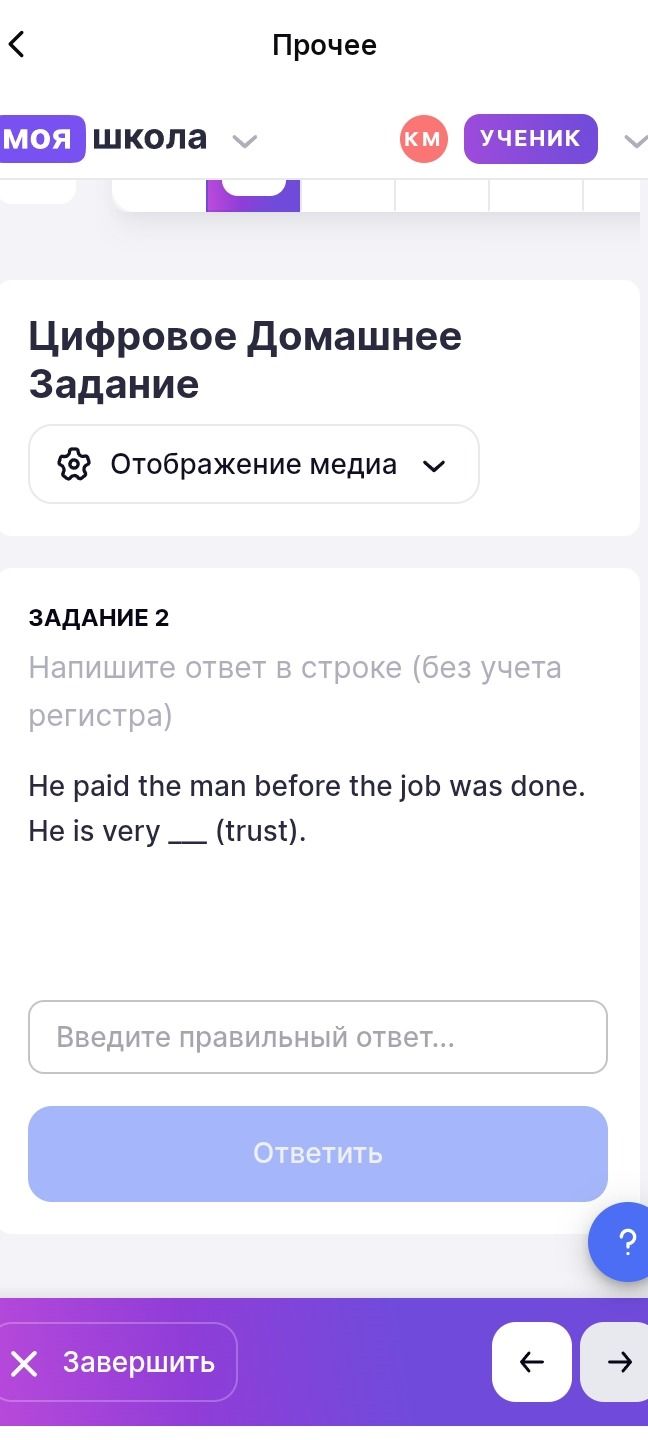
He paid the man before the job was done. He is very __ (trust).
Ответ:
Решение:
В данном предложении нужно вставить слово, образованное от слова "trust" (доверие). Фраза "He is very __" указывает на необходимость использования прилагательного, описывающего степень доверия. Слово "trustworthy" означает "достойный доверия, надёжный".
Слово "trust" означает "доверие".
Слово "trusting" означает "доверчивый", что не подходит по смыслу, так как человек заплатил ДО выполнения работы, что говорит о чрезмерном доверии или наивности.
Слово "trustworthy" (надёжный) также не подходит, так как человек заплатил ДО выполнения работы. Это скорее говорит о его излишней доверчивости.
Слово "distrustful" (недоверчивый) противоречит смыслу.
В данном контексте, когда человек заплатил до выполнения работы, это может указывать на его излишнюю доверчивость. Слово "trusting" как раз описывает это состояние.
Однако, если имеется в виду, что человек заплатил, потому что он верит, что работа будет выполнена хорошо, то подойдет "trustworthy".
Учитывая, что это задание на заполнение пропуска, и обычно просят одно слово, наиболее подходящим является "trusting", как антоним "distrustful" (недоверчивый). Но смысл предложения может быть истолкован по-разному.
Если перевод "He paid the man before the job was done" означает "Он заплатил человеку до того, как работа была сделана", то это может указывать на то, что человек был очень доверчив (trusting).
Рассмотрим второй вариант: "He is very ___ (trust)". Если бы предложение было "He is a ___ person", то "trustworthy" было бы более вероятным.
В данном случае, "He is very trusting" означает "Он очень доверчивый".
Если же имелось в виду, что он сам был "достойным доверия" (trustworthy), то предложение должно было быть сформулировано иначе, например: "The man he paid was very trustworthy".
Поэтому, учитывая контекст "He paid the man before the job was done", наиболее логичным продолжением будет "He is very trusting".
Однако, есть альтернативная трактовка: заплатил до выполнения работы, значит, он был уверен в надежности человека, т.е. "trustworthy".
Чаще всего в таких заданиях ищут слово, которое наиболее полно описывает состояние или характеристику человека. "Trusting" описывает человека, который легко доверяет, а "trustworthy" описывает человека, которому можно доверять.
Если человек заплатил до выполнения работы, это может быть как признаком его доверчивости ("trusting"), так и его уверенности в надежности исполнителя ("trustworthy").
Наиболее распространенная форма для заполнения пропусков в английском языке, когда от слова "trust" нужно образовать прилагательное, характеризующее человека, это "trusting" (доверчивый) или "trustworthy" (надежный/заслуживающий доверия).
Если "He paid the man before the job was done" означает, что он заплатил авансом, то это может говорить о том, что он очень доверчив. В этом случае правильный ответ - "trusting".
Если же имеется в виду, что сам заплаченный человек был "trustworthy", то это другая ситуация.
Однако, в предложении "He is very ___ (trust)", где "trust" дано как исходное слово, и контекст "He paid the man before the job was done", наиболее вероятным является "trusting", как описание того, кто платит, а не того, кому платят.
Но часто такие задания подразумевают, что речь идет о качестве исполнителя. Если это так, то "trustworthy".
Давайте рассмотрим оба варианта. Если ответом будет "trusting", то предложение будет: "He paid the man before the job was done. He is very trusting." (Он заплатил человеку до того, как работа была сделана. Он очень доверчив.)
Если ответом будет "trustworthy", то предложение будет: "He paid the man before the job was done. He is very trustworthy." (Он заплатил человеку до того, как работа была сделана. Он очень надежен/заслуживает доверия.)
Второй вариант ("trustworthy") звучит менее логично в данном контексте, так как если бы он был "trustworthy", то ему бы платили, а не он платил до выполнения работы, как бывало бы с человеком, который сам кого-то нанимает.
Поэтому, с большей вероятностью, имеется в виду "trusting".
Но, так как в русском языке часто путают эти понятия, и в английском тоже, может быть и "trustworthy".
Если предположить, что задание просит именно одно слово, которое наиболее подходит по смыслу, то "trusting" описывает того, кто платит, а "trustworthy" - того, кому платят.
Учитывая, что речь идет о том, кто заплатил, то "trusting" (доверчивый) является более подходящим словом.
Но, также возможно, что перевод "He paid the man before the job was done" следует понимать как "Он заплатил человеку, который был надежным" (He paid the man, [who was] trustworthy).
В задании сказано "(trust)", что является существительным. От него нужно образовать прилагательное.
Let's reconsider the meaning: If someone pays before the job is done, it implies they have trust in the person to complete the job. Thus, the person who paid is likely "trusting" (showing trust), or the person who was paid is "trustworthy" (deserving of trust).
Given the sentence structure "He is very ___", it describes the person who paid. Therefore, "trusting" seems more appropriate.
However, often in these exercises, the intention is to describe the recipient of the action or the quality that enables the action. If the job was done well, the man would be considered "trustworthy". The act of paying beforehand demonstrates trust, hence "trusting".
Let's assume the sentence implies the man who paid is very trusting of the person doing the job.
The word derived from "trust" that means "showing trust" is "trusting".
The word derived from "trust" that means "deserving of trust" is "trustworthy".
Since the sentence is about the person who paid, and the action of paying before the job is done shows trust, "trusting" is the more fitting adjective.
However, there's a common ambiguity in these types of exercises. Let's consider the possibility that the question intends to say that the person who was paid was trustworthy.
If the sentence were "The man he paid was very ___ (trust)", then "trustworthy" would be the clear answer.
Given the phrasing "He is very ___ (trust)", and the context "He paid the man before the job was done", the most direct interpretation is that the person who paid is "trusting".
Let's consider the common idiom. If someone pays before work is done, it implies a high level of trust in the worker. So the person paying is showing trust. Therefore, "trusting".
However, if the sentence implies that the reason for paying beforehand was the man's reliable nature, then "trustworthy" would be correct.
Without further context or clarification, both "trusting" and "trustworthy" are plausible, but "trusting" refers to the one who is paying, and "trustworthy" refers to the one who is being paid.
In many English grammar exercises, when the context is about the person who initiates an action based on belief in another, the adjective "trusting" is used.
Let's assume the question is asking for the quality of the person who paid.
Therefore, the answer is "trusting".
However, upon reflection, the phrase "He is very ___ (trust)" in the context of paying someone before a job is done could also imply that the reason for paying is that the person is highly reliable or trustworthy. If the person being paid is trustworthy, then it makes sense to pay them in advance.
Let's re-evaluate based on common usage and typical grammar exercises. If someone pays before work is done, it typically means they trust the person to do the work. So, the person paying is demonstrating trust. This points to "trusting".
However, if the statement implies that the person who was paid is the subject of the description "very ___", and the context is that he was paid before the job was done, it suggests he is a person of integrity and reliability, hence "trustworthy".
Given the ambiguity, let's consider which word is more commonly tested in such fill-in-the-blank scenarios related to "trust".
Often, exercises contrast "trusting" (easily trusting) with "distrustful" (suspicious) and "trustworthy" (reliable) with "untrustworthy" (unreliable).
The sentence "He paid the man before the job was done" implies that the person who paid had faith or confidence in the man who was to do the job. This faith is trust.
So, the person who paid is acting in a "trusting" manner. Hence, "He is very trusting."
Alternatively, if the statement is emphasizing the character of the man who was paid, then it would be "He is very trustworthy."
The phrasing "He is very ___ (trust)" usually refers to a quality of the subject of the sentence. The subject is "He", the one who paid. Therefore, "trusting" is the most logical fit.
Let's assume the question aims to test the understanding of the difference between "trusting" and "trustworthy".
If the person who paid is described as "very trusting", it means they are inclined to trust others easily.
If the person who was paid is described as "very trustworthy", it means they are reliable and honest.
The sentence structure "He is very ___" refers to the subject "He", who is the one who paid. Thus, it describes the payer's characteristic.
Therefore, "trusting" is the correct answer.
However, sometimes these questions are phrased poorly. If the intention was to say that the man being paid was trustworthy, the sentence would likely be structured differently, e.g., "The man he paid was very trustworthy."
Let's stick with the most direct interpretation of the sentence structure and context.
He paid the man before the job was done. -> This action shows trust from the payer.
He is very ___ (trust). -> This describes the payer.
Therefore, the payer is "trusting".
Final confirmation: "trusting" means inclined to trust. "trustworthy" means deserving of trust. Since "He" is the one paying, and paying before work is done shows trust, "trusting" is the correct adjective.
