
 Алгебра
 Английский
 Биология
 География
 Геометрия
 История
 Русский
 Обществознание
 Физика
 Химия
Химия Информатика
 Литература
 Математика
Вопрос:
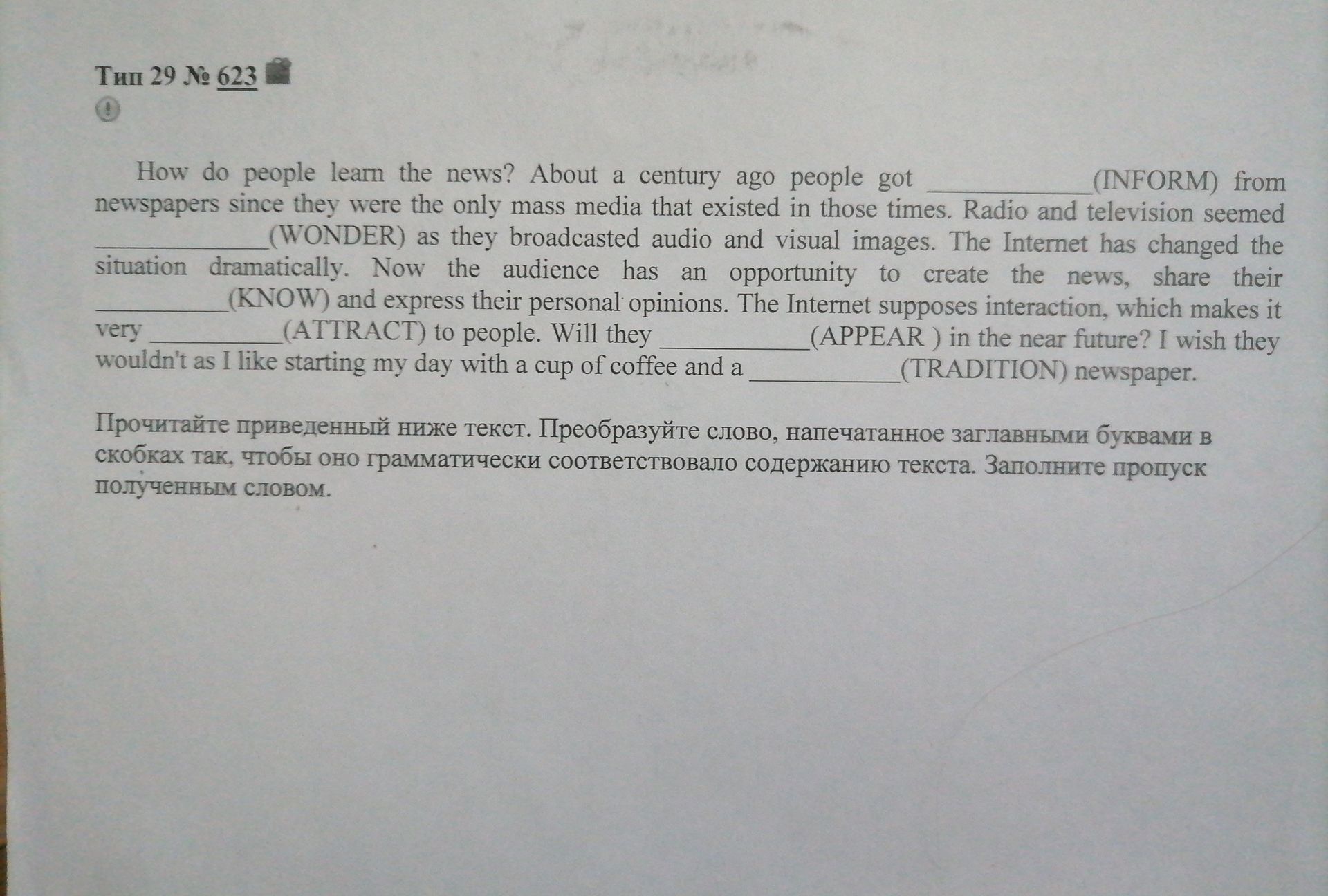
How do people learn the news? About a century ago people got ____ (INFORM) from newspapers since they were the only mass media that existed in those times. Radio and television seemed ____ (WONDER) as they broadcasted audio and visual images. The Internet has changed the situation dramatically. Now the audience has an opportunity to create the news, share their ____ (KNOW) and express their personal opinions. The Internet supposes interaction, which makes it ____ (ATTRACT) to people. Will they ____ (APPEAR) in the near future? I wish they ____ (TRADITION) newspaper.
Ответ:
Задание 1: Заполнение пропусков
Вот как должны выглядеть заполненные пропуски:
- About a century ago people got informed from newspapers since they were the only mass media that existed in those times.
- Radio and television seemed to wonder as they broadcasted audio and visual images.
- Now the audience has an opportunity to create the news, share their knowledge and express their personal opinions.
- The Internet supposes interaction, which makes it attractive to people.
- Will they appear in the near future?
- I wish they would not (choose/get) tradition newspaper. (Наиболее вероятный вариант, хотя фраза немного неточна)
Пояснение:
- INFORM -> informed (причастие прошедшего времени, описывающее состояние людей, получивших информацию).
- WONDER -> to wonder (инфинитив, в данном контексте означает, что люди с удивлением воспринимали радио и ТВ). Альтернативный вариант, который может подойти по смыслу, но грамматически менее вероятен - 'wondered'.
- KNOW -> knowledge (существительное, обозначающее то, чем аудитория может делиться).
- ATTRACT -> attractive (прилагательное, описывающее, каким делает интернет взаимодействие).
- APPEAR -> appear (инфинитив, вопрос о появлении в будущем).
- TRADITION -> (would not choose/get) tradition (самый сложный пропуск. Наиболее логично предположить, что автор хотел сказать "Я хотел бы, чтобы они не выбирали газету как традицию" или "Я хотел бы, чтобы они не получали газету традиционно", но в таком виде фраза звучит не совсем естественно. Если исходить из формы слова, то возможно "traditional" (прилагательное), но оно не сочетается с "wouldn't as I like starting my day with a cup of coffee and a...").
Ответ: informed, to wonder, knowledge, attractive, appear, tradition (или, возможно, traditional, в зависимости от авторской задумки).
