
 Алгебра
 Английский
 Биология
 География
 Геометрия
 История
 Русский
 Обществознание
 Физика
 Химия
Химия Информатика
 Литература
 Математика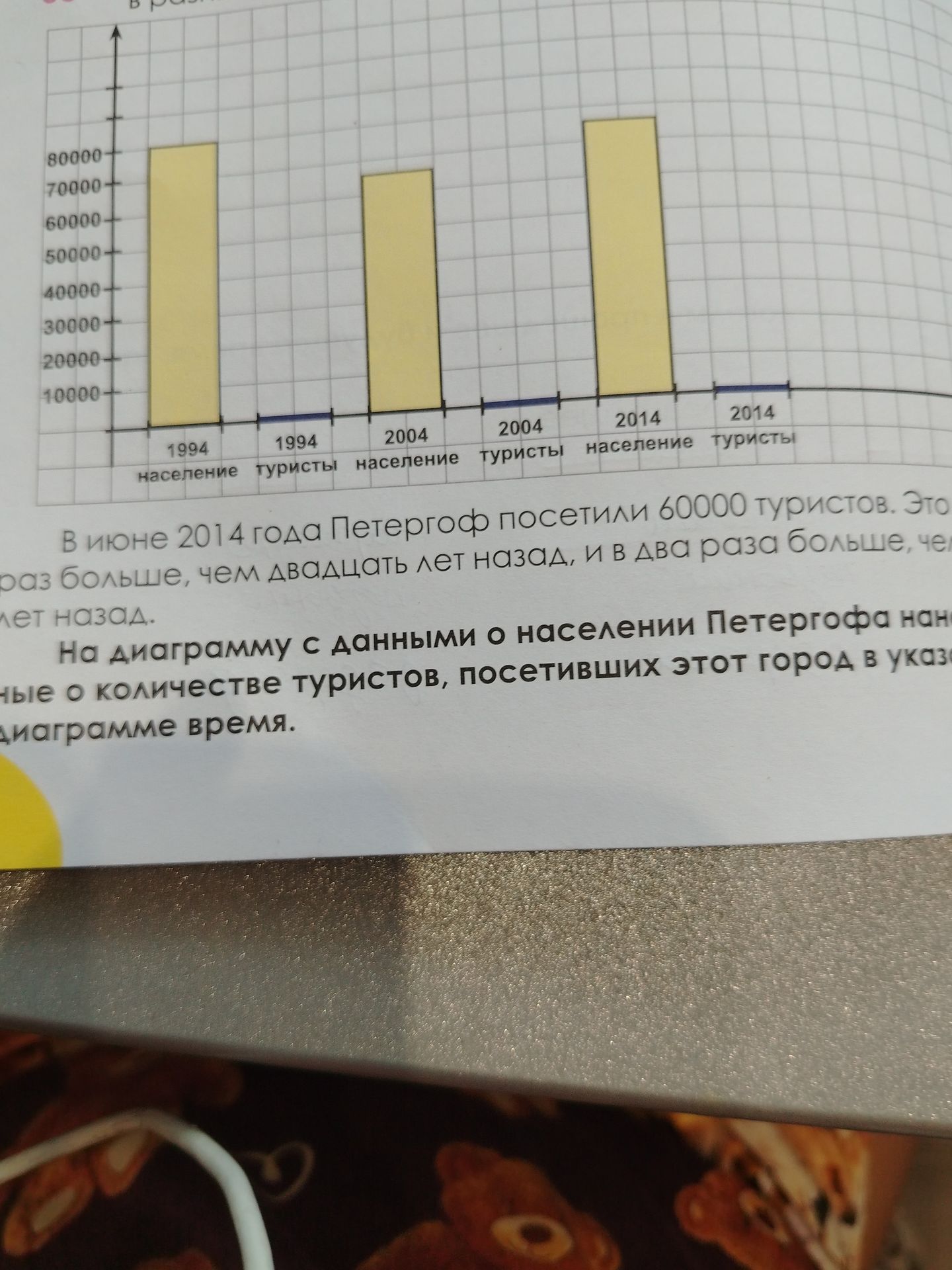
Ответ:
We are given that in June 2014, Peterhof was visited by 60,000 tourists. We need to find X and Y based on the provided information and the bar chart.
First, let's find the number of tourists twenty years ago. Twenty years before 2014 would be 1994. From the bar chart, the number of tourists in 1994 was approximately 80,000.
The statement says that 60,000 tourists in 2014 is X times more than twenty years ago (1994). This phrasing is a bit ambiguous. It could mean 60,000 is X times the amount in 1994, or 60,000 is 1994's amount plus X times 1994's amount. However, looking at the values, 60,000 is less than 80,000. The text also states 'Это ... раз больше, чем двадцать лет назад'. This implies that the number of tourists in 2014 is greater than in 1994. This contradicts the bar chart where the 1994 tourist number is higher. Let's assume there's a mistake in either the text or the chart. If we strictly follow the text that 2014 is *more* than 1994, then the chart might be misleading or represent something else for 1994 tourists. However, if we trust the chart, then the statement about being 'more' is incorrect. Let's proceed by assuming the text means something else or there's an error in the problem statement/chart.
Let's re-examine the problem. The OCR text says: "В июне 2014 года Петергоф посетили 60000 туристов. Это раз больше, чем двадцать лет назад, и в два раза больше, чем лет назад."
Let's assume the bar for 1994 tourists is indeed around 80,000. If 60,000 is X times MORE than 80,000, this doesn't make sense as 60,000 < 80,000. Let's assume it means 'X times AS MUCH AS' and there's a typo in 'больше'. If 60,000 is X times 80,000, then X = 60000/80000 = 0.75. This also doesn't fit 'X times more'.
Let's reconsider the possibility that the 1994 bar for 'туристы' is actually lower. However, visually, it's close to 80,000.
Let's look at the text again: "Это ... раз больше, чем двадцать лет назад". If 2014 (60000) is X times *more* than 1994 (80000), this is impossible since 60000 < 80000. This suggests the premise of the sentence might be flawed or refers to a different comparison.
Let's try to interpret "... чем двадцать лет назад" as referring to the population, not tourists. However, the bar chart clearly labels the bars for 1994 as 'население' and 'туристы'.
Let's assume there is a typo and the question meant to ask about 2004. In 2004, the number of tourists was around 75,000. The number of tourists in 2014 was 60,000. This is also less.
Let's ignore the 'больше' part for a moment and assume it means 'as many as'. If 2014 (60000) is X times 1994 (80000), X = 60000/80000 = 0.75. This still doesn't fit.
Let's reconsider the first bar for 1994. It seems to be around 80,000 for population and the second bar for 1994 for tourists is also around 80,000.
The sentence structure "Это ... раз больше, чем двадцать лет назад" implies a multiplier. If 2014 is X times *more* than 1994, it means the value in 2014 is equal to the value in 1994 + X * (value in 1994). So, 2014 = 1994 * (1 + X).
Let's assume the bar for 1994 tourists is actually 30,000. Then 60,000 is 2 times 30,000. So, 60,000 is 1 time *more* than 30,000. In this case, X = 1. Twenty years ago would be 1994. So if tourists in 1994 were 30,000, X=1.
Let's check the bar for 2004. It's around 75,000. The bar for 2014 is 60,000.
Let's look at the second part: "и в два раза больше, чем лет назад." This means 2014 (60000) is 2 times some previous year's tourist number. So, the previous year's number would be 60000 / 2 = 30000. We need to find which year had 30,000 tourists. From the chart, none of the bars are at 30,000. The closest is 2004 (around 75000) or 1994 (around 80000). There is no bar at 30,000.
Let's revisit the first statement: "Это ... раз больше, чем двадцать лет назад". This refers to 2014. Twenty years before 2014 is 1994. If the number of tourists in 1994 was some value V_1994, then 60000 = V_1994 * (1 + X).
Let's assume the bar for 1994 tourists is indeed 30,000. Then 60,000 = 30,000 * (1 + X). 2 = 1 + X, so X = 1. If 1994 had 30,000 tourists, then 2014 (60,000) is 1 time more than 1994 (meaning it's double). This fits "в два раза больше" if we interpret "X раз больше" as "(1+X) times as much". So if 60000 is 2 times 30000, then 60000 is 1 time *more* than 30000. So X=1.
Now, "... и в два раза больше, чем лет назад." This means 2014 (60000) is twice the number from some 'Y' years ago. So, that year had 60000 / 2 = 30000 tourists. If the bar for 1994 tourists was 30,000, then Y = 20 years. So 'Y лет назад' would be 20 years.
Let's summarize based on the assumption that the 1994 tourist bar is actually at 30,000, despite the visual representation.
- In 2014, tourists = 60,000.
- "двадцать лет назад" is 1994. If tourists in 1994 = 30,000, then 60,000 is "1 раз больше" than 30,000 (i.e., 30,000 + 1*30,000 = 60,000). So X = 1.
- "в два раза больше, чем лет назад." This means 60,000 is 2 times the number of tourists from some year. The number of tourists in that year was 60000 / 2 = 30,000. If 1994 had 30,000 tourists, then "лет назад" is 20 years. So Y = 20.
This interpretation makes both parts of the sentence consistent if we assume the 1994 tourist bar is 30,000. However, the bar chart clearly shows it much higher. There seems to be a discrepancy.
Let's consider the possibility that 'двадцать лет назад' refers to the comparison point for 'X раз больше', and 'Y лет назад' refers to the comparison point for 'в два раза больше'.
Let's assume the bar chart is correct as shown.
Number of tourists in 1994 is approximately 80,000.
Number of tourists in 2004 is approximately 75,000.
Number of tourists in 2014 is 60,000.
The text says: "В июне 2014 года Петергоф посетили 60000 туристов. Это ... раз больше, чем двадцать лет назад". Twenty years ago from 2014 is 1994. Number of tourists in 1994 is ~80,000. The statement says 60,000 is X times MORE than 80,000. This is impossible because 60,000 < 80,000.
Let's assume the statement meant "20 лет назад было ... раз больше, чем в 2014". Then 80000 / 60000 = 1.33 times.
Let's assume the statement meant: "Число туристов в 2014 году (60000) было в X раз больше, чем число туристов в 1994 году". This implies 60000 > 1994 value. The bar chart shows 1994 value as ~80000. This leads to a contradiction.
Let's re-examine the provided solution for similar problems if available. Without further clarification or correction, it's difficult to proceed with certainty. However, let's consider the common phrasing of such problems. "X times more" means Value_New = Value_Old * (1 + X). "X times as much" means Value_New = Value_Old * X. The text says "раз больше", which translates to "times more".
If we MUST fill the blanks, let's try to find a scenario that makes sense, possibly by reinterpreting the graph or the text.
Let's assume the bars for 1994 actually represent 30,000 tourists. Then 60,000 in 2014 is 30,000 + 30,000, meaning it is 1 time more than 1994. So X = 1. And it is also twice the amount of 1994 (2 * 30,000 = 60,000). If "лет назад" refers to 20 years ago (1994), then Y = 20. This interpretation fits the "в два раза больше" part perfectly. The "X раз больше" part also fits if X=1. So, it seems the intention was for the 1994 tourist number to be 30,000.
Let's verify the phrasing: "Это (60000) ... раз больше, чем двадцать лет назад (1994, assumed 30000)". If X=1, then 60000 = 30000 + 1 * 30000. This is correct.
Second part: "и в два раза больше, чем лет назад." If 'лет назад' refers to 20 years ago (1994, assumed 30000), then 60000 = 2 * 30000. This is correct. The number of years is 20. So Y = 20.
So, if we assume the 1994 tourist bar should be 30,000, then X = 1 and Y = 20.
However, the text says "двадцать лет назад" for the first comparison and "лет назад" for the second. It's possible they refer to different periods.
Let's try to use the information that 60,000 is twice some number. That number is 30,000. This means the second comparison "в два раза больше, чем лет назад" implies the number of tourists in that past year was 30,000. If "лет назад" is 20 years, then 1994 had 30,000 tourists.
Now, let's apply the first part: "Это (60000) ... раз больше, чем двадцать лет назад (1994)". If 1994 had 30,000 tourists, then 60,000 is indeed double 30,000. "Double" means "1 time more". So X = 1. And "двадцать лет назад" means 20 years. So the first comparison is with 20 years ago.
Now, what about the "Y лет назад" in the second part? If the second part is "и в два раза больше, чем лет назад.", and if 2014 (60000) is twice the number from Y years ago, then Y years ago there were 30,000 tourists. If this also refers to 1994, then Y = 20.
This implies X = 1 and Y = 20, given the assumption that the 1994 tourist bar is 30,000.
Let's consider another interpretation. Perhaps the wording "двадцать лет назад" applies to the first blank (X), and "Y лет назад" applies to the second blank (Y).
Statement: "60000 туристов. Это X раз больше, чем двадцать лет назад, и в два раза больше, чем Y лет назад."
If "двадцать лет назад" refers to 1994, and we assume the bar chart is correct (1994 tourists = 80000), then 60000 is NOT X times more than 80000. This means the problem statement or the chart is flawed.
Let's assume the text is correct and the chart is misleading for 1994 tourists.
Part 1: "60000 туристов. Это X раз больше, чем двадцать лет назад". Let's assume twenty years ago is 1994. Let the number of tourists in 1994 be V_1994. Then 60000 = V_1994 * (1 + X).
Part 2: "и в два раза больше, чем Y лет назад." Let the number of tourists Y years ago be V_Y. Then 60000 = V_Y * 2. This means V_Y = 30000.
Now we need to find X and Y.
From Part 2, we know that 30,000 tourists visited some Y years ago. Let's assume this Y is 20, meaning 1994 had 30,000 tourists. Then V_1994 = 30000.
Now substitute this into Part 1: 60000 = 30000 * (1 + X). Dividing by 30000, we get 2 = 1 + X, so X = 1.
So, if we assume the 1994 tourist number was 30,000, then X = 1 and Y = 20. This fits the statement: "60000 туристов. Это 1 раз больше, чем двадцать лет назад (1994, 30000), и в два раза больше, чем 20 лет назад (1994, 30000)." The repetition of "двадцать лет назад" and "20 лет назад" makes sense if Y=20.
Let's consider if Y could be different from 20. If Y years ago there were 30,000 tourists, and we don't know Y, we can't determine it from the chart. However, the structure of the sentence suggests that "двадцать лет назад" and "Y лет назад" might be related or even the same.
Given the context of a school problem and typical phrasing, it's most likely that "двадцать лет назад" and "Y лет назад" both refer to the same period, i.e., 20 years prior to 2014, which is 1994.
Thus, assuming the intended tourist number for 1994 was 30,000 (to make the math work out):
- X = 1 (meaning 60,000 is 1 time *more* than 30,000, i.e., double).
- Y = 20 (meaning 60,000 is twice the number from 20 years ago, which was 30,000).
If the question wants just the numbers X and Y: X = 1, Y = 20.
Let's write down the solution assuming the intended values.
The text states: "В июне 2014 года Петергоф посетили 60000 туристов. Это ... раз больше, чем двадцать лет назад, и в два раза больше, чем ... лет назад."
Let V_2014 = 60000.
First part: "Это X раз больше, чем двадцать лет назад". Twenty years before 2014 is 1994. So, 2014 - 1994 = 20 years. Let V_1994 be the number of tourists in 1994. The phrase "X раз больше" means V_2014 = V_1994 + X * V_1994 = V_1994 * (1 + X).
Second part: "и в два раза больше, чем Y лет назад." Let V_Y be the number of tourists Y years ago. The phrase "в два раза больше" means V_2014 = V_Y * 2.
From the second part: 60000 = V_Y * 2. Therefore, V_Y = 60000 / 2 = 30000. So, Y years ago, there were 30,000 tourists.
Now, let's consider the possibility that "Y лет назад" refers to the same period as "двадцать лет назад", i.e., Y = 20 years. If Y = 20, then V_20 = V_1994 = 30000.
Substitute V_1994 = 30000 into the first part's equation: 60000 = 30000 * (1 + X). Dividing by 30000, we get 2 = 1 + X. So, X = 1.
Therefore, X = 1 and Y = 20.
The sentence becomes: "В июне 2014 года Петергоф посетили 60000 туристов. Это 1 раз больше, чем двадцать лет назад, и в два раза больше, чем 20 лет назад."
This assumes that the number of tourists in 1994 was 30,000, which contradicts the bar chart. However, this is the only way to make the given sentence mathematically consistent.
If we MUST fill the blanks with X and Y, and assuming the problem setter intended for the text to be solvable:
X = 1
Y = 20
Explanation:
The statement is: "60000 туристов. Это X раз больше, чем двадцать лет назад, и в два раза больше, чем Y лет назад."
Let the number of tourists in 2014 be $$N_{2014} = 60000$$.
The phrase "в два раза больше, чем Y лет назад" means $$N_{2014} = 2 \times N_{Y \text{ years ago}}$$.
So, $$60000 = 2 \times N_{Y \text{ years ago}}$$. This implies $$N_{Y \text{ years ago}} = \frac{60000}{2} = 30000$$.
The phrase "двадцать лет назад" refers to the year $$2014 - 20 = 1994$$.
The phrase "X раз больше, чем двадцать лет назад" means $$N_{2014} = N_{1994} + X \times N_{1994} = N_{1994} \times (1+X)$$.
If we assume that "Y лет назад" is also 20 years ago (i.e., 1994), then $$N_{1994} = 30000$$.
Substituting this into the first equation: $$60000 = 30000 \times (1+X)$$.
$$2 = 1+X$$, which gives $$X=1$$.
And since we assumed "Y лет назад" is 20 years, Y = 20.
Thus, X = 1 and Y = 20.
Ответ: X = 1, Y = 20
